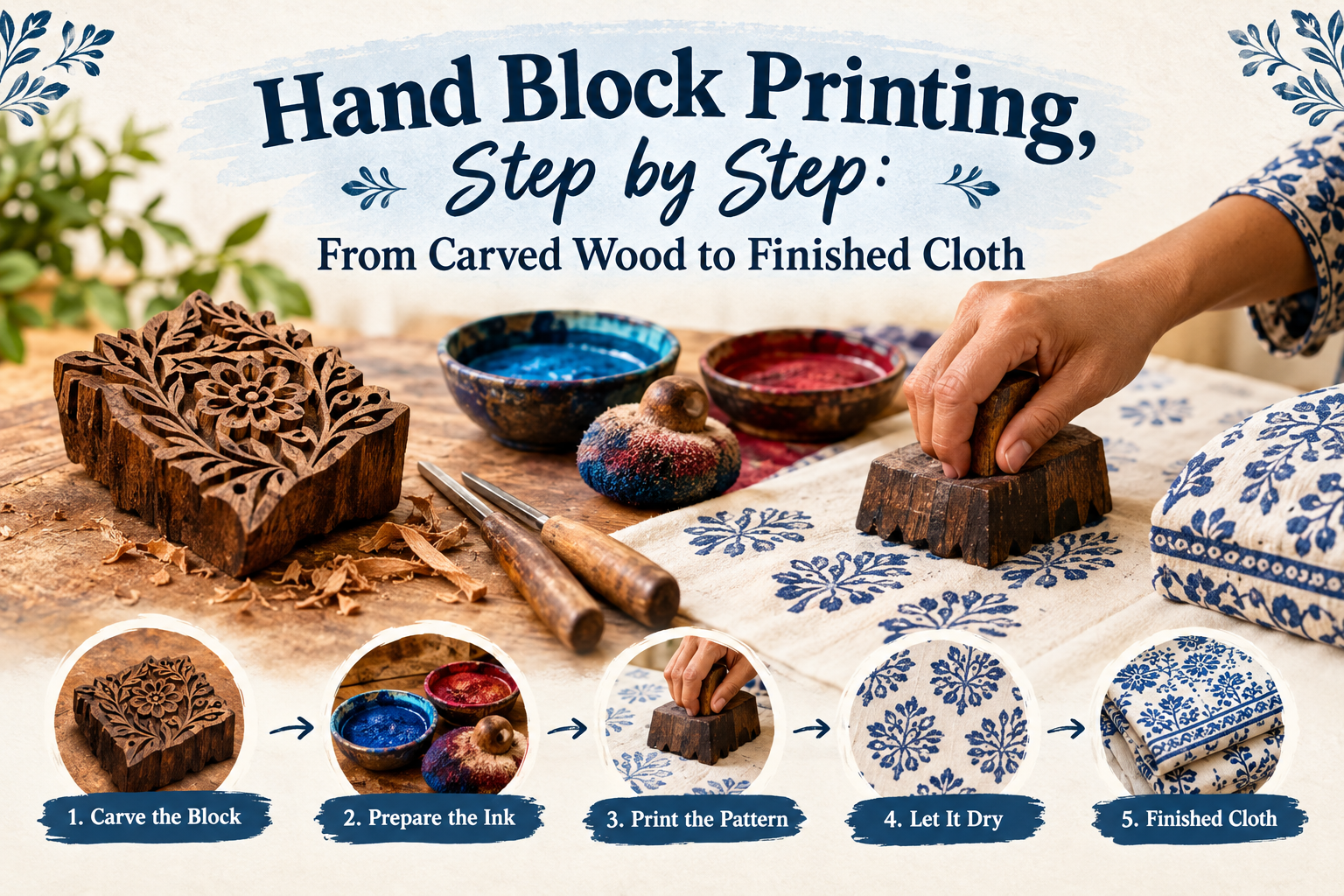
- Hand block printing means stamping fabric by hand with carved wooden blocks dipped in dye, one impression at a time.
- Each colour in a design needs its own carved block, so a five-colour print uses at least five blocks.
- The main Indian centres are Sanganer and Bagru in Rajasthan and Ajrakhpur in Gujarat, each with its own look.
- Small variations between repeats are proof of handwork, not defects.
- Proper drying, washing and fixing decide whether a print lasts for years or fades in months.
Hand block printing is one of the oldest ways of decorating cloth, and it is still practised much as it was centuries ago. A printer takes a carved wooden block, presses it into a tray of dye, places it on the fabric and strikes it by hand. Then they do it again, and again, often thousands of times, until a pattern covers the whole length of cloth.
This guide walks through the full hand block printing process step by step, explains where the craft comes from, compares the major regional styles and shows you how to recognise a genuine hand-printed textile when you shop. If you already own block printed pieces, our guide to washing block printed cotton covers how to keep them bright.
What is hand block printing?
Hand block printing is a textile technique in which a design is carved in relief on a wooden block, coated with dye or a resist paste, and pressed onto fabric by hand. The block is repeated across the cloth to build up a continuous pattern. Unlike screen printing, which pushes ink through a mesh, or digital printing, which sprays ink from a print head, every mark in a block print is placed by a person.
Most block printed textiles today are cotton, though silk, linen and blends are also printed. The craft is practised in several countries, but India is by far the largest and best-known centre, with deep traditions in Rajasthan and Gujarat in particular.
A short history of block printing in India
Printed and dyed cotton from India was traded widely long before the modern era. Fragments of Indian printed cotton have been found at Fustat, near Cairo, and trade across the Indian Ocean carried Indian textiles to East Africa, Southeast Asia and the Middle East. Indian dyers were famous for their mastery of mordants, the chemical helpers that make natural dyes bond to cotton and stay fast in washing.
From the 1600s, European trading companies shipped large quantities of Indian painted and printed cottons, often called chintz or calico, to Europe. They became so popular that they threatened local wool and silk industries. France banned imports of printed cottons in 1686, and England passed the Calico Acts in 1700 and 1721 to restrict them. Those bans did not end demand; they pushed European manufacturers to learn the techniques themselves.
In India, the craft survived industrialisation in pockets where skills passed down through families. Towns near Jaipur, such as Sanganer and Bagru, and communities in Kutch, Gujarat, kept printing by hand. Since the late twentieth century, renewed interest in handmade and naturally dyed textiles has helped many workshops grow again.
Tools and materials
A block printing workshop needs surprisingly few tools, but each has to be right.
- Wooden blocks. Usually carved from seasoned sheesham (Indian rosewood) or teak, which hold fine detail and resist warping when they get wet.
- A long padded table. Layers of fabric or felt under a cotton cover give the cloth a slight cushion so each impression prints evenly.
- Dye trays. A shallow tray with a pad of fabric over a mesh frame lets the printer coat the block evenly, much like an ink pad.
- Mordants and dyes. Natural dyes include indigo for blue, madder root for reds, pomegranate rind and turmeric for yellows, and iron solutions for black. Many workshops also use pigment or synthetic dyes, which give brighter colours and more consistent results.
- Resist pastes. In some styles, a paste of clay, gum and other ingredients is printed first to block dye from reaching parts of the cloth.
Step 1: Designing and carving the blocks
Every print starts on paper. The designer draws the pattern and separates it into layers: one for the outline and one for each colour. The design is traced onto the smoothed face of a wooden block, and a carver cuts away everything that should not print, using fine chisels and drills.
The outline block, known as the rekh, carries the fine lines that define the motif. The filling blocks, called datta or gadh blocks, carry the solid areas of colour. A simple two-colour design might need three blocks; an intricate floral border can need a dozen or more. Small holes are drilled through the block so trapped air can escape, which helps the dye release cleanly. A skilled carver may spend several days on one complex block, and a set of blocks can be used for years if it is cared for.
Step 2: Preparing the fabric
Cotton arrives from the mill with starch, oils and sizing that stop dye from soaking in. The cloth is washed, sometimes several times, and often beaten and dried in the sun. For natural dyes it is then treated with a mordant. Harda, made from myrobalan fruit, is widely used; it gives the fabric a soft yellow tint and helps later colours bond to the fibre. Skipping or rushing this stage is one of the main reasons cheap prints fade.
Step 3: Printing the outline and colours
The prepared cloth is pinned flat to the printing table. The printer presses the outline block into the dye tray, positions it on the fabric and strikes the back firmly with the heel of the hand so the dye transfers evenly. Guide points carved into the block help them line up the next impression exactly where the last one ended.
The outline goes down first across the full length. Once it is dry, the colour blocks follow, one colour at a time, each fitted inside the lines already printed. If a block lands even a few millimetres off, colour spills outside its outline, so this stage takes years of practice. An experienced printer works quickly, with a steady rhythm, and can place thousands of impressions in a working day.
Step 4 (in some styles): Mud resist printing
In dabu printing, associated especially with Rajasthan, the printer stamps a paste of local clay, gum, lime and wheat husk onto the cloth instead of dye. Sawdust is sprinkled over the wet paste so it does not smear. When the cloth is later dipped in a dye bath, usually indigo, the covered areas resist the dye and stay pale. The paste cracks as it dries, letting tiny veins of colour seep in, which gives dabu its soft, slightly crackled look. The process can be repeated to build layers of different shades.
Step 5: Drying, washing and fixing
Printed lengths are laid out in the sun to dry, which also helps develop many dyes. They are then washed thoroughly to remove gum, excess dye and resist paste. Natural-dye prints may be boiled with plant materials to brighten colours, and some are steamed to fix the dye. Only after these steps is the cloth cut and stitched into tablecloths, quilts, cushion covers or curtains. From blank fabric to finished product, a multi-colour hand block print often takes a week or more.
Regional styles of hand block printing
| Style | Where | Signature look |
|---|---|---|
| Sanganeri | Sanganer, near Jaipur | Fine floral and botanical motifs, often on a white or light ground |
| Bagru | Bagru, near Jaipur | Earthier colours from natural dyes, darker grounds, frequent use of dabu resist |
| Dabu | Rajasthan, several villages | Mud-resist patterns, usually indigo, with a crackled texture |
| Ajrakh | Kutch in Gujarat, and Sindh | Dense geometric patterns in indigo and madder red, made through many resist and dye stages |
| Kalamkari (block style) | Machilipatnam, Andhra Pradesh | Blocks combined with hand-drawn details, often with Persian-influenced motifs |
Ajrakh is one of the most complex forms. A single piece can pass through more than a dozen stages of printing, resist, dyeing and washing on both sides of the cloth, and the full process can take weeks.
How to spot real hand block printing
Many shops sell "block print style" fabric that is actually screen or digitally printed. These checks help you tell the difference.
- Look at the repeats. In a hand print, each impression is slightly different in colour density and alignment. In a machine print, every repeat is identical.
- Find the joins. Where one block meets the next, you can often see a faint overlap, a tiny gap or a slight shift.
- Turn it over. Hand-applied dye usually soaks through so the pattern shows clearly on the back. Many screen and digital prints sit mostly on the surface.
- Check the edges. Outlines may be a fraction off-register with the fill colour. That gentle irregularity is a sign of handwork.
- Ask about the process. A seller who works directly with printers will be able to tell you where the piece was made and which blocks were used.
Why hand block printed textiles cost more
A hand block printed tablecloth involves a carver, a dyer, one or more printers, and the people who wash, finish and stitch it. It takes days to make rather than minutes, and quality depends on skills learned over years. When you buy a genuine piece, you are paying for that time and expertise, and for a textile that softens and improves with washing instead of wearing out. Choosing well-made pieces also helps keep workshops and their traditions viable.
Caring for block printed fabric
Because hand prints can release a little excess dye early on, wash them separately in cold water for the first few washes, use a mild detergent without bleach, and dry them in the shade. Our full guide on how to wash block printed cotton covers machine settings, stain removal and storage in detail.
Decorating with block prints
Block prints work in almost any room because their small irregularities give them warmth. Start with one statement piece, such as a correctly sized tablecloth or a printed quilt, then repeat its colours in plainer textiles. If you want to combine several prints, our guide to mixing patterns explains how to vary scale so they work together. To understand the motifs you see most often, read about paisley meaning and elephant symbolism.
Frequently asked questions
What is hand block printing?
It is a technique where a carved wooden block is coated with dye and pressed onto fabric by hand, repeated across the cloth to build a pattern. Each colour needs its own block.
Is hand block printing eco-friendly?
It can be. The printing itself uses little electricity, and many workshops use natural dyes. The bigger factors are how dye water is treated and how the cotton is grown, so ask the maker.
Why does hand block printed fabric have imperfections?
Each impression is placed by a person, so slight shifts in alignment and dye coverage are normal. They show the piece was made by hand.
How long does hand block printing take?
A simple one-colour piece can be printed in hours, but with several colours, drying between layers, washing and finishing, most pieces take a week or more. Complex styles like ajrakh can take weeks.
What wood are printing blocks made from?
Most are carved from seasoned sheesham (Indian rosewood) or teak, which hold detail and resist warping when wet.