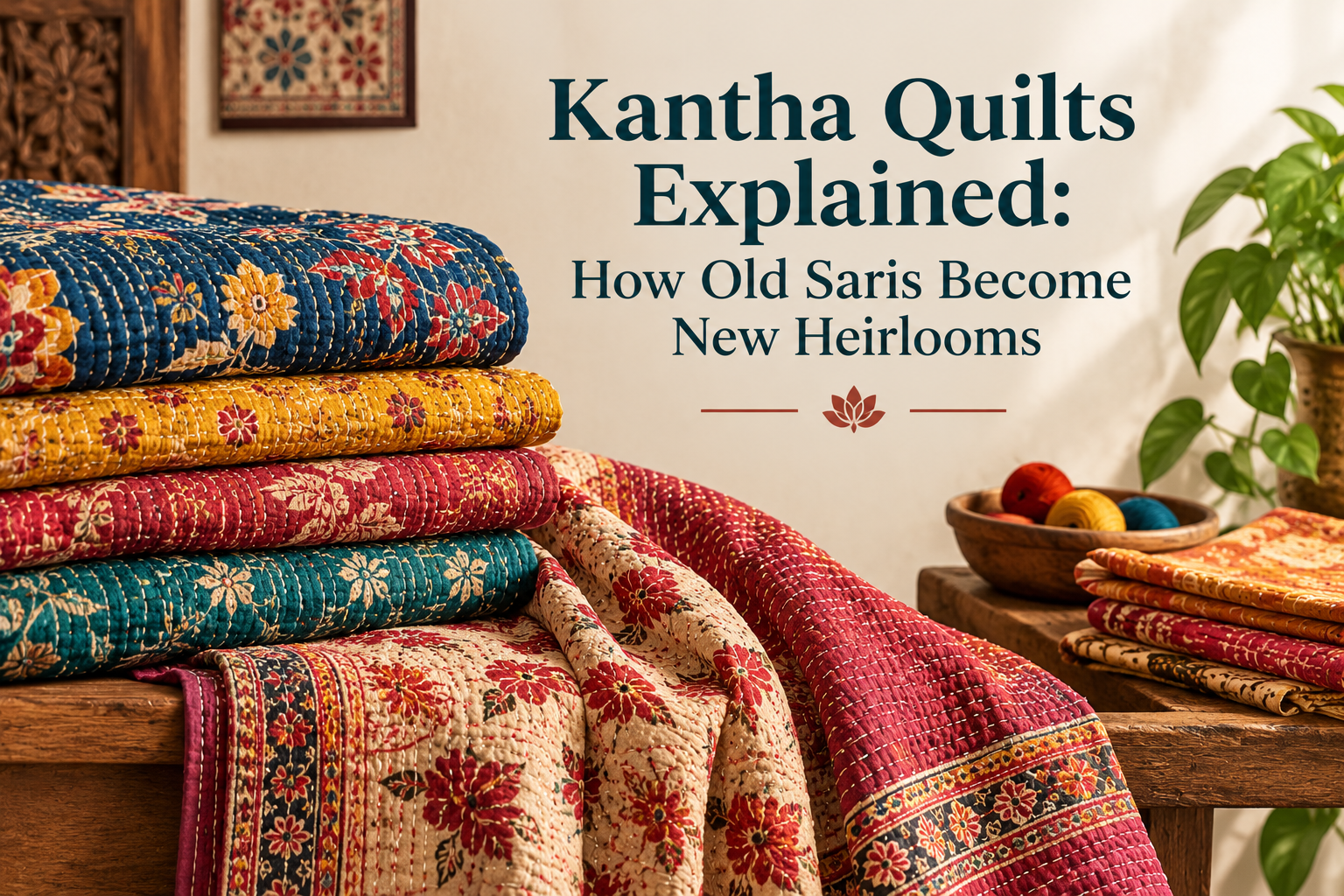
- A kantha quilt is made by layering old cotton saris or dhotis and stitching them together with rows of simple running stitch.
- Kantha comes from Bengal, today West Bengal in India and Bangladesh.
- The dense lines of stitching create kantha's signature rippled, crinkled texture.
- Every quilt is unique, and many are reversible with a different pattern on each side.
Kantha is one of the oldest forms of textile recycling in the world. For generations, women in rural Bengal took worn saris, layered them together and stitched them by hand into soft, lightweight quilts. The result was warm, practical and quietly beautiful, and nothing was wasted. Today kantha quilts and throws are loved around the world for their texture, colour and story. This guide explains what kantha is, where it comes from, how a kantha quilt is made, the different types you may find, how to tell a genuine piece and how to look after it.
What is kantha?
Kantha refers both to a style of embroidery and to the quilts and cloths made with it. The defining feature is the running stitch: a line of small, even stitches that passes in and out of the fabric. In a kantha quilt, rows of running stitch cover the whole surface, holding several layers of cloth together and giving the quilt its gently wavy texture.
The word kantha is commonly connected with the idea of rags or patched cloth, which reflects the craft's roots in reusing old fabric. Traditionally, worn saris and dhotis, too thin to wear, were given a second life as quilts, wraps, covers and bags.
A short history of kantha
Kantha developed in the villages of Bengal, a region that today spans the Indian state of West Bengal and the country of Bangladesh. References to kantha appear in Bengali literature written several centuries ago, and the craft is almost certainly much older than any written record.
Kantha was a domestic craft made by women, mostly for their own families. Quilts were stitched in spare hours, often over many months, and given as gifts at important moments: a wedding, the birth of a child or a new home. Many pieces were made for newborns, layered from the soft, much-washed saris of the mother and grandmothers. Because each piece reflected the maker's life and imagination, kantha became a kind of personal record, stitched with images of daily life, nature and belief.
During the twentieth century, as factory-made cloth became cheap and common, the craft declined in many areas. Since the later twentieth century, cooperatives, design studios and non-profit organisations in both India and Bangladesh have helped revive it, creating income for thousands of women who stitch kantha at home.
Nakshi kantha: the embroidered tradition
Nakshi kantha means decorated or patterned kantha. Instead of simple parallel lines alone, these pieces are richly embroidered with motifs: lotuses, fish, birds, elephants, trees, chariots, village scenes and stories from folklore and religion. The motifs are outlined and filled with running stitches in coloured threads, often pulled from the borders of the saris themselves. The background is then filled with running stitch that follows the shapes of the motifs, creating rippling outlines around them.
Nakshi kantha is especially associated with Bangladesh, where it is regarded as an important part of national cultural heritage. Some of the finest historical pieces are held in museum collections in both countries.
Types of kantha
Traditionally, kantha was made into many different objects, each with its own name.
| Type | Use |
|---|---|
| Lep kantha | Thick, padded winter quilts made from many layers |
| Sujni kantha | Lighter quilts and covers, often used for guests and ceremonies |
| Oaar kantha | Pillow covers |
| Baiton kantha | Wrappers for books and precious objects |
| Arshilata | Narrow covers for mirrors and combs |
| Durjani or thalia | Small square pouches or wallets |
Today, kantha is most often seen as throws, bedspreads, quilts, cushion covers, scarves and bags.
How a kantha quilt is made
- Collecting fabric. Old cotton saris or dhotis are collected, washed and sorted by colour. In new kantha, makers may use a mix of vintage and new cotton.
- Layering. Usually three to five layers are laid flat, one on top of another, with the most attractive sari on the outside.
- Basting. The edges are folded in and loosely stitched so the layers do not shift.
- Stitching. Working from the centre outward, stitchers sew parallel rows of running stitch across the whole surface. Many makers stitch while sitting on the floor, with the cloth spread across their laps.
- Embroidering motifs. For nakshi kantha, motifs are outlined and filled before or alongside the background stitching.
- Washing. The finished piece is washed, which slightly shrinks the cotton around the stitches and creates the characteristic crinkled texture.
A simple throw can take one woman several weeks. A large, densely embroidered nakshi kantha can take many months.
Vintage kantha vs new kantha
| Vintage kantha | New kantha | |
|---|---|---|
| Fabric | Recycled saris, often several decades old | New or mixed cotton, sometimes block printed |
| Look | Patchwork of colours, fading and visible mends | More uniform colours and patterns |
| Texture | Very soft and supple | Crisper at first, softens with washing |
| Durability | Gentle use; fabric may be fragile in places | Sturdier for everyday use |
| Uniqueness | Completely one of a kind | Similar pieces, though stitching still varies |
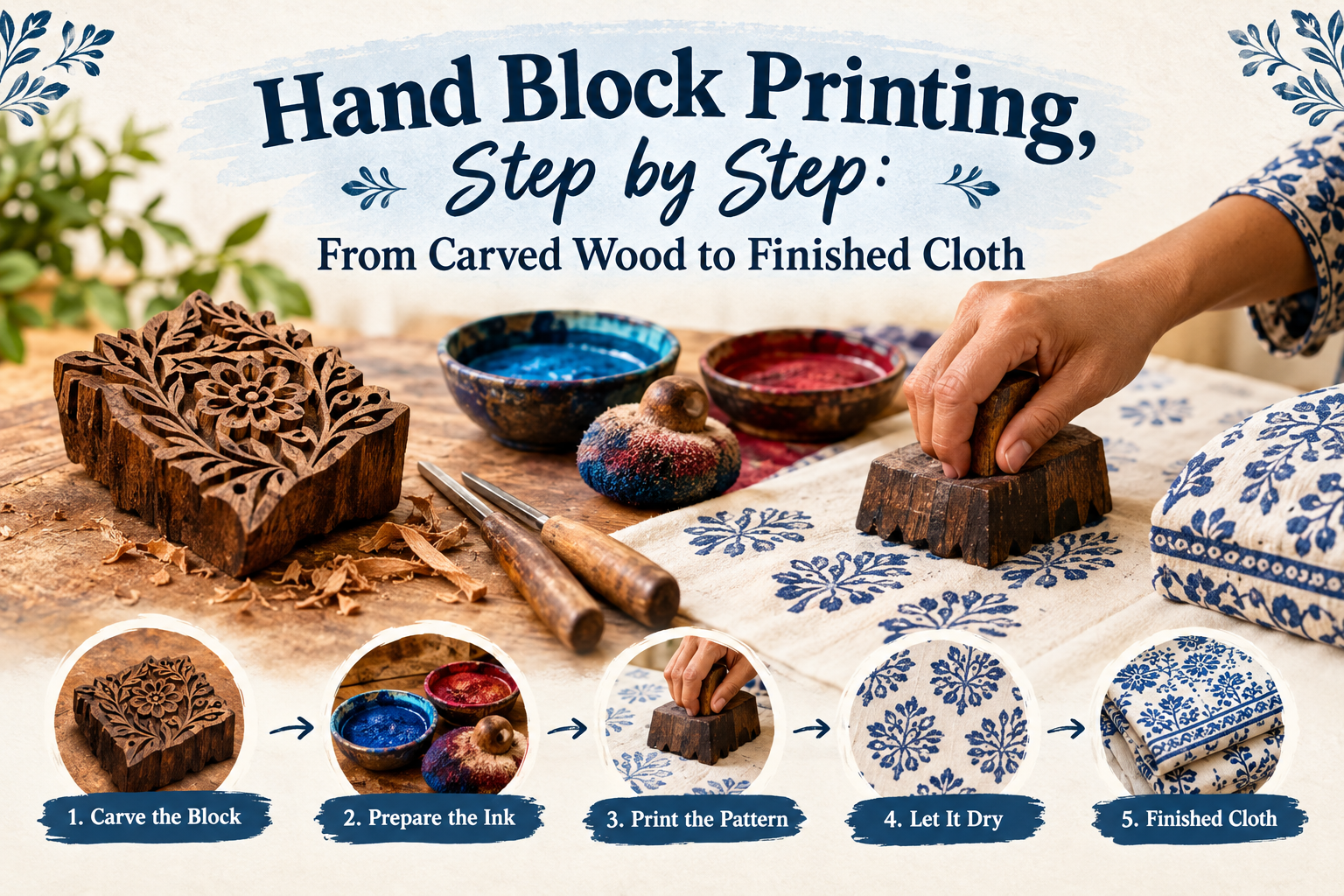
Many modern kantha pieces combine hand block printed cotton with kantha stitching. If you want to know how the printed layer is made, read our guide to hand block printing.
How to tell a real kantha quilt
- Stitching on both sides. Hand running stitch passes through all layers and is visible front and back.
- Uneven stitch length. Small variations in stitch length and spacing show handwork. Perfectly uniform rows suggest a machine.
- Crinkled texture. Genuine kantha has a soft ripple between stitch rows, especially after washing.
- Multiple fabric layers. Feel the edges; you should sense more than two layers.
- Visible knots or thread ends. Small knots and joins in the thread are normal in hand stitching.
- Mends and patches. In vintage pieces, small repairs are part of the history.
How to use kantha in your home
Kantha quilts are light enough to use as a summer bedcover, and work beautifully as a layer folded across the foot of a bed in cooler months. As a throw, kantha adds colour and texture over a sofa arm or armchair. Because kantha's texture reads as pattern without dominating, it is a useful partner for bolder prints; see our guide to mixing patterns in a bedroom. Kantha also looks at home in bohemian rooms; our boho living room ideas show how to layer it.
Smaller kantha pieces make good table runners, wall hangings and picnic blankets, and vintage kantha is often cut and remade into cushion covers, bags and jackets.
How to care for a kantha quilt
- Wash gently: hand wash in cold water with a mild detergent, or use a delicate cycle in cold water for newer, sturdier pieces.
- Wash alone at first: vintage sari fabrics may release some dye.
- Do not wring: press out water by rolling in a towel.
- Dry in the shade: lay flat or hang over two lines, out of direct sun.
- Avoid tumble drying on high heat, which can shrink the layers unevenly.
- Dry clean very heavy or fragile vintage pieces.
Our detailed guide to washing block printed cotton covers stain removal and storage, which apply to kantha too.
Buying guide: what to look for
- Size: throws are typically around 50 × 70 in; single quilts around 60 × 90 in; double and queen sizes around 90 × 108 in. Check measurements carefully.
- Weight: more layers means a warmer, heavier quilt. Lightweight kantha is best for warm climates and summer.
- Stitch density: closer rows generally mean more work, more durability and a richer texture.
- Maker: look for sellers who can tell you where and by whom the piece was made, and who pay artisans fairly.
Common kantha motifs and their meanings
Motifs in nakshi kantha often carry meaning. The lotus, frequently stitched at the centre, stands for purity and the universe. Fish suggest fertility and abundance, fitting for a region of rivers. Birds and trees represent life and growth, while elephants and horses suggest strength and royal processions. Learn more about animal motifs in our guide to elephant symbolism.
Why kantha is a sustainable choice
Kantha was built on reuse long before sustainability became a buzzword. Vintage kantha gives discarded saris a second life, and even new kantha is made by hand with almost no energy beyond human skill. Buying kantha from cooperatives and fair-trade makers supports women working from home in rural communities, often as an important source of independent income. A well-made kantha lasts for many years and becomes softer and more personal with every use.
Looking for a thoughtful gift? A small kantha throw is one of our favourite housewarming gifts.
Frequently asked questions
What does kantha mean?
The word is commonly connected with rags or patched cloth, reflecting the craft's roots in reusing old saris and dhotis.
Are kantha quilts warm?
Most are lightweight and suit warm climates and summer, or work as a layer over a duvet in colder months. Thicker lep kantha are made for winter.
Where does kantha come from?
Kantha comes from Bengal, a region covering West Bengal in India and Bangladesh.
Can you machine wash a kantha quilt?
Newer, sturdy kantha can go on a cold, delicate cycle. Hand wash vintage pieces and dry them flat in the shade.
How can I tell if a kantha quilt is handmade?
Look for running stitches visible on both sides, slightly uneven stitch lengths, a crinkled texture and several layers of fabric.