- Elephant symbolism centres on wisdom, strength, good fortune, protection and royalty.
- In Hinduism the elephant is linked with Ganesha, the remover of obstacles, and with Lakshmi, goddess of prosperity.
- In Buddhism a white elephant appears in the story of the Buddha's birth.
- An elephant with its trunk raised is popularly seen as a sign of good luck in decor.
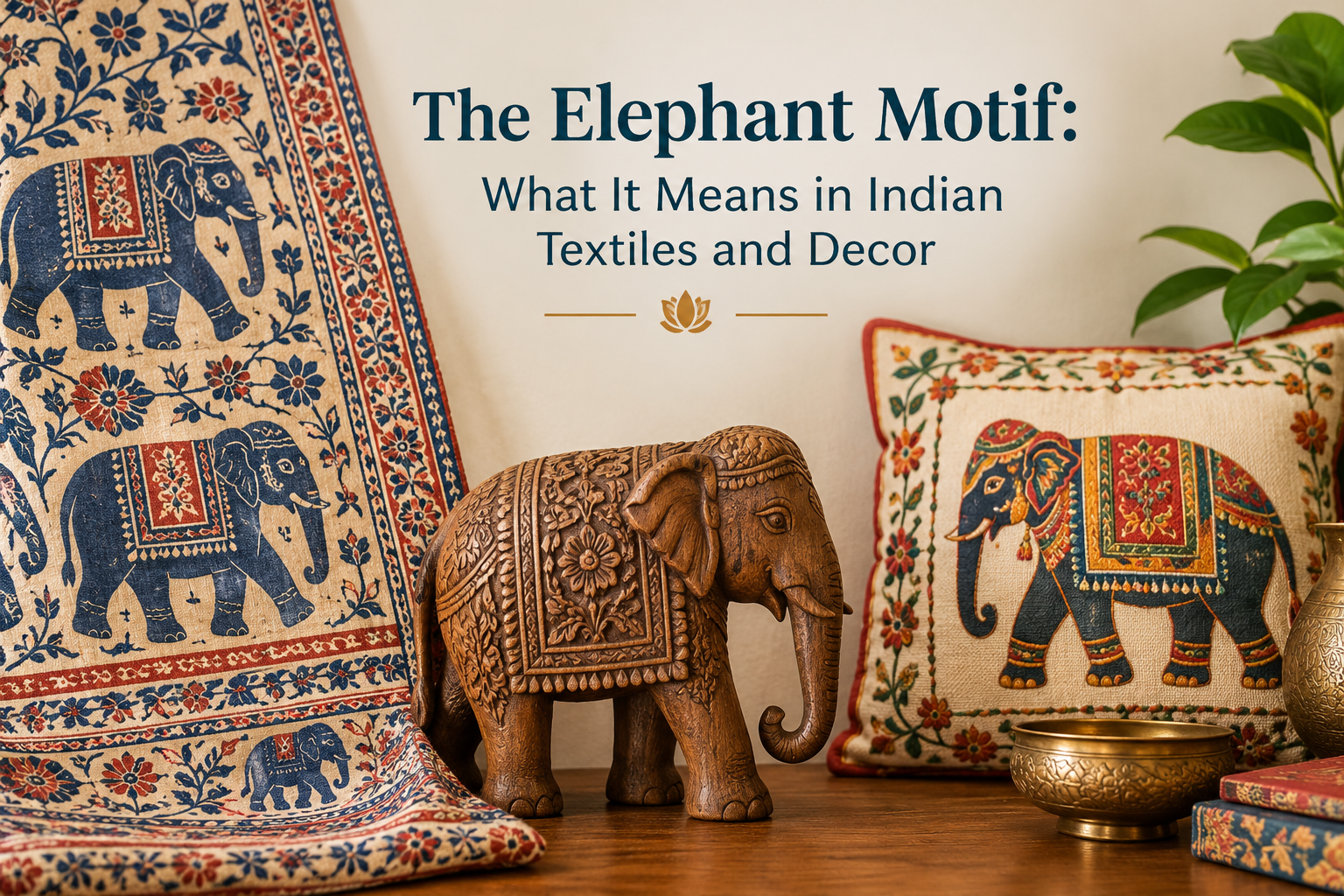
Elephants parade across Indian quilts, cushions, wall hangings and tablecloths for a reason. For thousands of years they have stood for wisdom, power and good fortune across South and Southeast Asia, appearing in temple carvings, royal processions and sacred stories. Understanding elephant symbolism helps you choose and place elephant motifs with meaning. This guide explains what the elephant represents in Hinduism, Buddhism and Jainism, its role in royal history, the popular beliefs about trunk position, and how to decorate with elephant prints today.
What does the elephant symbolise?
Across many cultures, the elephant's size, intelligence, long memory and close family bonds have shaped how people see it. The most common meanings are:
- Wisdom and intelligence, drawn from the elephant's long memory and calm nature.
- Strength and stability, from its sheer size and steady movement.
- Good fortune and prosperity, especially in South Asian traditions.
- Protection, particularly of family and home.
- Royalty and dignity, because elephants carried kings and nobles.
- Loyalty and family, reflecting how elephant herds care for their young.
Elephant symbolism in Hinduism
Ganesha, remover of obstacles
The most famous elephant figure in Indian culture is Ganesha, the elephant-headed god. He is honoured as the remover of obstacles, the patron of learning and the lord of beginnings. Hindus often invoke Ganesha before starting a new venture, a journey, a ceremony or the move into a new home. Because of this, elephant imagery in a house is widely understood as a wish for wisdom, smooth beginnings and freedom from obstacles.
Gaja Lakshmi and abundance
Lakshmi, the goddess of wealth and prosperity, is often shown as Gaja Lakshmi, seated on a lotus while two elephants pour water over her from pots held in their trunks. The image represents abundance, fertility and the rain that brings a good harvest. Pairs of elephants facing each other on textiles often echo this composition.
Airavata, the celestial elephant
Airavata is the white elephant who carries Indra, king of the gods. In some accounts he has several tusks or heads. He represents royal power, the clouds and the monsoon rains.
Elephant symbolism in Buddhism
In Buddhist tradition, Queen Maya dreamed that a white elephant entered her side before she conceived the future Buddha. The white elephant therefore stands for purity, spiritual strength and auspicious birth.
Buddhist teaching also uses the elephant as a metaphor for the mind. An untamed elephant is wild and destructive, while a trained one is calm, powerful and useful; in the same way, a trained mind becomes steady and strong. This gives elephant imagery a meaning of patience, self-discipline and mental strength.
Elephant symbolism in Jainism
In Jain tradition, the mother of a tirthankara (an enlightened teacher) sees a series of auspicious dreams before the birth, and a majestic white elephant is among them, a sign that a great soul is about to be born. Elephants are carved throughout Jain temples, including the celebrated marble temples of Rajasthan, as symbols of auspiciousness.
Elephants in royal India
For centuries, elephants were central to court life in India. Rulers rode them in processions, into battle and at festivals. Royal elephants were decorated with painted designs, jewelled headpieces and lavishly embroidered cloths. Mughal miniature paintings and Rajput art show elephants as symbols of power, wealth and ceremony.
Textile designers in Rajasthan drew directly on these processions. That is why so many hand block prints show elephants walking in rows, often with riders, canopies, tassels and decorated saddle cloths. When you see a line of parading elephants on a quilt or tablecloth, you are looking at a memory of royal celebration. Our guide to hand block printing explains how these motifs are carved and printed.
The elephant in Thailand and Southeast Asia
The elephant is a national symbol of Thailand. White elephants were traditionally considered sacred and associated with royal power; a king's possession of white elephants was seen as a sign of good rule. The flag of Siam featured a white elephant until 1917. Elephants also appear across Myanmar, Laos and Cambodia in temple carvings and textiles.
Trunk up or trunk down: what does it mean?
In popular feng shui and decorating lore, an elephant with its trunk raised is said to shower good luck, happiness and positive energy on a home. An elephant with a lowered trunk is sometimes read as storing energy, wisdom or fertility, or as a sign of steadiness and patience.
These are folk beliefs rather than fixed religious rules, and in Indian art both positions appear frequently. Ganesha himself is often shown with his trunk curving to one side. If you like the idea, choose trunk-up elephants for entryways and living spaces, and either position for bedrooms and quiet corners.
Elephant colours and their meanings
| Colour | Common association | Good for |
|---|---|---|
| White or ivory | Purity, sacredness, royalty | Bedrooms, meditation corners |
| Grey | Calm, wisdom, stability | Nurseries, living rooms |
| Gold | Prosperity, celebration | Dining rooms, festive table linen |
| Red or saffron | Energy, auspiciousness, weddings | Entryways, festive decor |
| Indigo | Depth, calm, tradition | Bedrooms, studies |
Elephant meaning in other cultures
The elephant's appeal reaches far beyond Asia. In many African cultures, where elephants have lived alongside people for millennia, the elephant is associated with strength, leadership and the wisdom of elders, and it appears in proverbs, carvings and royal regalia. In Western culture the saying "an elephant never forgets" reflects the animal's famous memory, and the elephant has become a common symbol of loyalty and remembering loved ones.
Because these meanings are so positive and widely shared, elephant motifs translate well across cultures. An elephant-print gift is rarely misunderstood, which makes it a safe and meaningful choice for friends of any background.
How to choose an elephant print
Not every elephant motif suits every room. A few questions help narrow it down.
- Scale: large single elephants make a bold statement on a throw or wall hanging, while small repeated elephants on a tablecloth or cushion read almost like a texture.
- Style: naturalistic elephants feel calm and modern; ornate, decorated elephants with canopies and riders feel traditional and festive.
- Arrangement: rows of parading elephants add movement and rhythm, which suits long surfaces like runners, bed throws and curtains.
- Colour: choose a print whose ground colour matches your room's main neutral, so the motif stands out without clashing.
If you are layering an elephant print with other patterns, keep it as the largest motif and pair it with stripes, small dots or solids.
Elephants in Indian textiles
You will find elephants across many Indian textile traditions:
- Block prints from Rajasthan, with rows of elephants and riders on cotton.
- Appliqué and patchwork wall hangings and canopies from Gujarat and Rajasthan.
- Kantha embroidery from Bengal, where elephants appear among fish, birds and flowers; see our guide to kantha quilts.
- Woven brocades from Varanasi, where small elephant motifs, called hathi buta, are woven into silk.
How to decorate with elephant motifs
Entryway
A pair of elephants facing the front door is a traditional welcome. Use carved wooden or brass figures on a console, or an elephant-print runner on a hall table.
Living room
One statement piece is enough: an elephant-print throw over the sofa, a framed textile panel or a set of cushions. Repeat the colours from the print in plain cushions. For more ideas on layering global textiles, see our boho living room guide.
Bedroom
An elephant-print duvet or quilt in indigo or grey feels calm and grounded. Balance it with solid sheets and a small geometric print, following our pattern mixing rules.
Nursery and children's rooms
Elephants are a classic nursery motif because they suggest gentleness, family and protection. Soft greys, sage greens and pale pinks work well.
Dining room
A parade of gold or red elephants on a tablecloth suits festive meals and celebrations. Check our festive table setting ideas for complete looks.
Elephant decor as a gift
Because the elephant symbolises good beginnings, protection and prosperity, elephant pieces make thoughtful gifts for a new home, a wedding, a new baby or a new business. An elephant-print cushion or set of napkins is an easy choice; see our list of housewarming gifts for more ideas.
Choosing elephant decor responsibly
Wild elephants face serious threats from habitat loss and poaching. Choose decor made from cotton, wood, brass, ceramic or other sustainable materials, and never buy anything made from ivory. Buying handmade elephant textiles from artisans supports traditional craft while honouring the animal's meaning.
Frequently asked questions
Is it good luck to have elephants in the house?
In many traditions, yes. Elephants are linked with wisdom, protection and good fortune, and a raised trunk is popularly seen as especially lucky.
What does an elephant symbolise in Hinduism?
The elephant is linked with Ganesha, the remover of obstacles and lord of beginnings, and with Lakshmi, the goddess of prosperity, shown as Gaja Lakshmi.
What does a white elephant mean in Buddhism?
Queen Maya dreamed of a white elephant before the Buddha's birth, so it symbolises purity, spiritual strength and auspicious beginnings.
Which way should an elephant face in the home?
Popular tradition places elephants facing the front door to welcome good fortune, often as a pair. This is a folk belief rather than a strict rule.
What does an elephant print symbolise on a quilt?
Usually prosperity, protection and a happy, stable home, drawing on Indian royal and religious symbolism.