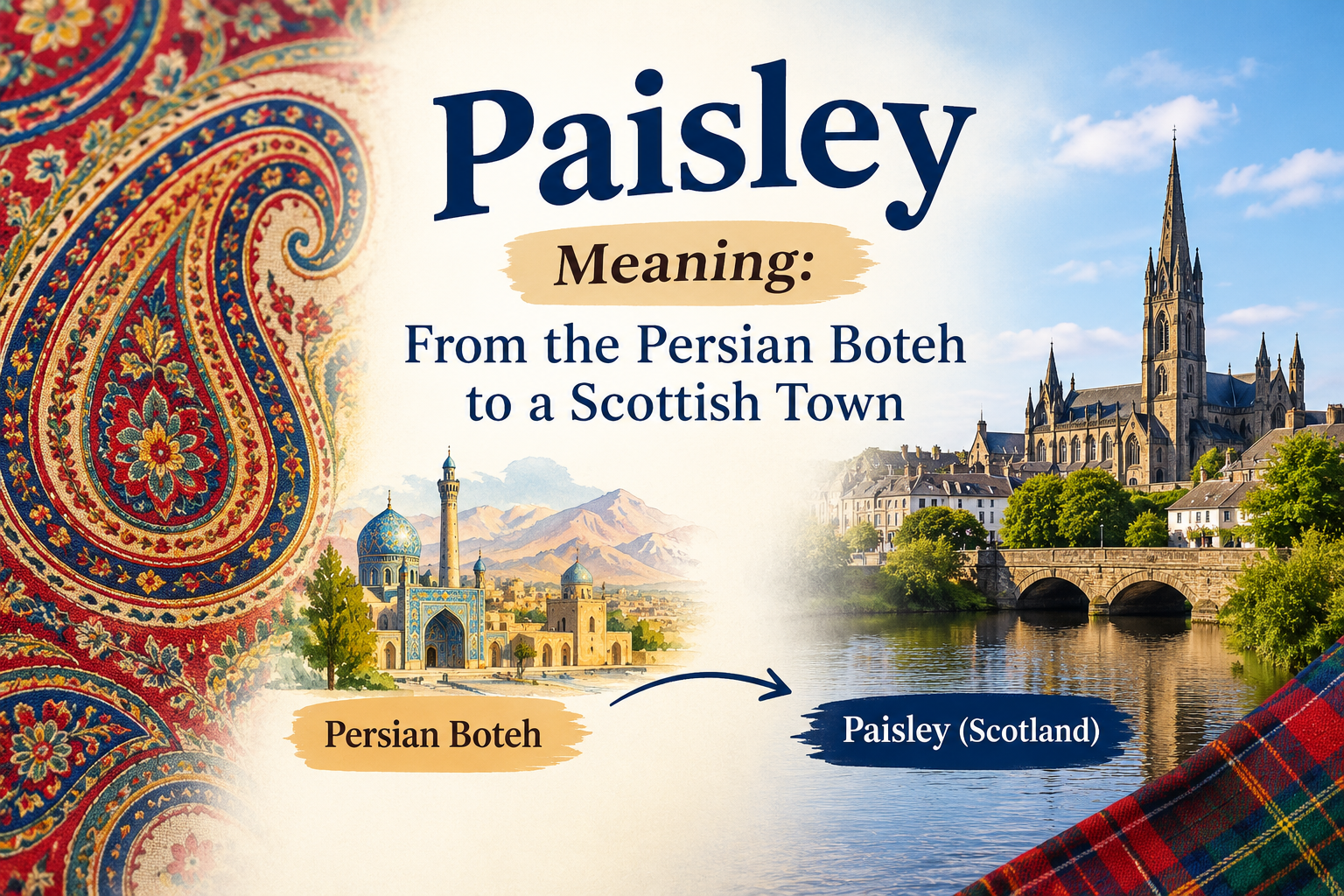
- The paisley motif began as the boteh in Persian art and is most often linked with life, fertility, growth and eternity.
- In India it is called buta, kairi (raw mango) or, in Tamil, mankolam (mango shape).
- Kashmiri shawls made the motif famous in Europe in the late 1700s.
- The English name comes from Paisley, a Scottish town whose mills mass-produced imitation shawls in the 1800s.
Few patterns have travelled as far as paisley. The curved teardrop with a bent tip appears on Persian carpets, Indian wedding saris, Victorian shawls, 1960s shirts, bandanas and modern bedding. Yet many people who love the pattern do not know what paisley means or where it comes from. This guide explains the meaning and symbolism of the paisley motif, traces its long history from Persia to Scotland, and shows how to use paisley in your home without overwhelming a room.
What is paisley?
Paisley is a decorative motif shaped like a droplet or a curved teardrop, with a rounded end that tapers into a point that curls to one side. The shape is usually filled with smaller patterns, such as flowers, vines, dots and lines, and repeated across fabric in rows or dense, interlocking fields.
The motif goes by many names. In Persian it is the boteh or buta, a word often translated as shrub, bush or flower bud. In Hindi and Punjabi it is commonly called kairi or aam, after the young mango it resembles. In Tamil it is mankolam, the mango pattern. In much of Europe it was simply called the pine or cone pattern. "Paisley" is the English name that stuck.
Where the paisley motif comes from
The boteh appears in Persian art and textiles from at least the Safavid period, and many historians believe its roots go back much further. There is no single agreed origin, and scholars have proposed several sources that probably blended over time.
- A flower bud or sprouting seed. The swelling base and curling tip look like new growth pushing upward.
- A cypress tree. In Persian tradition the cypress symbolised life and endurance, and some see the boteh as a cypress bent by the wind.
- A flame. Some writers connect the shape with Zoroastrian fire symbolism, in which flame represents the divine.
- A mango or almond. In South Asia the resemblance to a young mango gave the motif its everyday name and associations with fertility and abundance.
The honest answer is that the motif's meaning has shifted with the cultures that adopted it. That is part of why it has lasted so long: each place added its own story.
Paisley meaning and symbolism
Although interpretations vary, a few meanings appear again and again across cultures.
Life and fertility
Read as a seed or a bud, paisley suggests the beginning of life. This is one reason the motif is so common on South Asian wedding textiles, bridal saris and in mehndi designs drawn on a bride's hands and feet. It carries a wish for a fruitful marriage and new family.
Eternity and continuity
The tip that turns back toward the body of the shape has been read as a symbol of continuity, a line that never quite ends. Rows of paisleys flowing into each other reinforce that sense of endless movement.
Abundance and prosperity
A field of paisleys filled with flowers and vines suggests a garden in full bloom. In both Persian and Indian contexts, lush ornament was associated with plenty, good fortune and status.
Strength and resilience
Through the cypress reading, the motif also connects with endurance: a tree that bends in the wind without breaking.
Paisley in India and the Kashmir shawl
In India, the buta became a central motif of the shawls woven in Kashmir from extremely fine goat wool. Early shawls featured small, naturalistic flowering plants. Over time the motif grew larger, more stylised and more densely filled, until in the nineteenth century some shawls were covered almost entirely by sweeping, elongated paisleys.
Kashmir shawls took many months to weave on a hand loom using the twill tapestry technique, and they were treasured at the Mughal court and by wealthy patrons across the region. The motif also spread across Indian textiles more broadly, appearing in hand block prints, embroidery and woven silks. You will still find it in block printed bedspreads, tablecloths and cushions made in Rajasthan today; our guide to hand block printing explains how those prints are made.
How paisley reached Europe
In the late 1700s, Kashmir shawls began arriving in Britain and France, carried home by officers and traders connected with the East India Company. They became a highly fashionable accessory for women, worn over the light, high-waisted dresses of the period. Real Kashmir shawls were rare and extremely expensive, which created a huge market for cheaper copies.
Manufacturers in Norwich and Edinburgh began producing imitation shawls, followed by a small town near Glasgow that would become the most famous of all.
How a Scottish town gave paisley its name
The town of Paisley, in Renfrewshire, Scotland, already had a strong weaving industry. In the early 1800s its weavers turned to shawls, and they became so closely associated with the pattern that "Paisley" became the English name for the motif itself. The town's weavers adopted the Jacquard loom, which uses punched cards to control complex patterns, allowing them to produce intricate designs far more quickly than hand weavers in Kashmir and at a fraction of the price.
Paisley shawls stayed fashionable for decades, but by around the 1870s changing dress styles made the large shawl less practical, and demand fell. The town's museum still holds one of the world's largest collections of paisley shawls and pattern books.
Paisley in the twentieth century and today
Paisley never fully disappeared. It became a staple of the printed cotton bandana and of men's ties and pocket squares. In the 1960s it returned in a big way through psychedelic fashion and music culture, often in bright, saturated colours that drew directly on its Indian roots. Today paisley appears everywhere from luxury fashion houses to high street homeware, and in home decor it is closely associated with bohemian, traditional and global styles.
Types of paisley pattern you will see today
- Kashmiri or shawl paisley: large, elongated and densely filled with flowers, often in reds, golds and deep greens.
- Block printed paisley: smaller, crisp motifs stamped in rows, sometimes with tiny hand-printed variations between repeats.
- Bandana paisley: simplified white motifs on a red, navy or black ground, popular in casual and Western styles.
- Psychedelic paisley: exaggerated, swirling shapes in bright contrasting colours, inspired by 1960s fashion.
- Tonal paisley: the motif woven or printed in shades of one colour, which reads as a subtle texture and is easy to decorate with.
For a first paisley piece at home, tonal and block printed styles are the easiest to live with, because they add interest without dominating the room.
How to decorate with paisley
Paisley is busy by nature, so the key is to give it a clear role and enough space to breathe.
In the bedroom
A paisley duvet cover, quilt or bedspread makes a strong anchor. Pair it with solid sheets and one or two smaller supporting prints, such as a narrow stripe or a tiny floral, drawn from the same colours. Our step-by-step guide to mixing patterns in a bedroom shows exactly how to balance the scale.
In the living room
Use paisley on two or three cushions rather than the whole sofa, or choose a paisley throw over a plain chair. A paisley rug grounds a room well when the walls and larger furniture stay calm. For more ideas, see our boho living room guide.
In the dining room
A paisley tablecloth looks festive and warm. Keep plates simple and pull napkin colours from the print. Make sure the cloth fits well; our tablecloth size chart covers every table shape.
On windows
Choose paisley printed on lightweight cotton or voile so the pattern glows softly when light passes through, rather than a heavy fabric that darkens the room.
Choosing paisley colours
| Palette | Mood | Works well with |
|---|---|---|
| Indigo and white | Fresh, calm, coastal | Natural wood, linen, white walls |
| Red, saffron and gold | Warm, festive, traditional | Brass, dark wood, deep greens |
| Sage, blush and cream | Soft, romantic | Painted furniture, light oak |
| Teal, mustard and rust | Bohemian, eclectic | Rattan, plants, terracotta |
Paisley decorating mistakes to avoid
- Too many large-scale paisleys. One big paisley piece per room is usually enough.
- Competing busy prints. Pair paisley with simpler geometrics and solids rather than another dense pattern.
- No shared colour. Every other print in the room should repeat at least one colour from the paisley.
- No plain surfaces. Solid walls, sheets or upholstery give the eye somewhere to rest.
A good rule: let one paisley piece lead the room, and choose everything else from the colours already inside it.
If you are curious about other motifs on your textiles, read our guide to elephant symbolism in Indian decor.
Frequently asked questions
What does paisley symbolise?
Paisley is most often linked with life, fertility, growth, eternity and abundance. Its curling shape has been read as a seed, a bud, a cypress tree or a flame.
Is paisley Indian or Persian?
The motif originated as the boteh in Persian art and was developed into its best-known forms in India, especially in Kashmir shawls. The English name comes from Paisley in Scotland.
Why is it called paisley?
Because the Scottish town of Paisley mass-produced shawls with the motif in the 1800s, and its name became the English word for the pattern.
What is paisley called in India?
Common names include buta, kairi or aam (mango) in Hindi and Punjabi, and mankolam in Tamil.
Is paisley still in style for home decor?
Yes. Paisley is a lasting favourite in bohemian, traditional and eclectic interiors and works especially well on bedding, cushions and table linen.