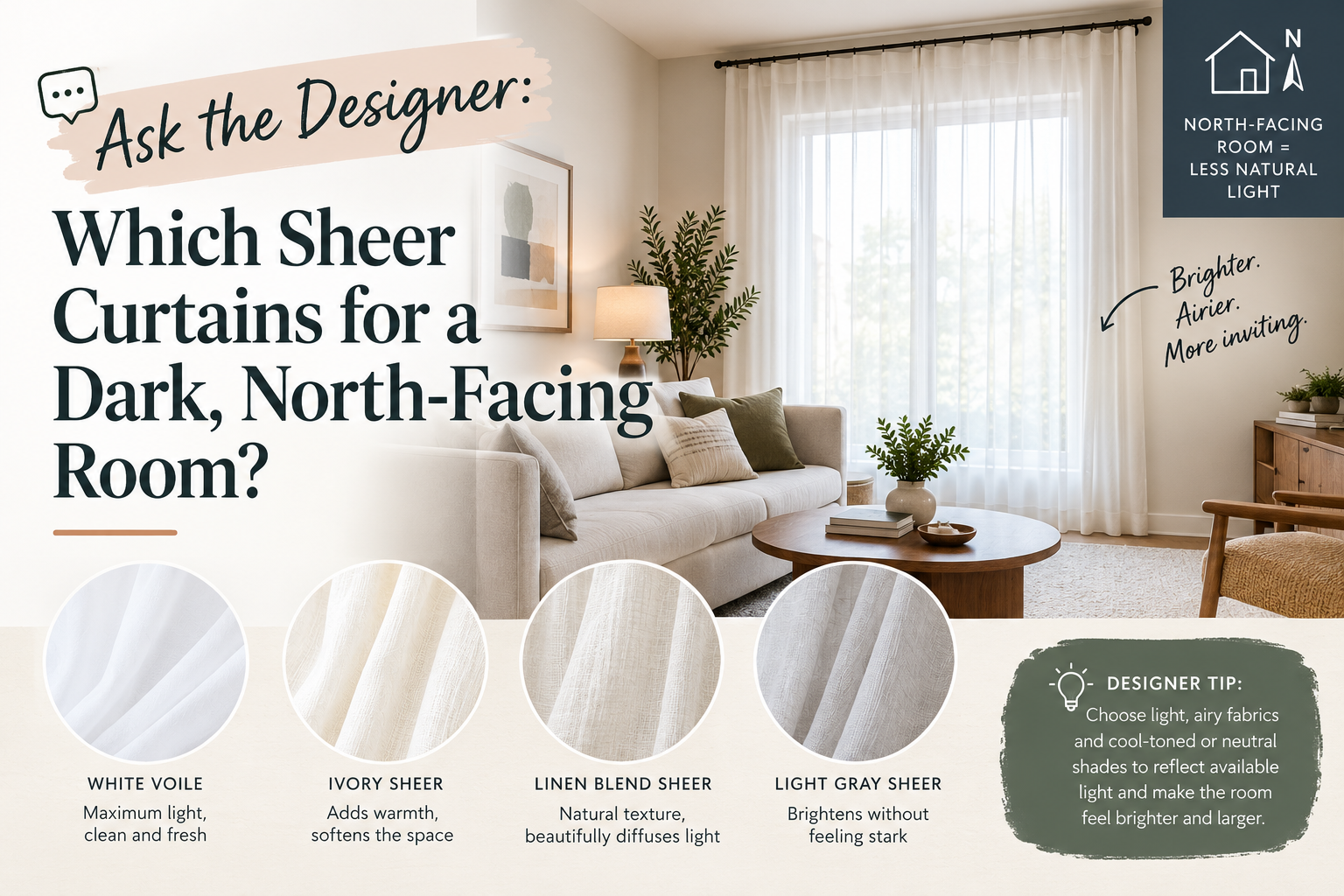
"My living room faces north and gets soft but limited light. I want curtains with some pattern and a bit of privacy from the street, but I'm worried about making it darker. What should I look for?" – Hina, reader question
- Choose sheer curtains in a light, open-weave cotton voile or mulmul with a pale ground.
- Pick a warm-toned, airy print with plenty of background between motifs.
- Make them 2 to 2.5 times the window width for soft fullness.
- Hang the rod high and wide so the curtains stack off the glass.
- Add a light blind behind them for night-time privacy.
Thank you for a great question, Hina. North-facing rooms are among the most common decorating challenges we hear about. The good news is that sheer curtains are the ideal solution: they soften the view, add daytime privacy and bring in colour and pattern, all while letting most of the light through. Here is everything you need to know to choose the right sheer curtains, size them correctly and hang them to make your room feel brighter.
Understanding north light
In the northern hemisphere, north-facing windows never receive direct sunlight for most of the day. Instead, they get indirect, even light from the sky. This light is steady and does not cause glare, which is why artists traditionally preferred north-facing studios. But it can feel cool and slightly bluish, and there is less of it, so north-facing rooms often feel dimmer and colder than other rooms. (In the southern hemisphere, the same applies to south-facing rooms.)
That means the goal for curtains in a north-facing room is twofold: let through as much light as possible, and add warmth to counteract the cool tone.
Choosing the right sheer fabric
Not all sheers are equally light. Weave, fibre and weight make a big difference.
| Fabric | Light through | Privacy by day | Feel |
|---|---|---|---|
| Cotton voile | High | Moderate | Soft, matte, natural |
| Cotton mulmul | High | Moderate | Very soft, slightly crinkled |
| Linen sheer | Medium to high | Good | Textured, relaxed |
| Polyester voile | High | Moderate | Smooth, slight sheen, wrinkle resistant |
| Organza | Very high | Low | Crisp, shiny, formal |
| Lightweight printed cotton | Medium | Good | Pattern-led, casual |
For a north-facing living room, cotton voile or mulmul is our top recommendation. Natural cotton diffuses light beautifully, feels warm and matte rather than shiny, and takes block printing well. Avoid lined curtains or heavy cotton in this room; they absorb light even when open.
Choosing the colour
A white, ivory or cream ground lets the most light through. Within that, warm whites are better than bright blue-whites for north light, which is already cool. Prints in warm tones, such as soft coral, ochre, rose, terracotta or mustard, add a gentle glow when light passes through them.
Avoid dark grounds like navy, charcoal or deep green on the window in a north-facing room. They block light and make the space feel smaller. If you love deeper colours, use them in cushions and throws instead, and keep the window light.
Choosing an airy print
Pattern on a sheer curtain behaves differently from pattern on a solid fabric. When light shines through a printed sheer, the print glows and appears almost suspended, which adds charm without weight. To keep it airy:
- Choose prints where motifs are spaced out, such as small florals, sprigs, buttis (small scattered motifs), dots or a light trellis.
- Avoid dense, all-over designs, which block more light and can look busy when backlit.
- Keep to one or two print colours on a pale ground.
- Relate the curtain to the room by repeating one print colour in a cushion or rug. Our guide to mixing patterns explains how.
Hand block printed sheers have a softness that machine prints lack, because the dye sinks into the fine cotton. Learn how they are made in our guide to hand block printing.
How to measure curtain width
Sheer curtains look best when they are full, with soft gathers, even when closed. Too little fabric looks thin and stretched.
- Measure the width of the window frame.
- Add the distance your rod will extend beyond the frame on each side, usually 6–10 in per side.
- Multiply the total by 2 to 2.5 for sheers. For an especially full, luxurious look, use up to 3.
- Divide by the number of panels you want, usually two.
Example: a 48 in window with a rod extending 8 in each side gives 64 in. Multiplied by 2.5, that is 160 in of fabric, or two panels of about 80 in width each. If standard panels are 50–55 in wide, use three panels.
How to measure curtain length
| Length | Where it ends | Best for |
|---|---|---|
| Sill length | About ½ in above the sill | Kitchens, windows above furniture |
| Below sill | 4–6 in below the sill | Bedrooms, casual rooms |
| Floor length | About ½ in above the floor | Living rooms; most polished look |
| Puddled | 1–3 in pooled on the floor | Romantic, relaxed looks; less practical |
Measure from the top of the rod, or from the bottom of the rings if you use rings, to where you want the curtain to end. For a north-facing living room, floor length makes the window look taller and the room more elegant.
How to hang sheer curtains for more light
- Hang high: mount the rod 4–6 in above the window frame, or halfway between the frame and the ceiling. This makes windows look taller.
- Hang wide: extend the rod 6–10 in beyond the frame on each side, so open curtains stack against the wall rather than over the glass.
- Choose easy-glide hardware: rings or clip rings let you open curtains fully each morning, maximising light.
- Keep the glass clear: tie-backs or holdbacks positioned beyond the window frame help too.
Heading styles
Rod pocket headings gather softly but slide less easily. Tab top curtains look relaxed and casual. Grommet or eyelet headings create neat, even folds and slide smoothly. Clip rings work with almost any flat-topped panel and are the easiest to take down for washing.
Layering sheers with other window treatments
Sheers work well on their own, but layering gives you more control over light and privacy through the day. The most popular combinations are:
- Sheers plus a roller or Roman blind: the blind handles privacy and darkness at night, while the sheers soften the window during the day.
- Sheers plus side panels: heavier printed or lined panels hang at the sides as a frame and are drawn only in the evening.
- Sheers plus a valance: a short valance at the top adds pattern and hides the rod without reducing light.
In a north-facing room, keep any heavier layer fully stacked off the glass during the day so it never blocks light.
How to add privacy at night
Sheers give good privacy during the day, when it is brighter outside than in. At night, when lamps are on, people outside can see silhouettes through them. There are three easy fixes:
- A light roller blind mounted inside the window frame, behind the sheers, lowered only in the evening.
- A double rod with sheers at the front or back and lined curtains on the other rod, drawn only at night.
- Café curtains covering the lower half of the window, for street-level rooms.
More ways to brighten a north-facing room
- Paint: choose warm whites, soft creams or warm pastels; avoid cool greys.
- Mirrors: place a large mirror on a wall adjacent to the window to bounce light deeper into the room.
- Lighting: use warm-white bulbs and layered lamps rather than one overhead light.
- Textiles: bring in warm colours like rust, ochre and coral through cushions and throws; see our boho living room ideas for layering tips.
- Keep windows clean: dirty glass can noticeably reduce incoming light.
Caring for sheer curtains
Sheers collect dust and can look grey over time. Wash them every few months by hand or on a delicate, cold cycle, and rehang while still slightly damp so the weight of the fabric pulls out creases. Avoid drying cotton sheers in strong sun if they are printed. Our full guide to washing block printed cotton covers stain removal and drying.
Common sheer curtain mistakes
- Too narrow: panels that only just cover the window look skimpy. Aim for 2–2.5 times the width.
- Rod too low or too short: curtains cover the glass even when open.
- Floor length that misses: curtains that end 2–3 in above the floor look like they shrank.
- Dark or dense prints: they block the light you are trying to keep.
- Expecting night privacy from sheers alone.
Have a question for our designers? Send it in and we may answer it in a future Ask the Designer article.
Frequently asked questions
Do sheer curtains block light?
Very little. Light, open-weave sheers soften light and give daytime privacy while letting most of it through.
How wide should sheer curtains be?
Aim for 2 to 2.5 times the total rod width so they gather softly when closed.
What colour curtains are best for a north-facing room?
Warm whites, ivory and cream with warm-toned prints such as coral, ochre or rose. Avoid dark grounds.
Can people see through sheer curtains at night?
Yes, when lights are on inside, silhouettes show through. Add a light blind or second layer of lined curtains for night privacy.
How high should I hang sheer curtains?
Mount the rod 4–6 in above the window frame, or halfway to the ceiling, and extend it 6–10 in past each side.