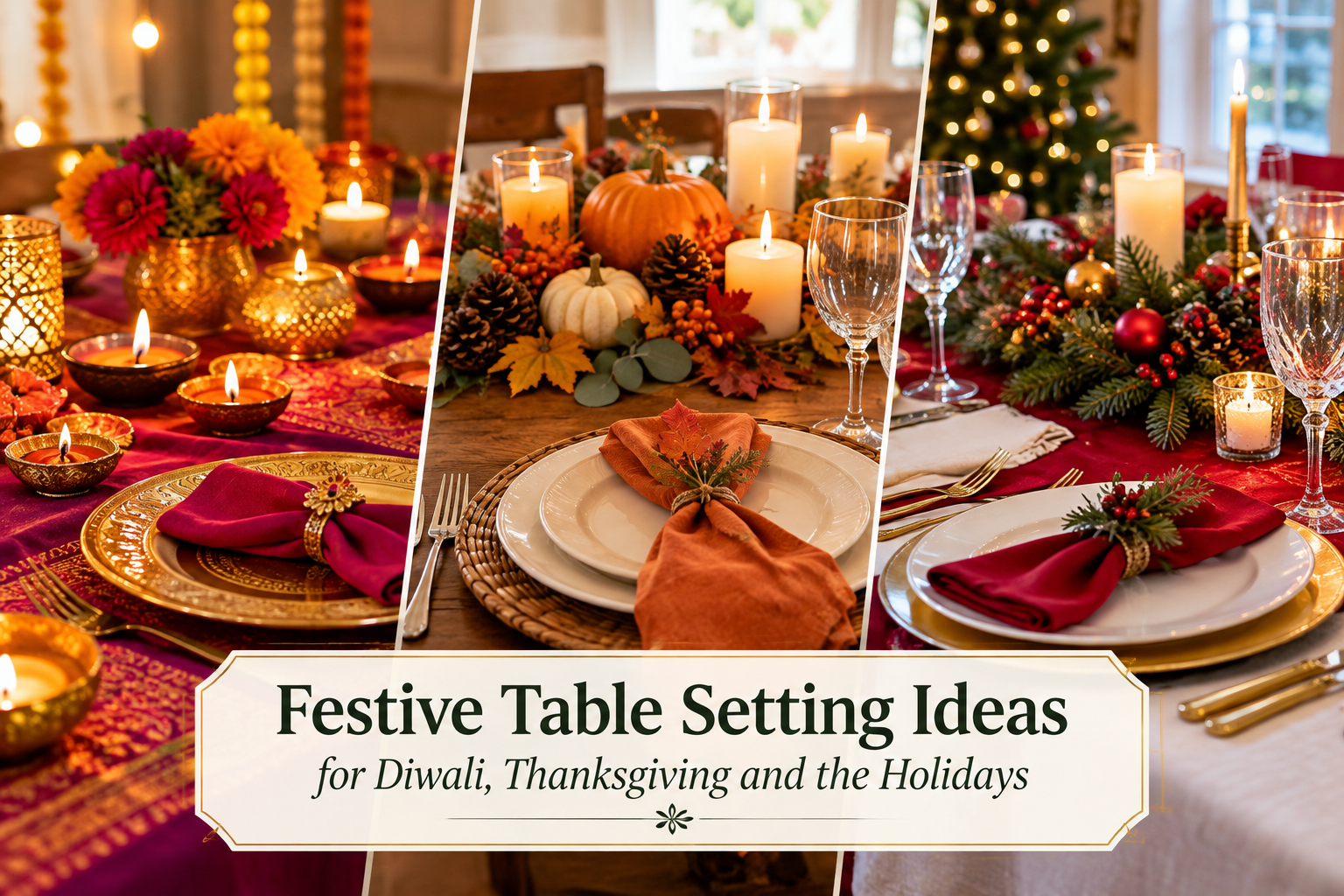
- Base: a patterned tablecloth with a 10–12 in drop.
- Line: a runner, garland or row of greenery down the centre.
- Light: candles or diyas at different heights, kept below eye level.
- Place: napkins, plates and one small personal detail at each seat.
From Diwali in autumn to New Year's Eve, the end of the year is the busiest hosting season of all. A beautiful table makes any meal feel like an occasion, and it does not need to be expensive or complicated. These festive table setting ideas give you a simple four-layer method that works for any celebration, five complete table plans you can copy, a guide to laying a correct place setting, and a checklist to keep the week before stress-free.
The four-layer method for any festive table
Layer 1: The base
The tablecloth sets the colour and mood for everything else. A printed cotton tablecloth in a festive colour does more work than any centrepiece. Size it carefully: for a dinner party, aim for a drop of 10–12 in on each side. Our tablecloth size chart gives exact sizes for every table shape. For extra richness, layer a smaller cloth or a square topper diagonally over a plain base cloth.
Layer 2: The line
A strong line down the centre of the table gives it structure. Use a table runner, a garland of greenery or flowers, or simply a row of small objects. A runner usually looks best at about one third of the table's width.
Layer 3: The light
Candlelight transforms a table. Mix candles of different heights in clusters rather than one straight row. Keep flames below guests' eye level or well above it, so people can see each other across the table. Use unscented candles near food so they do not compete with the meal.
Layer 4: The place
Each place setting is where guests feel welcomed. Fold napkins neatly, add a name card or a small sprig of herbs, and make sure every guest has enough elbow room, roughly 24 in of table edge each.
1. A Diwali table full of light
Diwali, the festival of lights, calls for a table that glows. Start with a tablecloth in deep red, marigold orange, magenta or indigo, ideally with a gold-toned or block printed pattern. Run a narrow runner down the centre and line it with clay diyas interspersed with loose marigold heads and rose petals.
Create a small flower rangoli at the centre of the table using petals arranged in a circle around a brass diya or urli bowl filled with water and floating flowers. Serve on brass or copper thalis and bowls if you have them, or on white plates that let the colours of the food stand out. Fold napkins in a contrasting jewel tone and tuck a single marigold into each fold.
- Palette: red, saffron, magenta, gold.
- Key pieces: printed tablecloth, diyas, marigolds, brass serveware.
- Tip: keep diyas on a heatproof tray or runner and away from the edges where sleeves and dupattas pass.
2. A relaxed harvest table for Thanksgiving
For Thanksgiving or any autumn gathering, choose a tablecloth in rust, mustard, olive or deep orange. A paisley or floral print suits the season; read about the meaning of paisley if you want a motif with a story behind it.
Keep the centre informal and abundant: small pumpkins, pears, pomegranates, wheat stems and tea lights in amber glass. Plain cream or oatmeal napkins tied with twine and a sprig of rosemary at each place feel personal without much effort. Wooden boards and earthenware dishes add warmth.
- Palette: rust, mustard, olive, cream.
- Key pieces: printed tablecloth, seasonal produce, tea lights, twine.
- Tip: use fruit and vegetables you will cook later in the week, so nothing goes to waste.
3. A winter indigo and white Christmas table
Indigo and white is festive without being the expected red and green, and it carries straight through from December into the New Year. Layer an indigo block printed tablecloth with white plates and silver or brass cutlery. Run evergreen branches, eucalyptus or cedar down the centre with white pillar candles in hurricane glasses.
Add pine cones, small white ornaments and a few sprigs of berries for colour. White napkins with a simple blue band or stripe tie it together.
- Palette: indigo, white, silver, evergreen.
- Key pieces: indigo tablecloth, greenery, pillar candles.
- Tip: secure greenery with a few small dabs of museum putty so branches do not roll.
4. A glamorous New Year's Eve table
For New Year's Eve, go for shine. A deep navy, black or plum tablecloth makes gold and glass sparkle. Use metallic chargers under plates, clusters of taper candles in brass holders and a scattering of small mirrored votives. A party favour or a handwritten wish card at each place adds fun at midnight.
- Palette: navy or black, gold, champagne.
- Key pieces: dark tablecloth, metallics, taper candles.
- Tip: keep the centre low so it does not block the toast.
5. A buffet that flows
For a large crowd, a buffet works better than a sit-down meal. Use a floor-length tablecloth, or one with at least a 15 in drop, to hide storage beneath. Create height by placing upturned bowls or boxes under the cloth and setting dishes on top. Label each dish with a small card, especially noting vegetarian, vegan and allergen-friendly options.
Place plates at the start of the line and cutlery and napkins at the end, so guests are not juggling. Put drinks on a separate table to avoid bottlenecks.
How to lay a correct place setting
A traditional Western place setting follows a simple logic: you use cutlery from the outside in.
| Item | Position |
|---|---|
| Dinner plate | Centre, about 1 in from the table edge |
| Forks | Left of the plate, dinner fork closest |
| Knife | Right of the plate, blade facing the plate |
| Spoons | Right of the knife |
| Dessert spoon or fork | Horizontally above the plate |
| Water and wine glasses | Above the knife, water glass closest |
| Bread plate | Upper left, above the forks |
| Napkin | On the plate or to the left of the forks |
For an Indian-style meal, a large thali with small bowls (katoris) around it, a spoon on the right and a glass at the upper right is a beautiful alternative.
Centrepiece rules that always work
- Keep it low: under about 12 in so guests can talk across the table.
- Or go tall and slim: very tall, narrow arrangements above eye level also work.
- Use odd numbers: groups of three or five look more natural than pairs.
- Leave room for food: on family-style tables, a slim runner of greenery is better than a big arrangement.
- Avoid strong scents: heavily perfumed flowers and candles compete with the meal.
Three easy napkin folds
- Simple rectangle: fold into quarters, then in half lengthwise, and lay to the left of the forks.
- Pocket fold: fold into quarters, turn down the top layer diagonally, then fold the sides under. Tuck cutlery or a menu card into the pocket.
- Napkin ring: pinch the centre, pull through a ring or tie with ribbon or twine, and fan out the corners.
A kids' table that survives dinner
Use a washable cotton print rather than your best linen, and cover the centre with brown paper and a jar of crayons. A low bowl of clementines doubles as dessert. Small, unbreakable cups and short candles kept well out of reach make it safer.
Festive colour palettes at a glance
| Occasion | Tablecloth | Accents | Napkins |
|---|---|---|---|
| Diwali | Red, marigold or magenta print | Brass, diyas, marigolds | Emerald or gold |
| Thanksgiving | Rust or mustard print | Pumpkins, wheat, amber glass | Cream or oatmeal |
| Christmas | Indigo or deep green print | Evergreen, white candles, silver | White |
| New Year's Eve | Navy, black or plum | Gold, mirrored votives | Champagne or gold |
| Eid | Emerald, ivory or teal print | Lanterns, dates, brass | Ivory or gold |
Festive tables on a budget
- A good tablecloth does most of the work; invest there and keep everything else simple.
- Borrow from the garden: branches, leaves and herbs cost nothing.
- Use fruit, nuts and spices as decor.
- Mix and match plates you already own, unified by one napkin colour.
- Collect jars and glasses to use as candle holders.
One-week hosting checklist
- Seven days before: confirm guest numbers, measure the table with any leaves added and check you have the right tablecloth.
- Five days before: wash and iron linens; our guide to washing block printed cotton explains how to keep colours bright.
- Three days before: buy candles and non-perishable decor; plan seating.
- The day before: lay the tablecloth, runner and place settings; buy flowers.
- On the day: add flowers and fresh produce, then light candles just before guests sit.
Hosting someone who has just moved? Our list of housewarming gifts has ideas for bringing something special to the table.
Frequently asked questions
What colours are traditional for a Diwali table?
Reds, golds, marigold orange and deep pinks are traditional, often with brass serveware and plenty of candlelight from diyas.
How do I make a cheap table look festive?
A strong patterned tablecloth does most of the work. Add candles at different heights and seasonal produce or greenery down the centre.
How tall should a table centrepiece be?
Keep centrepieces under about 12 in so guests can see each other, or use very tall, slim arrangements that sit above eye level.
How far should a tablecloth hang for a dinner party?
A 10–12 in drop on each side looks generous without getting in guests' laps.
Where do the glasses go in a place setting?
Glasses go above the knife on the right, with the water glass closest to the plate.