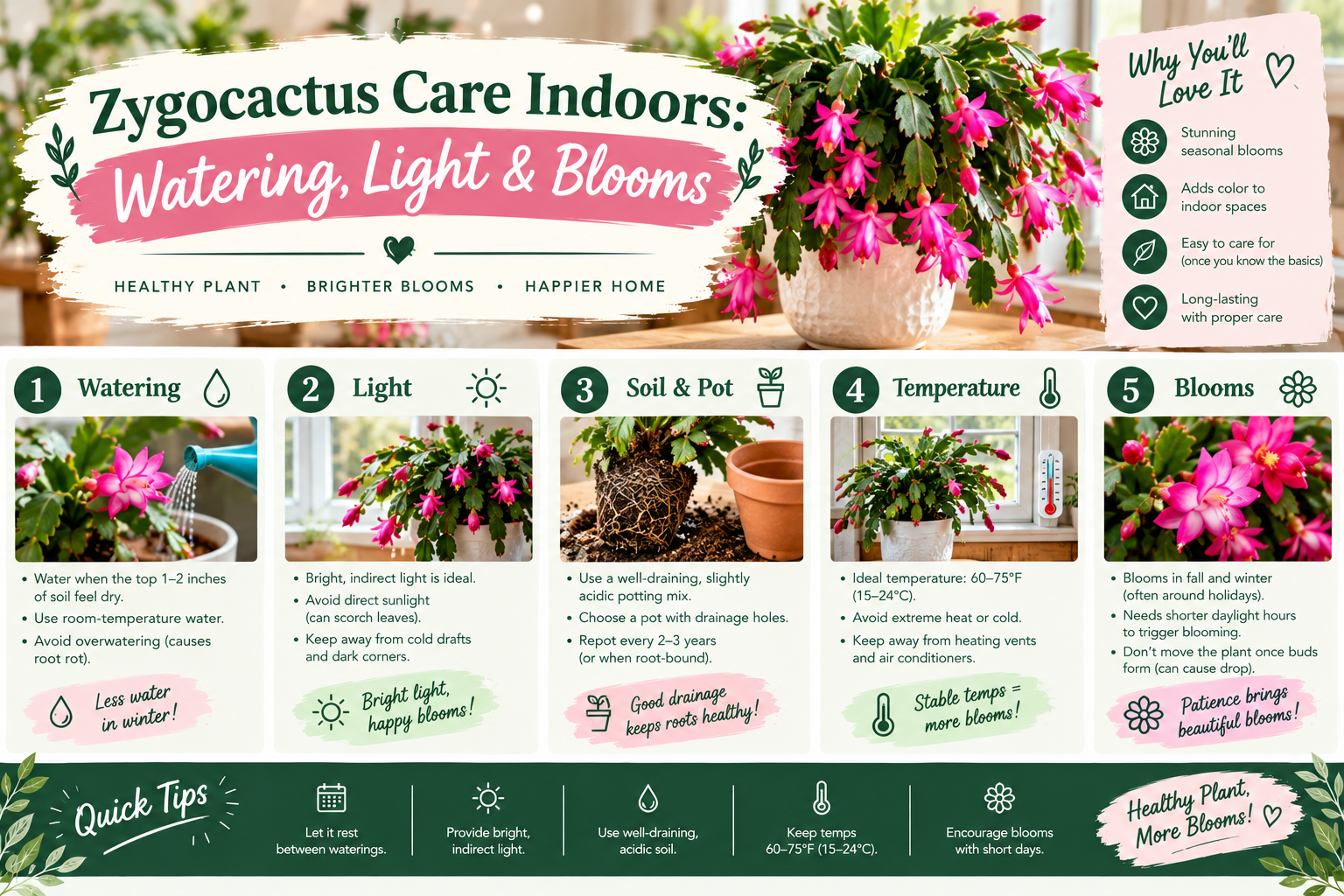
Zygocactus care indoors is easier than many people expect once you understand what makes this tropical cactus different from desert succulents. Also known as a Christmas cactus or holiday cactus, Zygocactus is loved for its arching green stems and colorful flowers that often appear around Thanksgiving and Christmas.
Unlike desert cacti, these plants naturally grow in humid Brazilian forests, where they receive filtered sunlight and moisture from their surroundings. This means they need more regular watering and less intense sunlight than a typical desert cactus.
A healthy Zygocactus can remain an attractive houseplant for many years. With appropriate care, it may produce beautiful pink, red, white, purple, or orange-toned flowers during the holiday season.
Quick answer: Keep your Zygocactus in bright, indirect light and a well-draining, moisture-retentive potting mix. Water regularly during active growth, allowing the upper layer of soil to dry slightly between waterings. Maintain comfortable indoor temperatures and moderate humidity. To encourage flowering, provide cooler nights and long periods of uninterrupted darkness during autumn.
This guide covers indoor Zygocactus care, watering, sunlight, flowering requirements, soil, fertilizing, propagation, and common problems.
What Is a Zygocactus?
Zygocactus is an older botanical name associated with the holiday cactus group now generally classified under Schlumbergera.
These plants belong to the cactus family, Cactaceae, but differ significantly from desert cacti.
They naturally grow in forest environments, often attached to trees or other supports.
Their green, flattened stem segments perform photosynthesis and give the plant its distinctive appearance.
The colorful flowers emerge from the ends of mature stems.
Zygocactus Indoor Care at a Glance
| Care factor | Recommended conditions |
|---|---|
| Botanical name | Schlumbergera species and hybrids |
| Older name | Zygocactus |
| Common names | Christmas cactus, Thanksgiving cactus, holiday cactus |
| Plant family | Cactaceae |
| Light | Bright, indirect or filtered light |
| Water | Keep moderately moist in active growth, never waterlogged |
| Soil | Well-drained, organic-rich potting mix |
| Temperature | About 65–69°F (18–20°C) during normal indoor growth |
| Blooming conditions | Cooler autumn nights and shortening days |
| Humidity | Moderate to higher humidity |
| Fertilizer | Light feeding during active growth |
| Propagation | Stem-segment cuttings |
| Flowers | Commonly late autumn through winter |
| Growing habit | Arching and trailing segmented stems |
These are general recommendations. Exact care depends on the plant's identity, age, environment, and seasonal growth.
Zygocactus vs. Christmas Cactus vs. Thanksgiving Cactus
Many houseplants sold as Christmas cacti are actually Thanksgiving cacti.
Their appearance is similar, but their stem shapes and flowering periods can help distinguish them.
<text></text>
Thanksgiving Cactus — Schlumbergera truncata
<text></text>
Thanksgiving cactus usually has pointed or claw-like projections along the edges of its flattened stem segments.
It commonly flowers during late autumn, often around November in the Northern Hemisphere.
True Christmas Cactus — Schlumbergera × buckleyi
True Christmas cactus generally has rounder, scalloped stem edges without the prominent pointed teeth of Thanksgiving cactus.
It typically flowers later, around December or into winter.
Easter Cactus
Easter cactus is a related holiday plant historically grouped with similar cacti, but it belongs to a different botanical lineage often classified under Rhipsalidopsis.
It generally flowers during spring.
Quick Identification Table
| Feature | Thanksgiving Cactus | Christmas Cactus | Easter Cactus |
|---|---|---|---|
| Botanical name | Schlumbergera truncata | Schlumbergera × buckleyi | Rhipsalidopsis species/hybrids |
| Stem margins | Pointed, claw-like projections | Rounded, scalloped | Rounded segments |
| Typical flowering | Late autumn | Early to midwinter | Spring |
| Main growing conditions | Forest cactus care | Forest cactus care | Similar general environment, with species-specific differences |
Flowering times overlap, especially under controlled indoor conditions. Look at the stem segments as well as the season when identifying your plant.
How Much Light Does Zygocactus Need Indoors?
Bright, indirect light is ideal for indoor Zygocactus.
These plants naturally grow in forest environments where sunlight is filtered by surrounding vegetation.
Strong direct sunlight, particularly during hot afternoons, can damage their tender stem segments.
Best Window Placement
An east-facing window is often a suitable choice because it provides gentle morning light.
Near a south- or west-facing window, filtered light or some distance from the glass may be necessary.
In a north-facing room, make sure the plant still receives sufficient natural brightness.
If winter daylight is very limited, an appropriate grow light may support healthy growth.
Signs of Too Much Light
Excessive light may cause reddish discoloration, bleaching, or brown damaged patches on the stem segments.
Reddish coloration can also have other causes, so examine watering and temperature before assuming sun damage.
Signs of Too Little Light
A Zygocactus receiving insufficient light may grow slowly and produce fewer flowers.
If the plant appears healthy but rarely blooms, poor light during the active growing season may be one contributing factor.
Move it gradually to a brighter location.
How Often Should You Water Zygocactus Indoors?
Watering is one of the most important parts of Zygocactus care.
Unlike desert cacti, these plants do not prefer prolonged complete dryness during active growth.
However, their roots can deteriorate when the potting mix remains saturated.
How to Check Soil Moisture
Insert your finger into the upper inch or so of the potting mix.
During active growth, water when the upper layer has begun drying but the deeper root zone has not become severely dry.
For larger pots, check moisture at multiple depths.
The goal is evenly moist, well-aerated roots rather than constantly wet soil.
How to Water Correctly
Water the potting mix thoroughly.
Allow excess water to flow through the drainage holes.
Empty any water collected in an outer decorative pot or saucer.
Avoid leaving the root system sitting in standing water.
Zygocactus Watering Schedule by Season
| Season | Watering approach |
|---|---|
| Spring | Water regularly as active growth begins |
| Summer | Maintain moderate moisture; check more often in warm conditions |
| Early autumn | Reduce watering somewhat during the pre-flowering rest period |
| Bud formation and flowering | Return to consistent moisture without waterlogging |
| After flowering | Reduce watering during the resting period |
These are seasonal care principles, not a fixed number of days between waterings.
Actual frequency changes with pot size, soil, temperature, humidity, and light.
Best Soil for Indoor Zygocactus
A Zygocactus needs a growing medium that retains some moisture but drains easily.
This requirement reflects its natural epiphytic growth habit.
Heavy soil that remains constantly wet can damage roots.
Recommended Potting Mix
A practical indoor mixture might contain:
Two parts quality houseplant potting mix
One part fine orchid bark
One part perlite or pumice
The precise proportions can be adjusted depending on your home's conditions and the materials available.
You can also use an appropriate commercial potting mix for epiphytic cacti.
Can You Use Regular Cactus Soil?
Some commercial cactus mixes may work, but not all are ideal.
Very gritty desert-cactus mixtures can dry too quickly in warm indoor environments.
A Zygocactus generally benefits from more organic moisture-retentive material than many desert cacti.
Choose a medium with both drainage and moisture retention.
Does Zygocactus Need Drainage Holes?
Yes. A pot with adequate drainage is strongly recommended.
Decorative pots without drainage should be used as outer containers rather than the primary growing vessel.
Temperature and Humidity for Indoor Zygocactus
During active growth and flowering, holiday cacti generally prefer temperatures around 65–69°F (18–20°C), according to the Royal Horticultural Society.
Normal household temperatures can work well.
Avoid positioning the plant beside hot radiators, heating vents, fireplaces, or cold drafts.
Does Zygocactus Like Humidity?
Yes. These tropical forest plants prefer more humidity than many desert cacti.
If your home becomes very dry during winter, consider a clean room humidifier or a pebble tray containing water.
If using a pebble tray, keep the base of the plant's pot above the waterline.
Can You Keep Zygocactus in a Bathroom?
A bathroom may provide suitable humidity if it receives bright, indirect light and adequate ventilation.
A dark bathroom without a window or grow light is generally unsuitable for long-term healthy growth.
How to Make Zygocactus Flower Indoors
Flowering is one of the most rewarding parts of growing a Zygocactus.
However, a healthy plant does not always bloom automatically under typical household lighting.
Holiday cacti respond to seasonal changes in temperature and day length.
They are often described as short-day plants, meaning that extended periods of darkness can help trigger flower bud formation.
Step 1: Provide Adequate Light During Active Growth
Throughout spring and summer, grow the plant in bright, filtered light.
Healthy stem development helps the plant build the growth needed for future flowers.
Step 2: Introduce a Cooler Autumn Rest Period
In early autumn, provide cooler conditions where practical.
The RHS recommends approximately 55–59°F (12–15°C) for a period before buds begin forming.
Avoid frost or damaging cold.
Step 3: Allow Long, Uninterrupted Nights
Holiday cacti may need at least 12 hours of uninterrupted darkness each night for reliable bud development, depending on temperature and variety.
A location illuminated by lamps late into the evening may interfere with flowering.
A naturally dark room at night can be suitable.
You can also use a controlled light-and-dark routine where necessary.
Step 4: Reduce Watering During the Rest Period
Allow the upper potting mix to dry more between waterings while the plant is resting.
Do not leave it completely dry for prolonged periods.
Step 5: Watch for Flower Buds
Small buds generally appear near the ends of mature stem segments.
Once buds develop, return the plant to stable, moderately warm growing conditions.
Water consistently and avoid unnecessary stress.
Step 6: Avoid Sudden Environmental Changes
Developing flower buds may drop after abrupt changes in temperature, moisture, drafts, or location.
Keep the plant in a stable environment once flowering begins.
Practical Zygocactus Blooming Calendar
| Time | Recommended action |
|---|---|
| Spring to summer | Encourage healthy stem growth |
| Late summer | Continue suitable light and moderate feeding |
| Early autumn | Begin cooler conditions and reduced watering |
| Autumn nights | Provide long, uninterrupted darkness |
| When buds appear | Maintain stable warmth and appropriate moisture |
| Flowering period | Avoid temperature shocks and severe moisture changes |
| After flowering | Allow a cooler, less heavily watered rest period |
This schedule is most relevant to plants grown under Northern Hemisphere seasonal conditions.
Flowering dates can shift depending on species, location, and indoor environment.
Why Is My Zygocactus Not Flowering?
A plant with healthy green stems but no flowers may need changes to its seasonal care.
Common Causes
Too much nighttime light: Artificial lighting may interrupt the darkness needed for flower initiation.
Warm nights: Constantly warm indoor conditions can delay or reduce budding.
Insufficient light during growth: Plants growing in deep shade may lack the vigor needed for abundant flowering.
Too much water during the rest period: Constantly wet soil may not support the appropriate seasonal response.
Immature plant: Younger plants may need time to develop additional stem segments.
Recent stress: Repotting, root damage, pests, or sudden environmental changes can affect growth.
How to Encourage More Flowers
Provide brighter indirect light during active growth.
Introduce a cooler autumn rest period.
Allow uninterrupted darkness at night.
Reduce watering moderately until flower buds begin forming.
Keep the plant stable after buds appear.
Do not assume that fertilizer alone can force flowering.
Why Are Zygocactus Flower Buds Falling Off?
Bud drop is one of the most common frustrations with holiday cacti.
A plant may develop numerous buds, only to lose them before the flowers open.
Potential causes include sudden temperature changes, inconsistent watering, low humidity, and moving a plant into very different light conditions.
How to Prevent Bud Drop
Keep watering consistent once buds begin developing.
Avoid placing the plant near heating vents or cold drafts.
Protect it from abrupt temperature changes.
Avoid moving it repeatedly between locations with very different conditions.
Do not repot during active bud development unless there is an urgent root-health problem.
A few dropped buds do not always indicate a serious issue, but widespread bud loss suggests that the growing environment should be reviewed.
How to Fertilize Zygocactus Indoors
Zygocactus benefits from modest feeding during active growth.
A balanced liquid houseplant fertilizer is usually suitable when applied according to its instructions.
The Royal Horticultural Society recommends feeding during the active growing period, approximately April through September in the Northern Hemisphere.
Fertilizing Tips
Use a diluted feed if appropriate for the product and plant.
Avoid applying strong fertilizer to dry, stressed roots.
Reduce or pause feeding during the autumn pre-flowering rest period and after flowering.
Watch for white salt deposits on the potting mix or leaf-tip damage that could indicate excessive fertilization.
When and How to Repot Zygocactus
Holiday cacti do not usually need frequent repotting.
They often perform well in relatively snug containers.
Repot when the growing medium has broken down, drainage has become poor, or the root system genuinely needs additional space.
How to Repot
Choose a pot with drainage holes, only slightly larger than the existing one when an increase is needed.
Prepare a well-draining, organic-rich potting mix.
Remove the plant carefully.
Inspect the roots and remove clearly damaged tissue using clean tools.
Replant at a suitable depth without burying the stem base excessively.
Water appropriately and let excess moisture drain away.
Spring, after the main flowering and resting periods, is often a convenient time to repot.
Avoid unnecessary root disturbance while the plant is covered in buds.
How to Propagate Zygocactus From Cuttings
One of the easiest ways to propagate a holiday cactus is through its segmented stems.
The method is suitable for beginners and can produce additional houseplants from an established parent plant.
Step 1: Choose a Healthy Stem
Select a firm, healthy stem with several segments.
Avoid material affected by rot, severe pests, or extensive damage.
Step 2: Remove Two or Three Segments
Hold the stem carefully and twist or detach a section at the natural joint.
A cutting containing approximately two or three healthy segments is a practical starting point.
Avoid crushing the tissue.
Step 3: Allow the Cut Surface to Dry Briefly
Set the cutting in a clean, shaded location until the wound surface is dry.
Do not leave it for so long that the stem segments become severely dehydrated.
Step 4: Prepare a Small Pot
Use a clean container with drainage holes.
Fill it with a suitable, lightly moistened propagation mix.
Step 5: Plant the Cutting
Insert the lowest segment approximately half an inch (1 cm) into the medium, or just deep enough to hold the cutting upright.
Do not bury multiple segments unnecessarily.
Step 6: Provide Warmth and Filtered Light
Place the pot in bright, indirect light.
Maintain stable warmth and avoid harsh sunlight.
Step 7: Water Sparingly While Roots Form
Keep the rooting medium from becoming completely desiccated, but avoid saturation.
The RHS notes that holiday cactus cuttings can take approximately three to twelve weeks to root.
Step 8: Establish the New Plant
Once the cutting develops a functional root system and begins growing reliably, continue with normal young-plant care.
You can plant several rooted cuttings together to create a fuller pot.
Common Zygocactus Problems and Solutions
| Problem | Possible cause | What to do |
|---|---|---|
| Limp stem segments | Underwatering or root damage | Check soil moisture and roots |
| Yellowing segments | Excess moisture, stress or aging | Review drainage and conditions |
| Reddish stems | Strong light or other stress | Assess light and overall care |
| Soft, black base | Possible stem or root rot | Inspect roots and remove affected material |
| Dropping buds | Environmental changes or moisture stress | Stabilize conditions |
| No flowers | Inadequate darkness or cooler rest | Adjust autumn care |
| Wrinkled stems | Dehydration or nonfunctioning roots | Check root-zone moisture |
| White cottony insects | Mealybugs | Isolate and identify pests |
| Small flying insects | Possible fungus gnats | Inspect growing medium and watering |
Why Are My Zygocactus Leaves Limp?
The flattened green structures are stem segments rather than true leaves.
Limp segments can result from drought, but they may also occur when damaged roots cannot absorb water.
Check the potting mix before adding more water.
If the mix is very dry, water appropriately.
If the mix is wet and the plant remains limp, investigate root health.
Why Are My Zygocactus Stems Turning Red?
Reddish coloration can sometimes result from strong light or environmental stress.
The exact cause cannot be determined from color alone.
Review direct sunlight, temperature, moisture, and any recent changes in care.
How Do You Save an Overwatered Zygocactus?
Stop adding water unnecessarily.
Remove the plant from an outer pot if it is sitting in water.
Check drainage and root condition.
If roots are soft, blackened, or rotting, remove damaged material and replace unsuitable potting mix.
If the plant has extensive stem or root rot, saving healthy stem cuttings may be more practical than trying to recover the entire plant.
Zygocactus Care After Flowering
Once the last flowers fade, your plant enters a period when a reduction in watering and cooler conditions may be beneficial.
Remove spent flowers gently if they have not fallen naturally.
Avoid heavy fertilizing immediately after flowering.
The RHS recommends a second cooler rest period during late winter before active spring growth resumes.
After the resting phase, return to normal watering and growing-season care.
If you want to encourage a fuller shape, spring is also a suitable time to remove selected terminal segments and propagate them.
Can You Keep Zygocactus Outdoors?
Holiday cacti may be placed outdoors during suitable warm weather.
Choose a sheltered location with filtered light.
Avoid strong direct afternoon sun, heavy prolonged rain, and cold temperatures.
Bring the plant inside before outdoor temperatures approach damaging levels.
The RHS recommends keeping these tender plants above approximately 50°F (10°C).
Outdoor placement is generally seasonal for gardeners in colder US states, the UK, and Canada.
Frequently Asked Questions About Zygocactus Care Indoors
How Do You Care for Zygocactus Indoors?
Keep it in bright, indirect light with a well-draining, organic-rich potting mix. Water regularly during active growth, avoid waterlogging, and provide cooler autumn conditions to encourage flowering.
How Often Should I Water My Indoor Zygocactus?
Water when the upper potting mix begins to dry during active growth. Reduce watering during the autumn pre-flowering rest and after flowering. Actual frequency depends on room conditions.
Does Zygocactus Need Direct Sunlight?
No. Bright, filtered light is usually preferable. Strong direct sun can damage the stem segments.
What Is the Best Position for a Zygocactus Indoors?
An east-facing window or another bright location with indirect light is often suitable. Keep the plant away from radiators, cold drafts, and strong midday sunlight.
How Do I Make My Zygocactus Flower?
Provide good light during active growth, then a cooler autumn rest with long, uninterrupted nights. Resume consistent moisture when buds appear.
Why Is My Zygocactus Not Flowering?
Possible causes include artificial light during the night, overly warm autumn conditions, low daytime light, immature growth, or environmental stress.
What Is the Difference Between a Zygocactus and Christmas Cactus?
Zygocactus is an older name associated with the genus now called Schlumbergera. Plants sold under this name may be Thanksgiving or Christmas cacti.
Can You Propagate Zygocactus in Water?
Some stem cuttings may develop roots in water, but rooting in a suitable propagation mix is a well-established method and avoids a separate transition from water to soil.
Why Are My Zygocactus Buds Falling Off?
Bud drop may result from temperature changes, inconsistent watering, drafts, or abrupt changes in the growing environment.
Is Zygocactus a Succulent?
Yes. It has fleshy, water-storing stems, but it is a tropical forest cactus rather than a desert cactus.
Should I Mist My Zygocactus?
These plants appreciate humidity, but misting alone is not a substitute for correct watering. Good airflow and a suitable indoor humidity level are important.
When Should I Repot My Zygocactus?
Repot when the root system needs space or the potting medium has deteriorated. Spring, after the main flowering and resting period, is often convenient.
How Long Can an Indoor Zygocactus Live?
Holiday cacti can be exceptionally long-lived. With suitable care, they may survive for decades and sometimes much longer.
Conclusion
Successful Zygocactus care indoors depends on treating this beautiful holiday plant as a tropical forest cactus rather than a desert succulent.
Provide bright, indirect light, well-draining soil, consistent moisture during active growth, and moderate humidity.
To encourage Christmas or Thanksgiving flowers, introduce a cooler autumn period with longer, uninterrupted nights.
Avoid abrupt changes once flower buds appear, and reduce watering after the flowering season.
With suitable conditions, a Zygocactus can become a long-lived indoor plant that produces attractive seasonal flowers year after year.
Authoritative References
Last reviewed: October 17, 2026. The care recommendations are general and should be adjusted for plant identity, growing environment, and seasonal conditions.