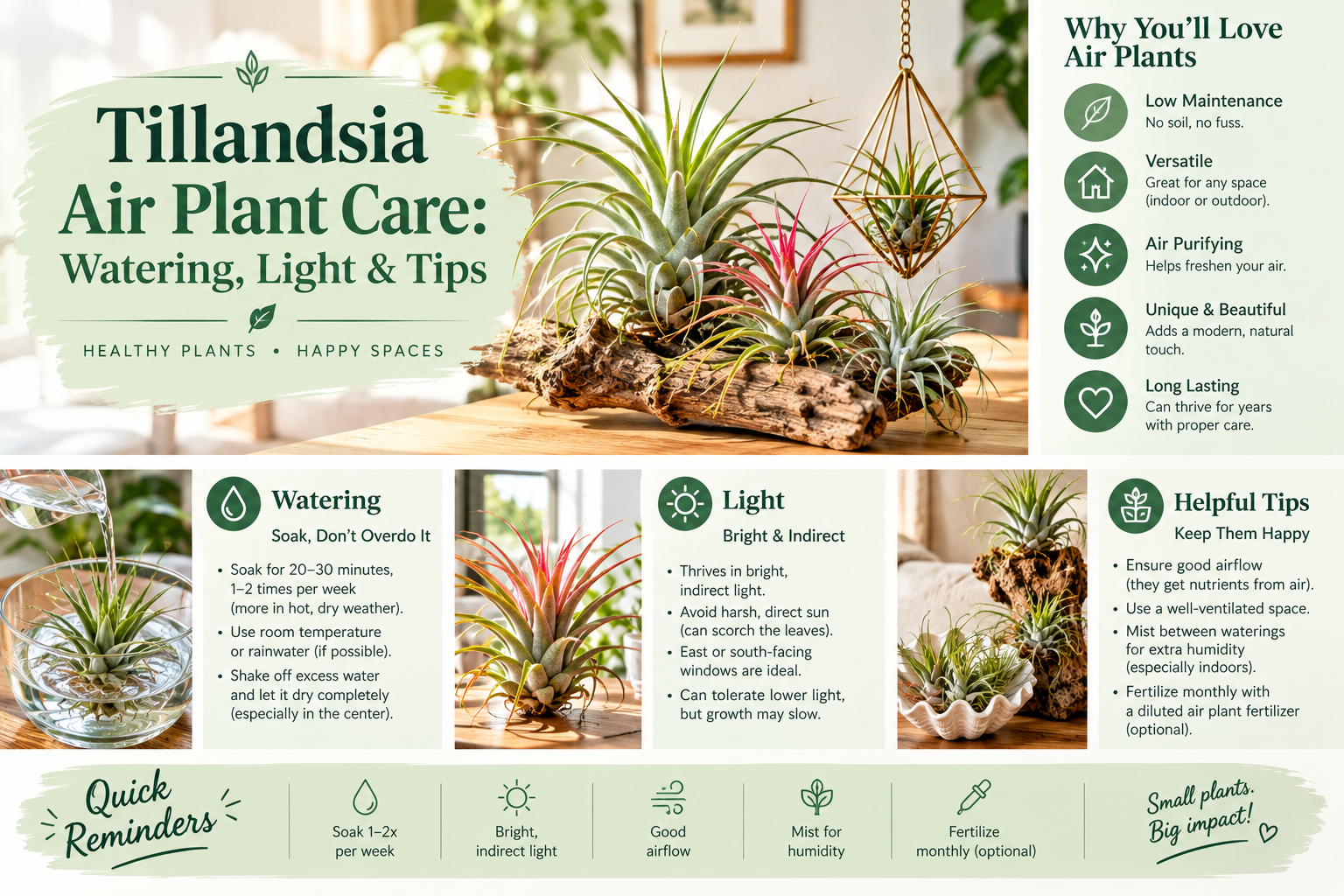
Tillandsia air plants are fascinating houseplants that can grow without traditional potting soil. With their sculptural leaves, unusual shapes, and colorful flowers, they make attractive additions to shelves, hanging displays, terrariums, and indoor gardens.
Unlike most houseplants, Tillandsia absorb much of their moisture through specialized structures on their leaves. But that doesn't mean they survive on air alone. Proper watering, light, and airflow are essential for keeping them healthy.
Whether you've just bought your first air plant or you're trying to save one with brown or curling leaves, understanding its natural growing conditions makes care much easier.
Quick answer: Most Tillandsia air plants grow best in bright, indirect light with regular thorough watering and excellent airflow. Depending on the species and indoor conditions, you can soak, rinse, or mist them. After watering, gently shake away excess moisture and allow the entire plant, especially its base, to dry completely before returning it to a holder.
This guide explains how to care for Tillandsia air plants, how often to water them, which varieties are best for beginners, and how to prevent common problems such as leaf browning and crown rot.
What Are Tillandsia Air Plants?
Tillandsia is a genus of flowering plants in the bromeliad family, Bromeliaceae.
Commonly called air plants, these plants occur naturally in parts of North, Central, and South America.
Many species grow attached to trees, branches, rocks, or other surfaces rather than rooting in the ground.
Plants that grow upon another plant for support without taking nutrients directly from it are called epiphytes. Species that grow on rocks are known as lithophytes.
How Do Air Plants Grow Without Soil?
Most Tillandsia species have small roots that primarily help them anchor to a surface.
Their leaves contain specialized structures called trichomes, which absorb water and dissolved nutrients.
Trichomes also give some species their silvery or fuzzy appearance.
Because of this adaptation, air plants generally do not require potting soil.
However, they still need sufficient light, moisture, suitable temperatures, and ventilation.
Tillandsia Air Plant Quick Care Guide
| Care factor | General recommendation |
|---|---|
| Botanical name | Tillandsia spp. |
| Plant family | Bromeliaceae |
| Common name | Air plant |
| Growing habit | Epiphytic or lithophytic |
| Light | Bright, filtered or indirect light |
| Water | Thorough watering adjusted to species and conditions |
| Drying | Drain and dry completely after watering |
| Temperature | Generally comfortable warm indoor temperatures |
| Humidity | Depends on species; moderate to higher humidity suits many |
| Soil | Usually none |
| Fertilizer | Occasional very dilute suitable fertilizer |
| Propagation | Offsets or pups; seeds |
| Flowers | Most individual rosettes flower once |
Types of Tillandsia Air Plants
Not all Tillandsia plants grow under identical conditions.
Understanding the difference between mesic and xeric plants helps you choose appropriate watering and lighting routines.
Mesic Air Plants
Mesic Tillandsia species generally come from environments with more consistent moisture.
They often have greener, smoother leaves with less conspicuous trichomes.
Some examples include Tillandsia bulbosa and other green-leaved species.
They typically benefit from regular moisture, filtered light, and adequate humidity.
However, they still need good air circulation and should not remain constantly wet.
Xeric Air Plants
Xeric Tillandsia are more adapted to comparatively dry habitats.
Their leaves often appear gray, silver, or fuzzy because of denser trichomes.
Examples include Tillandsia xerographica and Tillandsia tectorum.
Many prefer brighter conditions and need careful drying between watering sessions.
Avoid assuming that all xeric air plants should be soaked for the same duration.
Some species with dense or tightly overlapping leaves are particularly vulnerable to retained water.
Mesic vs. Xeric Air Plants
| Feature | Mesic Tillandsia | Xeric Tillandsia |
|---|---|---|
| Typical leaf appearance | Greener, smoother | Silvery, gray, sometimes fuzzy |
| Natural habitat | Relatively moist environments | Comparatively dry environments |
| Light | Bright filtered light | Often tolerates brighter light |
| Moisture | Generally more frequent | Usually adjusted more cautiously |
| Main risk | Dehydration in dry indoor air | Water trapped in leaves or crown |
| Examples | T. bulbosa and selected green types | T. xerographica and T. tectorum |
These are broad groupings. Individual species and their growing environments determine the best care routine.
How Much Light Do Tillandsia Air Plants Need?
Most air plants perform well in bright, indirect or diffused light.
A location near a bright window is often suitable.
However, sunlight intensity varies considerably by season, window direction, and geographical location.
Best Window Placement
An east-facing window can provide gentle morning sunlight.
A bright south- or west-facing window may also work when light is filtered or plants are positioned appropriately.
In northern regions with shorter winter days, such as parts of Canada and the UK, supplemental grow lighting may be helpful.
Can Air Plants Tolerate Direct Sunlight?
Some species tolerate more direct light than others.
Silvery xeric varieties are often better adapted to brighter conditions than green-leaved mesic varieties.
However, strong afternoon sunlight through glass can cause overheating or leaf damage.
Introduce brighter light gradually and observe the plant.
Signs of Too Much Light
Sun damage may appear as bleached, pale, or dry brown patches.
If the leaves become scorched, move the plant away from harsh direct exposure.
Signs of Too Little Light
Insufficient light may cause weak growth, loss of vigor, or poor flowering.
Move the plant to a brighter location or consider appropriate artificial lighting.
How to Water Tillandsia Air Plants
Watering is one of the most important parts of Tillandsia care.
Air plants should not be treated like traditional potted plants.
They obtain much of their moisture through their leaves and need the opportunity to dry after watering.
The three main techniques are soaking, rinsing, and misting.
Method 1: Soaking Air Plants
Soaking is convenient for many common air plant species.
Step 1: Fill a clean container with suitable room-temperature water.
Step 2: Place the plant in the water, using a soaking duration appropriate to its species.
For many commonly grown varieties, approximately 20–30 minutes can be a reasonable starting point.
Step 3: Remove the plant and gently shake off excess water.
Step 4: Place it sideways or upside down in a well-ventilated location.
Step 5: Let the plant dry thoroughly before replacing it in its display.
Penn State Extension describes soaking as one successful approach, while the Royal Horticultural Society recommends adjusting watering to environmental conditions.
Not every species benefits from prolonged immersion, so identify the variety before choosing a routine.
Method 2: Rinsing Air Plants
Rinsing is another practical method.
Hold the plant under a gentle flow of suitable lukewarm water.
Thoroughly wet the leaves without damaging them.
Then shake away excess moisture and allow the plant to dry completely.
Penn State Extension describes thorough rinsing as a convenient technique for many indoor Tillandsia.
Method 3: Misting Air Plants
Misting can help provide moisture between thorough watering sessions.
It is particularly useful for certain mounted plants that are difficult to remove.
However, a brief decorative mist may not provide enough water, especially in dry indoor conditions.
The Royal Horticultural Society advises that misting should generally supplement rather than replace thorough watering.
Choose a method that meets the species' moisture needs without keeping the plant wet for prolonged periods.
How Often Should You Water Air Plants?
There is no universal watering schedule for every Tillandsia.
The frequency depends on species, temperature, humidity, airflow, and light exposure.
A plant in a warm, dry, heated home may need moisture more often than one in a humid environment.
Starting Watering Guide
| Conditions | Suggested approach |
|---|---|
| Average indoor conditions | Assess moisture needs and consider thorough watering around once weekly |
| Very dry, heated rooms | Monitor more frequently and adjust watering |
| Humid conditions | Allow more time between watering when plants remain moist |
| Silvery xeric varieties | Follow species-specific recommendations; avoid retained crown moisture |
| Warm summer conditions | Check more often for signs of dehydration |
| Cool winter conditions | Water cautiously and avoid prolonged wetness |
This is an observational guide, not a fixed calendar prescription.
For example, North Carolina State Extension suggests soaking Tillandsia xerographica for around 15 minutes every one or two weeks, with less frequent soaking during winter under suitable conditions.
Other Tillandsia species may need more frequent watering.
The most important rule is to thoroughly hydrate your plant when needed and allow it to dry completely afterward.
How to Dry Air Plants After Watering
Proper drying can be just as important as watering.
Air plants naturally grow in locations with airflow.
If water remains trapped in the center of a rosette, it may contribute to crown rot.
Safe Drying Steps
Remove the plant from water.
Gently shake away excess droplets.
Position it sideways or upside down on a clean towel or drying rack.
Provide good air movement.
Inspect the base and inner leaves before returning it to the display.
Penn State Extension recommends allowing air plants to dry for at least four hours after watering before returning them to a terrarium.
The exact drying time depends on plant structure and household conditions.
If the center is still wet, give the plant more time.
Never place a freshly soaked Tillandsia directly inside a tightly enclosed glass container.
What Water Is Best for Tillandsia?
Water quality can affect air plant health.
Rainwater can be suitable when collected safely.
Filtered water may be useful where tap water contains substantial dissolved minerals.
The Royal Horticultural Society advises caution with hard tap water because deposits can accumulate on Tillandsia trichomes.
Can You Use Tap Water?
Tap water may be usable depending on its quality.
If your water is very hard and leaves persistent mineral deposits, consider a better-quality alternative.
Avoid using chemically contaminated or unsuitable water.
Do not use water that is excessively hot or cold.
Tillandsia Temperature and Humidity Requirements
Most commonly cultivated Tillandsia prefer warm temperatures.
Penn State Extension describes daytime temperatures of approximately 65–90°F (18–32°C) and nighttime temperatures above about 55°F (13°C) as suitable general conditions.
However, the tolerance of individual species varies.
Best Indoor Placement
Keep air plants away from direct heating vents, cold drafts, and air-conditioning outlets.
Avoid enclosed spaces where moisture remains trapped.
Moderate indoor humidity can work for many species when the watering routine is appropriate.
In particularly dry homes, additional watering or controlled humidity may be necessary.
Can Air Plants Live in Bathrooms?
Yes, when the bathroom receives sufficient light and ventilation.
Humidity alone does not replace proper lighting or periodic thorough watering.
A windowless bathroom without grow lighting is generally not an ideal long-term location.
Do Tillandsia Air Plants Need Fertilizer?
Air plants can survive with relatively little fertilizer, but occasional feeding may support healthy growth and flowering.
Use a fertilizer suitable for bromeliads, Tillandsia, or appropriate epiphytic plants.
Follow the manufacturer's dilution instructions.
Overfertilization can damage leaf surfaces or cause salt accumulation.
A very dilute feed during active growth is usually more appropriate than frequent strong applications.
Do not fertilize a plant that is severely dehydrated, rotting, or otherwise stressed.
How to Display Air Plants Indoors
Because air plants usually do not require soil, they offer flexible decorating possibilities.
Driftwood Displays
Natural driftwood can provide an attractive mounting surface.
Secure the plant using safe supports without crushing its base.
Hanging Air Plant Holders
Wire holders or hanging fixtures can improve airflow and show off the plant's shape.
Check that the fixture is secure and that the plant can be removed for watering.
Cork Bark Mounts
Cork bark provides a lightweight, natural-looking surface.
It's suitable for many mounted epiphytic displays.
Open Glass Containers
An open glass vessel can highlight a small Tillandsia.
However, enclosed containers often retain moisture and may restrict ventilation.
Remove the plant for watering and let it dry fully before returning it.
Decorative Bowls and Shelves
A cluster of air plants can decorate a shelf or tabletop.
Choose a position with adequate light rather than selecting a display location based only on appearance.
Common Tillandsia Air Plant Problems and Fixes
| Symptom | Possible cause | Recommended action |
|---|---|---|
| Brown, crispy tips | Dehydration, dry air or mineral buildup | Review water quality and hydration |
| Soft, dark base | Possible crown or stem rot | Remove trapped moisture and assess damage |
| Curling leaves | Species habit or dehydration | Compare with normal species appearance |
| Yellow or bleached patches | Excess direct light | Move to filtered light |
| Slow growth | Insufficient light or unsuitable conditions | Improve environment gradually |
| Leaves falling from the center | Possible advanced rot | Inspect crown and remaining tissue |
| No flowers | Immaturity or insufficient light | Provide appropriate long-term care |
| White cottony insects | Mealybugs | Isolate and identify the pest |
Why Is My Air Plant Turning Brown?
Brown leaf tips may indicate moisture stress, dry indoor air, mineral deposits, or physical damage.
Inspect the plant before making changes.
Dry tips with otherwise firm leaves are different from a soft, collapsing brown center.
A soft center may indicate rot rather than drought.
Why Are My Air Plant Leaves Curling?
Some species naturally have curling or twisted leaves.
For others, more pronounced curling may indicate dehydration.
Compare the plant with healthy specimens of the same species rather than assuming every curled leaf is a problem.
How to Save an Overwatered Air Plant
Remove the plant from its container.
Shake away trapped water and place it in an airy, appropriately lit position.
Check whether the base remains firm.
If the crown is mushy and the central leaves detach easily, advanced rot may be irreversible.
Avoid additional soaking until the issue has been assessed.
How to Revive a Dry Air Plant
If leaves are dry but the plant remains firm, provide species-appropriate thorough watering.
Allow it to drain and dry.
Adjust the routine gradually.
Completely dead or extensively rotted plants cannot reliably be restored.
How Do Tillandsia Air Plants Flower?
Many Tillandsia produce colorful flowers or decorative flower bracts.
Colors may include pink, red, purple, yellow, and white.
Flowering depends on species, plant maturity, light, and growing conditions.
A healthy Tillandsia may take years to reach flowering maturity.
Do Air Plants Flower More Than Once?
Most individual Tillandsia rosettes are monocarpic, meaning they flower once during their life cycle.
However, the plant often develops offsets, called pups, that can continue growing after the mother rosette flowers.
The original rosette usually declines gradually rather than dying immediately after flowering.
How to Propagate Tillandsia From Pups
Pups are small new plants that develop near the base of the parent Tillandsia.
They provide a relatively simple way to propagate many air plants.
Step 1: Wait for Pups to Develop
After flowering, examine the base of the plant for new growth.
Do not immediately remove tiny offsets.
Step 2: Allow Them to Grow
Wait until the pups are approximately one-third to one-half the size of the parent, or until they can be separated without damage.
Step 3: Separate Carefully
Some pups can be gently detached.
Others may require clean, careful cutting.
Avoid damaging the growing points.
Step 4: Provide Normal Care
Place separated pups in appropriate light and humidity.
Water carefully and allow them to dry completely.
You can also leave pups attached to form an attractive cluster.
Air plants may be propagated from seeds, but seed propagation is generally much slower and requires more controlled conditions.
Popular Tillandsia Varieties for Indoor Growing
| Species | Identifying characteristics | Main care consideration |
|---|---|---|
| Tillandsia ionantha | Compact rosette; some forms blush red before flowering | Bright filtered light and regular moisture |
| Tillandsia xerographica | Large silvery curling foliage | Avoid water trapped in its broad leaf bases |
| Tillandsia bulbosa | Bulb-like base and twisting green leaves | Good airflow and careful drying |
| Tillandsia caput-medusae | Thick, curving leaves | Drain water from the base thoroughly |
| Tillandsia tectorum | Dense white, fuzzy trichomes | Follow species-specific, conservative watering guidance |
| Tillandsia usneoides | Hanging strands known as Spanish moss | Provide airflow and sufficient moisture |
Choose species according to your growing environment.
Not every air plant is equally well suited to low humidity or a bright, sunny window.
Tillandsia Care in the USA, UK and Canada
United States
Indoor conditions vary greatly between humid southeastern states and arid southwestern regions.
Dry indoor air, air conditioning, and strong sunlight can affect care.
Adjust watering and placement to your local conditions.
United Kingdom
Lower winter light and cooler indoor conditions may slow growth.
Maintain adequate brightness and ensure plants dry thoroughly after watering.
Avoid exposing tropical Tillandsia to cold windows or outdoor frost.
Canada
Long winters and indoor heating may create low humidity and limited natural light.
A suitable grow light may help in darker rooms.
Keep plants away from heating vents and cold drafts.
Across all three countries, species identification and indoor conditions matter more than national averages.
Frequently Asked Questions About Tillandsia Air Plants
How Do You Care for Tillandsia Air Plants?
Provide bright, indirect light, regular species-appropriate watering, good airflow, and warm indoor conditions. Allow plants to dry fully after watering and avoid leaving moisture trapped in the crown.
How Often Should I Soak My Air Plant?
Many commonly grown varieties benefit from thorough watering roughly weekly under average indoor conditions, but frequency and soaking duration vary by species, humidity, and temperature.
Do Tillandsia Need Soil?
No. Most cultivated Tillandsia are epiphytes or lithophytes and grow attached to surfaces without traditional potting soil.
Can Air Plants Survive Without Water?
No. Although they can absorb moisture through their leaves, indoor air plants generally require regular watering to remain healthy.
Can Tillandsia Grow in Direct Sunlight?
Some species tolerate brighter direct sun than others, but strong sunlight through glass may cause damage. Bright filtered light is a reliable starting point for many houseplants.
Why Are My Air Plant Tips Turning Brown?
Brown tips may develop from dehydration, low humidity, water-quality issues, or other stress. Review your care routine and examine the base for signs of rot.
How Do You Know if an Air Plant Is Dead?
A dead plant may be completely dried and brittle or severely rotted. If the center is mushy and leaves detach easily, recovery may be unlikely. Some naturally dry outer leaves do not indicate death.
Can You Put Air Plants in a Closed Terrarium?
Closed containers are generally risky because they restrict airflow and retain moisture. Open displays are usually easier to manage.
Do Air Plants Need Fertilizer?
They need only modest feeding. An appropriately diluted fertilizer may support growth, but overfeeding can cause damage.
Do Air Plants Die After Flowering?
Most individual rosettes flower once and gradually decline afterward, often producing pups that continue growing.
How Do You Propagate Tillandsia?
The easiest method for many species is separating mature pups from the parent plant. Pups can also be left attached to form a clump.
Are All Tillandsia Air Plants Easy to Grow?
No. Their care requirements vary substantially. Some tolerate average household conditions, while others need more specific moisture, light, or airflow management.
Conclusion
Tillandsia air plant care becomes much easier when you understand how these unusual plants grow in nature.
They don't need traditional soil, but they do need appropriate light, water, warmth, and ventilation.
For many species, thorough watering followed by complete drying is more reliable than leaving the plants in constantly damp displays.
Learn whether your Tillandsia is mesic or xeric, adjust your care routine to your home environment, and watch for early signs of dehydration or rot.
With the right conditions, air plants can become beautiful, long-lasting additions to indoor plant collections and decorative displays.
Authoritative Sources
Last reviewed: October 17, 2026. Tillandsia watering requirements differ by species and growing environment. Adjust care to the plant rather than relying exclusively on a fixed schedule.