Learning how to propagate fiddle leaf fig is a rewarding way to grow new houseplants from an existing tree. Whether your fiddle leaf fig has become too tall, needs pruning, or you simply want another plant for your home, propagation allows you to reuse healthy stems instead of throwing them away.
The fiddle leaf fig (Ficus lyrata) is known for its large, violin-shaped leaves and upright growth. Although it is a popular indoor tree, rooting its cuttings requires a little patience and the right growing conditions.
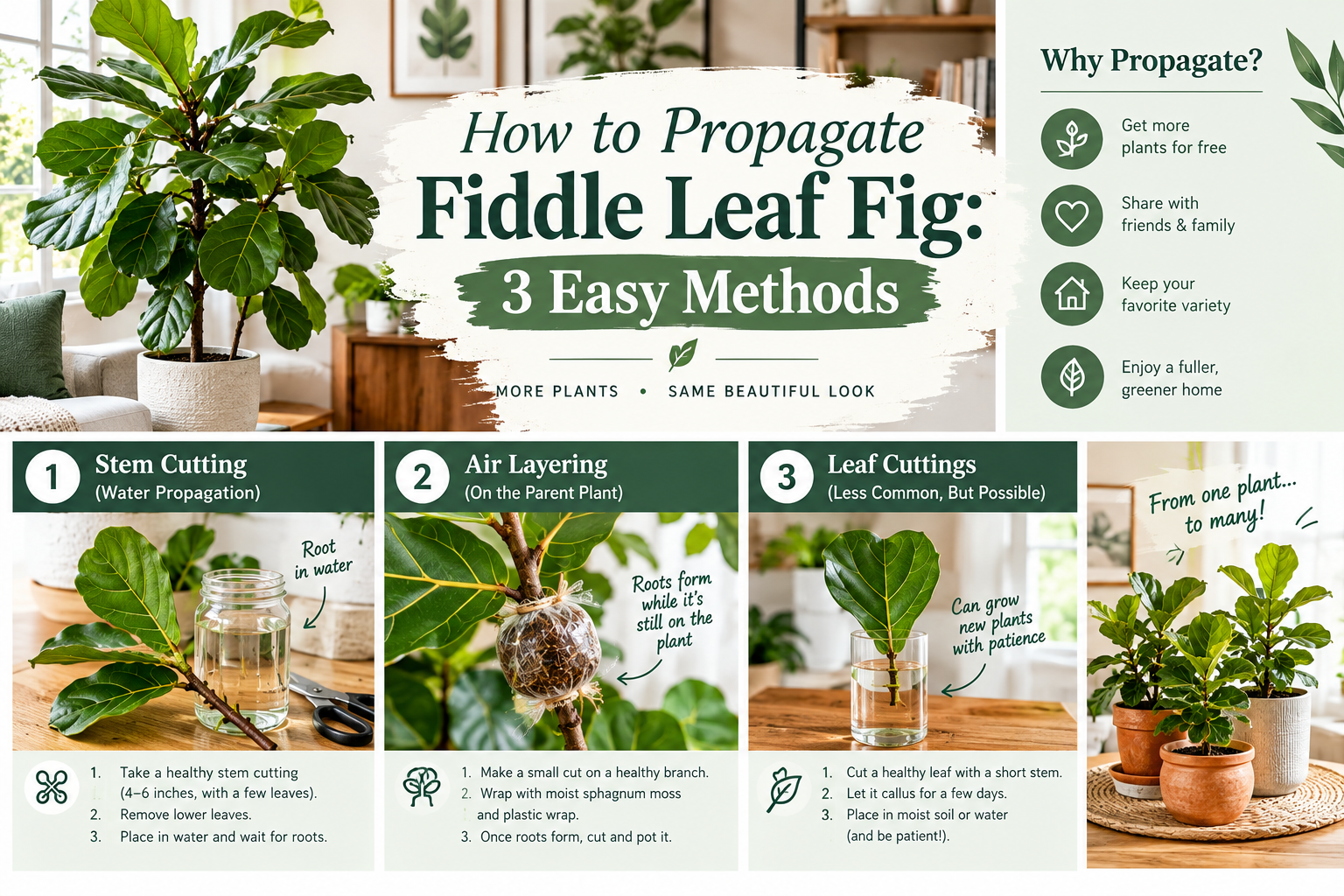
You can propagate a fiddle leaf fig in water, directly in a well-draining propagation mix, or through air layering. Each method has advantages, and the best choice depends on the size and condition of your plant.
Quick answer: To propagate a fiddle leaf fig, take a healthy stem cutting with at least one viable node, ideally two or more. Remove the lower leaves and place the node in clean water or a moist, well-draining rooting mix. Keep the cutting warm and in bright, indirect light. Roots may begin forming within several weeks, although some cuttings take longer. A leaf without a stem node may produce roots but generally cannot grow into a complete new tree.
In this guide, you'll learn exactly where to cut a fiddle leaf fig, the difference between water and soil propagation, how air layering works, and what to do when your cutting isn't growing roots.
Can You Propagate a Fiddle Leaf Fig?
Yes. A fiddle leaf fig can be propagated through vegetative methods, including stem cuttings and air layering.
Vegetative propagation allows a new plant to grow from part of an existing plant. The resulting plant generally has the same genetic characteristics as the parent plant.
Fiddle leaf figs are commonly propagated from stem sections because stems contain nodes and buds capable of supporting new shoot growth.
The three practical methods are:
Water propagation: Root a stem cutting in water so you can observe root development.
Soil propagation: Place the cutting directly into a moist, well-aerated rooting medium.
Air layering: Encourage roots to develop on a stem while it remains attached to the parent plant.
For beginners, water propagation is easy to monitor. Soil propagation avoids the separate transition from water to potting mix. Air layering is particularly useful when shortening or reshaping a larger fiddle leaf fig.
What You'll Need to Propagate a Fiddle Leaf Fig
Gather supplies before cutting the plant so the exposed stem does not sit unnecessarily long without water or rooting medium.
| Supply | Purpose |
|---|---|
| Sharp pruning shears or scissors | Make a clean stem cut |
| Rubbing alcohol | Disinfect cutting tools |
| Clean glass container | Hold cuttings for water propagation |
| Small nursery pot with drainage holes | Root cuttings in propagation mix |
| Perlite and suitable propagation mix | Support roots while allowing airflow |
| Rooting hormone (optional) | Encourage rooting when appropriate |
| Clear propagation cover (optional) | Reduce moisture loss |
| Clean water | Hydrate cuttings |
| Gloves | Protect skin from irritating sap |
Fiddle leaf figs release a milky latex sap when cut. The sap may irritate skin and eyes, so wear gloves, avoid touching your face, and clean your tools after pruning.
Keep cuttings and plant material away from pets and children who may chew them.
Where to Cut a Fiddle Leaf Fig for Propagation
The location of the cutting is one of the most important factors in successful propagation.
A healthy stem cutting needs viable stem tissue and at least one node.
What Is a Node on a Fiddle Leaf Fig?
A node is the point on a stem where a leaf attaches or previously attached.
It is associated with a bud that can develop into new shoot growth.
The section of stem between two nodes is called the internode.
A leaf blade and its petiole alone do not ordinarily contain a viable shoot bud.
Where Should You Make the Cut?
Select a healthy stem with several leaves and visible nodes.
As a practical starting point, take a cutting approximately 4–8 inches (10–20 cm) long, depending on the plant and stem structure.
Cut just below a node with clean, sharp pruning shears.
A cutting with two or three nodes usually offers more flexibility: lower nodes can be placed in the rooting medium while upper nodes and leaves remain above it.
Do not remove more of your parent plant than it can safely tolerate.
Can You Use a Woody Stem?
Yes, fiddle leaf figs can root from suitable semi-woody or woody stem material.
However, older or larger cuttings may take longer to root and can lose water before roots become established.
A smaller, healthy cutting with manageable leaf area is often easier for beginners.
Method 1: How to Propagate Fiddle Leaf Fig in Water
Water propagation is popular because it allows you to observe root formation through a clear container.
It is simple to set up and requires few supplies.
However, roots formed in water need to adjust when the cutting is eventually transferred to potting mix.
Step 1: Select a Healthy Cutting
Choose a firm stem from a healthy fiddle leaf fig.
Look for a cutting with at least one viable node and preferably two or three.
Avoid stems that are blackened, mushy, severely damaged, or affected by active pests.
Step 2: Make a Clean Cut
Disinfect the blades of your pruning tool.
Cut the stem just below a node.
Avoid crushing or tearing the stem.
The plant may release milky sap. Handle the cutting carefully and wash any sap from your tools.
Step 3: Remove the Lower Leaves
Remove any leaves that would sit beneath the waterline.
Leaving leaves submerged encourages decay and may contaminate the water.
Retain one or two healthy upper leaves when practical.
Because fiddle leaf fig leaves are large, excessive leaf area can increase moisture loss before roots develop.
For particularly large leaves, reducing leaf area may help limit water loss.
Step 4: Place the Cutting in Water
Fill a clean glass or jar with room-temperature water.
Place the lower node or nodes beneath the waterline.
Keep the leaves above the water.
Make sure the cutting stands securely without being crushed by the container.
Step 5: Provide Bright, Indirect Light
Position the jar where it receives bright, indirect light.
Avoid harsh direct afternoon sun, which can heat the water and stress the cutting.
Maintain a relatively warm indoor environment and avoid cold drafts.
Step 6: Refresh the Water Regularly
Check the water level and cleanliness.
Replace cloudy water promptly.
As a practical routine, change the water once or twice weekly and more often if it becomes unpleasant or visibly contaminated.
Keep the rooting portion of the cutting submerged.
Step 7: Wait for Roots to Develop
Rooting time varies.
Some healthy cuttings may begin forming roots in approximately four to six weeks, while others take eight weeks or longer.
Temperature, light, stem maturity, and cutting health all affect the result.
Do not discard a firm, healthy cutting simply because roots have not appeared after a few weeks.
Step 8: Transfer the Rooted Cutting to Soil
Once the cutting has a reasonable root system, move it into a small pot with drainage holes.
Iowa State University Extension recommends transplanting many water-rooted houseplant cuttings when roots are approximately one inch long.
For a relatively large fiddle leaf fig cutting, several healthy roots can make the transition easier.
Use a suitable houseplant potting mix that provides drainage and aeration.
Water the mix after planting and keep the newly potted cutting in stable conditions while it adjusts.
Method 2: How to Propagate Fiddle Leaf Fig in Soil
Soil propagation allows the cutting to establish roots directly in its growing medium.
It is a useful choice if you do not want to transplant water-grown roots later.
Step 1: Prepare a Propagation Mix
Use a clean, well-draining medium that retains some moisture without staying saturated.
For example, a mixture containing approximately equal portions of perlite and an appropriate moisture-retentive propagation ingredient can provide a useful balance.
Commercial seed-starting or propagation media may also work when suitable for stem cuttings.
Avoid using heavy garden soil in a small propagation pot because it may retain excessive moisture and introduce pests or pathogens.
Step 2: Choose a Pot With Drainage
Use a clean nursery pot with drainage holes.
A pot that is only moderately larger than the inserted stem generally makes moisture management easier than an oversized container.
If the cutting is tall, provide appropriate support.
Step 3: Take a Healthy Stem Cutting
Use a clean pruning tool.
Select a healthy stem with at least one viable node, preferably more.
Remove the leaves that would otherwise be buried in the rooting medium.
Step 4: Apply Rooting Hormone if Desired
Rooting hormone is optional, not essential.
Some rooting products contain auxins that may encourage root initiation.
If using one, follow the product instructions.
Avoid dipping a wet or contaminated stem directly into the main hormone container.
Step 5: Insert the Cutting Into the Mix
Moisten the rooting medium before planting.
Create a small hole using a clean pencil or similar tool.
Insert the stem so that a lower node is beneath the surface.
Firm the mix gently around it to provide support.
Do not bury the remaining leaves.
Step 6: Maintain Humidity
Cuttings without roots can lose moisture rapidly through their leaves.
A clear propagation cover may help maintain humidity.
Keep the cover from resting directly on the foliage and allow appropriate ventilation.
If excessive condensation or mold develops, improve airflow and reduce unnecessary moisture.
Step 7: Keep the Medium Lightly Moist
The mix should not remain waterlogged.
Check the medium regularly and add water when required.
Standing water, poor drainage, and excessive moisture can lead to stem rot.
Step 8: Check for Root Development
After several weeks, look for healthy new growth or resistance when the cutting is moved very gently.
Avoid repeatedly pulling the cutting out of the medium to inspect the roots.
Once the plant has developed a stable root system, gradually reduce any extra humidity and continue normal young-plant care.
Method 3: How to Propagate Fiddle Leaf Fig by Air Layering
Air layering encourages new roots to form while a stem remains attached to the original plant.
It can be useful for tall, leggy, or mature fiddle leaf figs because the selected stem continues receiving resources from the parent plant during rooting.
However, air layering requires more careful preparation than placing a cutting in water.
Step 1: Choose a Healthy Stem
Select a healthy part of the tree with enough foliage above the intended rooting location.
Choose a spot that will produce a plant of manageable size after separation.
Step 2: Prepare the Rooting Area
Clean your tools and protect yourself from the plant's irritating latex sap.
Air layering commonly involves carefully wounding or removing a narrow ring of outer stem tissue at the chosen location.
The exact technique depends on stem diameter and maturity.
Avoid cutting deeply into the structural center of the stem or damaging the entire branch.
Step 3: Apply Rooting Medium
Place moist sphagnum moss or another suitable rooting material around the prepared section.
The material should remain damp but not soaking wet.
Step 4: Wrap the Moss
Cover the rooting medium with appropriate plastic film to retain moisture.
Secure both ends without crushing the stem.
Check the wrapped section periodically.
Step 5: Allow Roots to Develop
Root development may take several weeks or several months.
Look for a substantial root system visible through or around the moss.
Do not separate the upper stem immediately after seeing the first tiny root.
Step 6: Separate the Rooted Section
Once sufficient roots have developed, cut below the rooted area using a clean pruning tool.
Remove the wrapping carefully without damaging the roots.
Step 7: Pot the New Plant
Plant the rooted section in a suitable container with a well-draining potting mix.
Support the plant if necessary.
Keep it in stable, bright, indirect light while it adjusts to growing independently.
Air layering is especially valuable when you want to shorten a tall fiddle leaf fig without losing its leafy upper portion.
Water vs. Soil vs. Air Layering: Which Method Is Best?
Each propagation method has advantages and limitations.
| Method | Advantages | Limitations | Best For |
|---|---|---|---|
| Water propagation | Roots are easy to observe; simple setup | Requires transition to soil | Beginners and small cuttings |
| Soil propagation | Roots develop in growing medium | Root progress is harder to see | Routine stem propagation |
| Air layering | Stem stays attached during rooting | More preparation and monitoring | Mature, tall or woody plants |
My recommendation: For a first attempt, use a modest-sized stem cutting in water or a well-aerated rooting medium. If your main goal is to shorten a valuable, mature fiddle leaf fig, consider air layering.
There is no universal success rate for these methods. Plant health, temperature, cutting size, and care influence the outcome.
Can You Propagate a Fiddle Leaf Fig From a Single Leaf?
A single fiddle leaf fig leaf can sometimes develop roots when placed in water or suitable rooting media.
However, a leaf without viable stem tissue and a shoot bud generally cannot develop into a new fiddle leaf fig tree.
This is one of the most important facts to understand before propagation.
Why a Leaf Can Root but Not Grow a Tree
The petiole is the stalk connecting a leaf to the stem.
A detached leaf may produce adventitious roots under suitable conditions.
But a new stem normally requires a viable growing bud associated with the stem node.
Without that bud, the rooted leaf may remain alive for an extended period without producing branches or additional leaves.
This is sometimes called a "zombie leaf."
What About a Leaf With a Small Piece of Stem?
A leaf cutting that includes viable stem and bud tissue may be able to develop into a complete plant.
That is different from placing a detached leaf and petiole in water.
For reliable propagation, choose a stem cutting with a visible node rather than relying on a single leaf.
How Long Does Fiddle Leaf Fig Propagation Take?
Rooting does not follow an exact schedule.
The time required depends on temperature, season, plant health, cutting maturity, light, and propagation method.
Typical Propagation Timeline
| Stage | What You May Notice |
|---|---|
| Week 1 | Cutting adjusts; some temporary drooping may occur |
| Weeks 2–3 | Stem remains firm; early root activity may develop internally |
| Weeks 4–6 | Some cuttings begin showing visible roots |
| Weeks 6–8 | Root growth may become more noticeable |
| Weeks 8–12+ | Slower cuttings may continue developing |
| After rooting | New growth and gradual establishment in potting mix |
These are approximate observation periods, not guaranteed deadlines.
A cutting that remains firm and green may still be viable even if root growth takes longer than expected.
Best Time to Propagate a Fiddle Leaf Fig
Spring and early summer are often convenient times to propagate indoor fiddle leaf figs.
During periods of active growth, warmer temperatures and longer daylight can help support root formation.
Propagation is also possible indoors during other seasons when conditions remain suitable.
However, winter propagation may progress more slowly in homes with lower light and cooler temperatures.
Ideal Propagation Conditions
Aim for bright, indirect light and stable warmth.
Avoid cold drafts and sudden temperature changes.
For soil-rooted cuttings, maintain moderate humidity without allowing the medium to become saturated.
Indoor growing conditions matter more than the calendar alone.
Fiddle Leaf Fig Cutting Not Rooting: Common Problems
A cutting that fails to produce roots may be affected by poor conditions or unsuitable cutting material.
Problem 1: The Cutting Has No Node
A stem cutting needs viable growth tissue.
If you rooted a leaf without a stem node, it may never develop into a complete plant.
Fix: Start with a healthy stem cutting containing at least one viable node.
Problem 2: Water Is Cloudy or Smelly
Cloudy water can indicate microbial growth or decomposing plant material.
Fix: Replace the water, clean the container, and check the submerged stem for rot.
Problem 3: The Stem Is Soft or Black
A soft, darkened stem may indicate decay.
Fix: Remove the affected cutting from its medium and assess whether healthy tissue remains. Severe rot may make the cutting unsalvageable.
Problem 4: The Leaves Are Drooping
A newly taken cutting may droop because it has no established root system.
Fix: Reduce excessive leaf area where appropriate, maintain suitable humidity, and avoid strong sunlight.
Problem 5: The Soil Is Too Wet
Excess moisture reduces oxygen availability around the rooting stem and can encourage rot.
Fix: Use a clean, porous medium and a container with drainage.
Problem 6: The Cutting Is Too Cold
Cool conditions can slow biological processes involved in root development.
Fix: Move the cutting to a stable, comfortably warm location away from cold windows and drafts.
Problem 7: Too Much Direct Sunlight
Strong sun may increase water loss before roots develop.
Fix: Provide bright, indirect light.
How to Know When a Fiddle Leaf Fig Cutting Has Rooted
For water propagation, roots are visible through the container.
Healthy new roots commonly appear pale or cream-colored, although color varies with conditions.
For soil propagation, signs may include new leaf growth and increasing stability.
However, new leaves alone do not prove that a cutting has developed a strong root system.
Avoid pulling repeatedly on the stem because that can damage developing roots.
When the cutting has sufficient roots to support itself, it can transition to ordinary container care.
How to Transplant a Rooted Fiddle Leaf Fig Cutting
Once the cutting has developed roots, choose a small pot with drainage holes.
Use a suitable indoor plant potting mix that balances water retention with drainage.
Step 1: Prepare the Pot
Fill the container partly with lightly moistened potting mix.
Avoid choosing a container much larger than the root system.
Step 2: Position the Roots
Create enough space for the roots to spread naturally.
Handle them gently because new roots can be fragile.
Step 3: Add Potting Mix
Fill around the roots without compressing the medium excessively.
Keep the stem at an appropriate planting depth.
Step 4: Water Carefully
Water until the mix is evenly moistened and excess water drains away.
Do not leave the pot standing in water.
Step 5: Provide Stable Aftercare
Place the plant in bright, indirect light.
Keep conditions consistent.
Avoid major changes in lighting, temperature, or fertilizer concentration immediately after transplanting.
Some temporary adjustment is normal.
How to Care for a Newly Propagated Fiddle Leaf Fig
A newly rooted cutting is not yet as established as a mature tree.
Its roots need time to adapt and expand.
Light
Provide bright, indirect light.
Gradually introduce stronger light only if the plant responds well and conditions are appropriate.
Water
Check the potting mix rather than watering according to a rigid schedule.
Water when the medium has dried to a degree appropriate for the plant, pot, and indoor conditions.
Humidity
Normal household humidity may be adequate once the plant is established.
Very dry conditions can increase stress, especially shortly after rooting.
Fertilizer
Avoid heavy fertilization immediately after rooting.
Once the plant is actively growing and established, use an appropriate indoor plant fertilizer according to its label.
Repotting
Do not rush to move the new plant into a large decorative container.
Allow its roots to establish before increasing pot size.
Common Fiddle Leaf Fig Propagation Mistakes to Avoid
Taking a leaf without a node: Roots alone do not guarantee a new tree.
Choosing unhealthy stems: Damaged or diseased material has a lower chance of successful establishment.
Using dirty tools: Unclean cutting equipment can spread plant pathogens.
Submerging leaves: Leaves sitting in water can decay.
Overwatering soil cuttings: Saturated media can contribute to rot.
Placing cuttings in harsh sunlight: Excessive water loss can cause wilting.
Removing the humidity cover too abruptly: Rapid changes can stress soil-rooted cuttings.
Transplanting before roots are ready: A weak root system may struggle to support the cutting.
Giving up too early: Fiddle leaf figs may take several weeks or longer to develop useful roots.
Frequently Asked Questions About Fiddle Leaf Fig Propagation
How Do You Propagate a Fiddle Leaf Fig?
Take a healthy stem cutting with at least one viable node, remove lower leaves, and place the cutting in clean water or a moist, well-draining rooting medium. Keep it warm with bright, indirect light until roots develop.
Can You Propagate Fiddle Leaf Fig in Water?
Yes. A stem cutting with nodes can develop roots in water. Change the water regularly and transplant the cutting into a suitable potting mix after an adequate root system has formed.
Where Do You Cut a Fiddle Leaf Fig for Propagation?
Make a clean cut just below a stem node. A cutting with two or three nodes is often convenient because one or more lower nodes can be placed in the rooting medium while leaves remain above it.
Can You Propagate a Fiddle Leaf Fig From One Leaf?
A single leaf may form roots, but without a viable stem node and shoot bud it generally cannot grow into a complete tree. Stem cuttings are the more reliable approach.
How Long Does It Take a Fiddle Leaf Fig to Root?
Some cuttings begin rooting within four to six weeks, while others take eight weeks or longer. Conditions, stem maturity, and propagation method affect the timeline.
Is It Better to Propagate Fiddle Leaf Fig in Water or Soil?
Both methods can work. Water makes root development visible, while soil propagation allows roots to establish directly in a growing medium. Choose the method you can monitor and maintain consistently.
Can You Propagate Fiddle Leaf Fig Without Rooting Hormone?
Yes. Rooting hormone is optional. A healthy stem cutting, appropriate moisture, suitable light, and stable warmth are more important than relying on hormone alone.
Why Is My Fiddle Leaf Fig Cutting Drooping?
A new cutting lacks established roots and may lose water faster than it can replace it. Reduce excessive leaf area if necessary, maintain suitable humidity, and avoid strong direct sunlight.
Why Is My Fiddle Leaf Fig Cutting Not Growing Roots?
Possible causes include insufficient warmth, unsuitable light, excess moisture, stem rot, unhealthy cutting material, or simply a slow rooting response. Confirm that the cutting contains viable nodes.
When Should I Move My Fiddle Leaf Fig From Water to Soil?
Transplant when a useful root system has developed. A common starting guideline for water-rooted houseplant cuttings is roots around one inch long, although larger cuttings may benefit from several well-developed roots.
Can You Propagate a Large Fiddle Leaf Fig Tree?
Yes. Air layering can be particularly useful for propagating a large or mature tree because roots develop while the chosen stem remains attached to the parent plant.
What Is the Best Season to Propagate Fiddle Leaf Fig?
Spring and early summer are often convenient because plants are more actively growing. Indoor propagation can also work at other times when adequate warmth and light are available.
Conclusion
Learning how to propagate fiddle leaf fig gives you several ways to grow new plants from an existing tree.
Water propagation is easy to observe, soil propagation allows roots to develop directly in a growing medium, and air layering can be useful for mature or oversized plants.
Whichever method you choose, begin with healthy material and make sure the cutting contains viable stem nodes.
Provide stable warmth, bright indirect light, suitable moisture, and enough time for roots to develop.
Most importantly, remember that a single leaf without a viable stem bud may produce roots but generally cannot grow into a complete fiddle leaf fig tree.
With careful cutting, consistent conditions, and patience, you can turn part of an established fiddle leaf fig into a new houseplant.
Authoritative Sources and Further Reading
Iowa State University Extension — How to Propagate Houseplants by Stem Tip Cuttings
University of Georgia Cooperative Extension — Starting Plants From Cuttings for the Home Gardener
Last reviewed: October 17, 2026. Rooting timelines are approximate and depend on plant health, cutting size, temperature, light, and care.