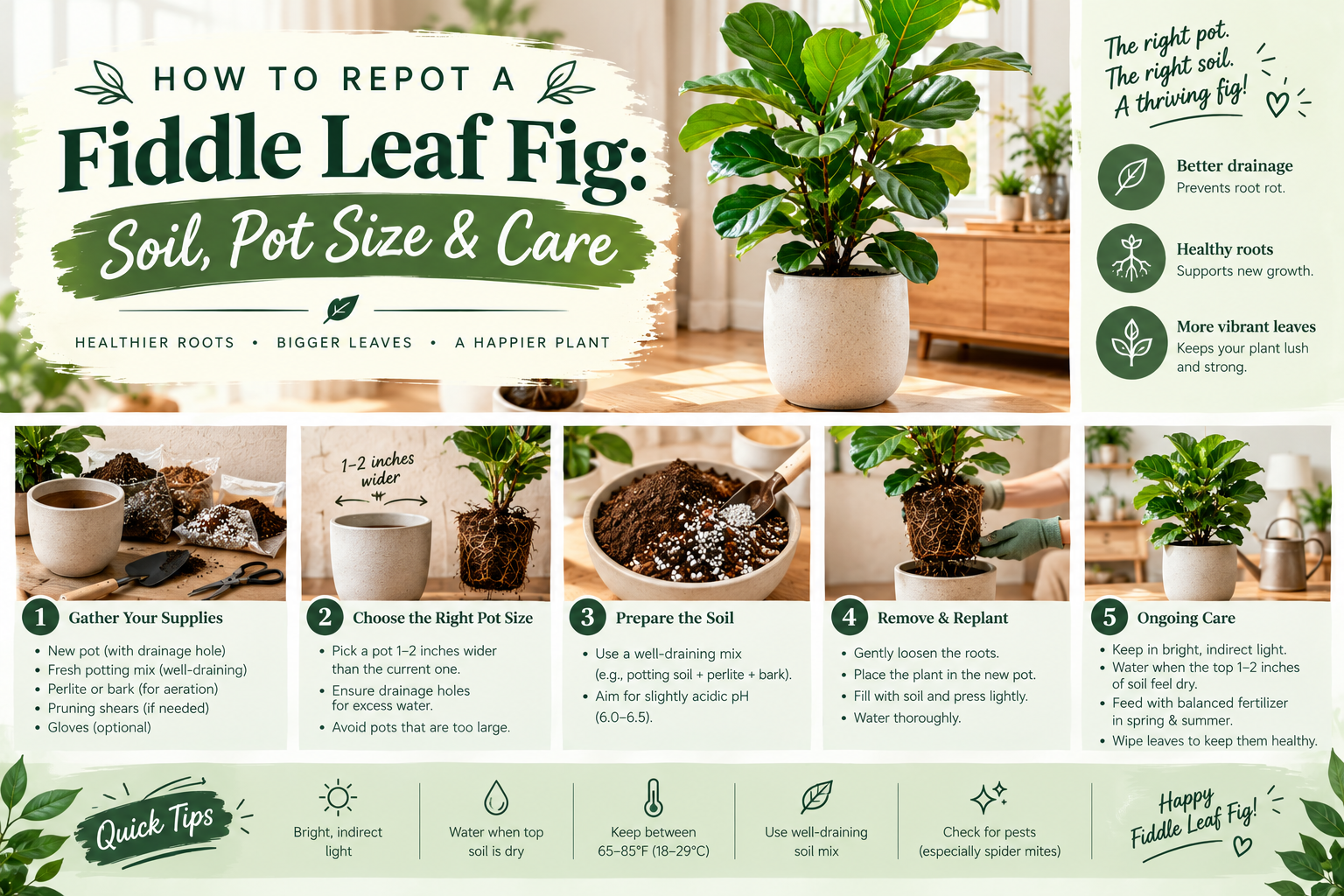
Learning how to repot a fiddle leaf fig is an important part of keeping this popular indoor tree healthy as it grows. A fiddle leaf fig can develop an extensive root system, and eventually its container may become too small to provide adequate space, moisture, and stability.
However, repotting too frequently—or moving a small plant into a dramatically oversized pot—can create more problems than it solves.
The key is knowing when your fiddle leaf fig actually needs repotting, selecting a suitable container, handling its roots carefully, and providing consistent care afterward.
Quick answer: To repot a fiddle leaf fig, choose a container with drainage holes that is usually about 1–2 inches wider than the current pot. Gently remove the plant, inspect its roots, loosen tightly circling roots where necessary, and place it in a well-aerated indoor potting mix. Keep the plant at approximately its original planting depth, water thoroughly, allow excess moisture to drain, and return it to suitable bright, indirect light.
This guide explains when to repot a fig tree, what size container to choose, which soil works best, and how to prevent drooping, leaf drop, and other problems after transplanting.
This article covers the indoor fiddle-leaf fig, Ficus lyrata. Repotting a fruit-producing common fig, Ficus carica, involves different seasonal and growing considerations.
What Does Repotting a Fiddle Leaf Fig Mean?
Repotting means moving an established plant into a different container, usually with fresh growing medium.
Gardeners may also call this transplanting.
For fiddle leaf figs, repotting can improve root space, replace deteriorated potting mix, and provide a more stable container as the tree becomes taller.
Fiddle leaf fig trees are tropical evergreen plants native to western and central Africa.
Their distinctive broad leaves make them popular indoor statement plants, but their upright growth can eventually cause the foliage and trunk to become disproportionately large compared with their pots.
Repotting allows you to address these problems while maintaining healthy growing conditions.
Fiddle Leaf Fig Repotting Quick Guide
| Question | Recommendation |
|---|---|
| Botanical name | Ficus lyrata |
| Best time to repot | Spring or early active growth |
| Typical pot increase | About 1–2 inches wider |
| Large established plants | Assess root ball and stability individually |
| Pot type | Container with drainage holes |
| Soil | Well-draining indoor potting mix |
| Root handling | Gentle loosening; minimal necessary pruning |
| Planting depth | Approximately the same as before |
| Watering afterward | Water thoroughly and drain |
| Light afterward | Bright, indirect light |
| Fertilizer | Avoid unnecessary strong feeding immediately |
| Main risks | Excessively wet soil, root damage, leaf drop |
When Should You Repot a Fiddle Leaf Fig?
A fiddle leaf fig doesn't need repotting simply because a year has passed.
The decision should depend on the condition of its roots, soil, and container.
A healthy plant can remain in the same pot for an extended period if it has adequate root space and suitable growing conditions.
7 Signs Your Fiddle Leaf Fig Needs Repotting
1. Roots Are Growing Through Drainage HolesRoots emerging from the bottom of the container can indicate that the root system has expanded.
A single visible root isn't always an emergency, but several roots growing out of the pot suggest that closer inspection is worthwhile.
2. Roots Are Circling Inside the PotWhen roots have little room to spread, they may begin circling the inner walls of the container.
Remove the plant carefully to inspect the root ball if you suspect this is happening.
3. The Potting Mix Dries Out Unusually FastA densely rooted container may have relatively little growing medium left to retain water.
If the plant requires much more frequent watering than before, check its root system.
However, increased watering frequency can also result from warmer temperatures or brighter light.
4. The Plant Has Become Top-HeavyA tall fiddle leaf fig can become unstable in a narrow or lightweight pot.
A broader or heavier container may help prevent accidental tipping.
5. Growth Has Slowed Despite Good CareStunted growth can indicate restricted roots, although insufficient light and other stresses can cause similar symptoms.
Do not repot based on slow growth alone.
6. The Growing Medium Has DeterioratedOld potting mix may become compacted, poorly aerated, or difficult to rewet.
Refreshing the medium can improve growing conditions even if the plant doesn't require a significantly larger pot.
7. The Existing Pot Is DamagedA cracked container or one with blocked drainage may need replacement.
In such cases, you might choose a new pot of a similar size rather than increasing the diameter.
When Is the Best Time to Repot a Fiddle Leaf Fig?
Spring is generally the most convenient season for repotting indoor houseplants.
As daylight increases, fiddle leaf figs typically begin growing more actively.
New root growth can help the plant establish itself in fresh potting mix.
Can You Repot a Fiddle Leaf Fig in Summer?
Yes, especially if the plant is healthy and actively growing.
Avoid carrying out unnecessary root disturbance during extreme heat.
Can You Repot a Fiddle Leaf Fig in Winter?
It is possible when necessary.
However, winter is often less convenient in homes with reduced daylight and cooler temperatures.
If the plant is healthy and only slightly root-bound, waiting until spring may be preferable.
If its roots are rotting, the pot is broken, or drainage is seriously compromised, corrective repotting may be needed regardless of the season.
What Size Pot Is Best for a Fiddle Leaf Fig?
Choosing the right pot size is one of the most important parts of repotting.
A container that is too small may restrict roots and become unstable.
A container that is too large may hold an excessive volume of wet potting mix around a relatively small root system.
General Pot Sizing Rule
For a healthy indoor fiddle leaf fig, choose a container approximately 1–2 inches wider than the current pot as a practical starting point.
For larger, established trees, the appropriate increase may differ depending on the actual root ball, growth rate, potting medium, and stability requirements.
Avoid choosing a very large pot solely because you want the tree to grow faster.
Fiddle Leaf Fig Pot Size Chart
| Current pot diameter | Example next pot diameter |
|---|---|
| 4 inches | 5–6 inches |
| 6 inches | 7–8 inches |
| 8 inches | 9–10 inches |
| 10 inches | 11–12 inches |
| 12 inches | 13–14 inches |
| 14 inches or larger | Assess roots, stability and soil volume individually |
This table illustrates conservative sizing. It is not a mandatory rule for every plant.
Should You Use a Tall or Wide Pot?
For a tall fiddle leaf fig, consider both the width and weight of the container.
A stable base is important because the tree's large leaves and upright growth can make it top-heavy.
However, simply selecting a tall planter does not guarantee stability.
Evaluate the complete arrangement, including the plant's center of gravity, the weight of the pot, and the potting mix.
Best Pots for Fiddle Leaf Fig Trees
Different pot materials affect moisture retention, weight, and ease of handling.
| Pot material | Advantages | Limitations |
|---|---|---|
| Plastic nursery pot | Lightweight, affordable and easy to move | May be less stable for tall plants |
| Terracotta | Porous and relatively heavy | Potting mix may dry faster |
| Glazed ceramic | Attractive and potentially stable | Can be heavy and difficult to move |
| Fiberglass | Lightweight and available in larger sizes | Stability depends on shape and weight |
| Concrete | Heavy and potentially stable | Difficult to move |
| Decorative cachepot | Conceals a nursery pot | Usually has no drainage itself |
Does a Fiddle Leaf Fig Need Drainage Holes?
Yes. A container with effective drainage holes is strongly recommended.
Without proper drainage, excess water can accumulate around the roots.
Constantly saturated potting mix reduces oxygen availability and may contribute to root rot.
If you prefer a decorative planter without holes, keep the fiddle leaf fig inside a separate nursery pot with drainage.
Remove standing water from the outer container after watering.
Best Soil for Repotting a Fiddle Leaf Fig
Fiddle leaf figs need potting media that retain useful moisture while allowing air and excess water to move through the root zone.
A suitable mix should not remain waterlogged.
Recommended Soil Ingredients
A quality indoor houseplant potting mix can provide the main growing medium.
Perlite helps create air spaces and improves physical structure.
Fine pine bark can add additional texture and aeration.
Coconut coir or peat-based components help retain moisture.
Example DIY Fiddle Leaf Fig Soil Mix
A practical starting recipe is:
Two parts quality indoor potting mix
One part perlite
One part fine pine bark
Adjust the ingredients to the environmental conditions.
For example, a cool room with slower drying may benefit from a more open mixture, while a very warm and bright room may require slightly greater moisture retention.
You don't need a complicated proprietary fertilizer or soil formula to repot successfully.
Can You Use Regular Garden Soil?
Avoid using unmodified outdoor garden soil in indoor containers.
It may compact, drain poorly, and introduce pests or pathogens.
A purpose-made container potting mix is usually a more suitable choice.
Should You Put Rocks in the Bottom of a Plant Pot?
No. A gravel layer beneath potting mix does not automatically improve drainage.
In fact, it can cause water to remain in the finer potting mix above the gravel layer.
This happens because the difference in pore size affects how water moves between materials.
The University of Illinois Extension explains that gravel beneath potting soil can create a perched zone of water rather than eliminating excess saturation.
Better approach: Use drainage holes and an appropriately aerated potting mix throughout the rooting area.
A small piece of mesh over a large drainage hole may help prevent potting mix from escaping, provided the hole remains open.
How to Repot a Fiddle Leaf Fig in 9 Steps
Follow these steps to minimize unnecessary root disturbance.
Step 1: Gather Your Supplies
Prepare a new pot, fresh potting mix, gloves, clean pruning shears, a suitable work surface, and water.
If the tree is large or heavy, arrange assistance before attempting to lift it.
Wear gloves because fiddle leaf fig sap may irritate skin.
Step 2: Choose the Right Location
Repot on a protected floor, table, patio, or another stable surface.
Provide enough room to handle the tree without crushing its large leaves.
Avoid working in intense sunlight or cold, windy conditions.
Step 3: Prepare the New Pot
Check that the new container has functioning drainage holes.
Clean it if previously used.
Add enough lightly moistened potting mix to support the root ball at the correct height.
Don't place a drainage layer of gravel beneath the soil.
Step 4: Remove the Tree From Its Old Container
Support the root ball while gently sliding the plant from the pot.
If it is stuck, squeeze the sides of a flexible nursery pot or tap the container carefully.
Avoid pulling the tree forcefully by its trunk.
For a large plant, ask another person to support the foliage and trunk while you handle the pot.
Step 5: Inspect the Root Ball
Look for healthy firm roots.
Check whether roots are tightly circling the container.
Remove obviously dead, mushy, or damaged roots with clean tools when necessary.
Avoid cutting healthy roots simply because they are visible.
Step 6: Loosen Tightly Circling Roots
Gently tease apart roots that are densely matted around the exterior.
For severely bound root systems, limited corrective pruning may be appropriate.
However, aggressive cutting is not necessary for every fiddle leaf fig.
The goal is to encourage roots to expand into the new potting mix without causing excessive damage.
Step 7: Position the Plant in the New Pot
Place the root ball in the center of the container.
Keep the top of the original root ball at approximately the same planting depth.
Avoid burying the trunk base under a thick layer of soil.
Leave enough space below the pot rim for watering.
Step 8: Add Fresh Potting Mix
Fill the gaps around the root ball.
Gently firm the mix to stabilize the plant.
Do not press so hard that the medium becomes compacted and loses its air spaces.
Check that the tree stands upright.
Step 9: Water and Allow the Pot to Drain
Water the new potting mix thoroughly.
Allow excess water to leave through the drainage holes.
Empty the saucer or outer decorative pot if water accumulates.
Return the fiddle leaf fig to a suitable location with bright, indirect light.
How to Repot a Large Fiddle Leaf Fig Tree
Large fiddle leaf figs require additional attention because of their weight and height.
A tree that reaches several feet tall may be difficult to remove without damaging leaves or stems.
Use a Stable Work Area
Lay the pot on a padded surface if needed and if the plant can be safely handled in that position.
Support the root ball and trunk throughout the process.
Do not lift the tree solely by its branches.
Consider Container Weight
A large fiddle leaf fig may need a heavier, wider pot for stability.
However, a decorative heavy outer planter can sometimes provide stability without requiring an excessively large inner growing container.
Avoid Excessive Root Disturbance
Large plants can be more difficult to recover if a substantial portion of the root system is damaged.
Work gradually and remove only roots that clearly require correction.
Can You Repot a Fiddle Leaf Fig Without Making It Larger?
Yes.
If you want to maintain the tree at approximately its current size, a root-management and potting-mix refresh strategy may be possible.
However, significant root pruning is an advanced technique and should be paired with careful evaluation of plant health and top growth.
For a valuable, mature specimen, consider professional horticultural advice before undertaking severe root reduction.
Should You Water a Fiddle Leaf Fig Immediately After Repotting?
Generally, yes.
Thorough watering helps settle the fresh potting mix around the roots.
Make sure excess water drains freely.
Afterward, do not assume the plant needs watering again on its previous schedule.
A larger container with fresh soil may remain moist longer than the old pot.
How Often Should You Water After Repotting?
Check the potting mix rather than watering every fixed number of days.
Allow the upper portion to dry appropriately before watering again.
The actual interval depends on the new pot size, growing medium, light, humidity, and temperature.
How to Care for a Fiddle Leaf Fig After Repotting
The first few weeks after repotting are an important adjustment period.
Light
Keep the plant in bright, indirect light.
Avoid abruptly moving it into strong direct sunlight.
Temperature
Maintain stable indoor warmth.
Protect it from cold drafts and heating vents.
Watering
Check the actual soil moisture.
Avoid both prolonged drought and constantly saturated conditions.
Fertilizer
Do not rush to add strong fertilizer.
Fresh potting mix may already contain nutrients.
Wait until the plant is established and producing healthy growth before resuming ordinary feeding, taking the product label into account.
Movement
Avoid repeatedly moving the tree around your home.
A consistent location can reduce additional environmental stress.
Fiddle Leaf Fig Drooping After Repotting: Is It Normal?
Temporary drooping can occur after repotting because the root system has been disturbed or the plant is adjusting to different moisture conditions.
However, drooping should not automatically be dismissed as harmless transplant shock.
Check for these potential causes:
Excessively wet potting mix
Insufficient water
Damaged roots
Too much direct sunlight
Temperature fluctuations
Poor drainage
If leaves become progressively limp while the soil remains saturated, inspect the root zone rather than adding more water.
Why Is My Fiddle Leaf Fig Losing Leaves After Repotting?
Leaf drop can result from several types of environmental stress.
Fiddle leaf figs are sensitive to changes in watering, light, and temperature.
Repotting may coincide with one or more of these changes.
Common Causes of Leaf Drop
Root damage: Excessive root cutting can temporarily reduce water uptake.
Overwatering: Fresh soil in a larger pot can stay wet longer than expected.
Underwatering: Disturbed roots may struggle to supply sufficient moisture.
Abrupt relocation: A new window position can change light and temperature.
Preexisting problems: Pests or root disease may have been present before repotting.
What to Do
Maintain consistent growing conditions.
Check moisture before watering.
Remove standing water from decorative pots.
Inspect for pests or root rot if decline continues.
Avoid applying fertilizer as an immediate response to unexplained leaf drop.
Common Fiddle Leaf Fig Repotting Mistakes
| Mistake | Why It Causes Problems | Better Approach |
|---|---|---|
| Choosing a dramatically oversized pot | Excess mix may remain wet | Increase size conservatively |
| Using a pot without drainage | Water may accumulate | Use drainage holes |
| Adding gravel beneath soil | Does not correct poor drainage | Use one suitable mix throughout |
| Cutting too many roots | Can impair water uptake | Correct roots only as necessary |
| Burying the trunk too deeply | Keeps the stem base excessively moist | Maintain planting depth |
| Compacting soil heavily | Restricts airflow | Firm gently |
| Watering on the old schedule | New soil may retain water longer | Check moisture |
| Fertilizing heavily immediately | Adds stress and salt exposure | Wait for establishment |
| Repotting without a real need | Causes unnecessary disturbance | Inspect roots first |
Fiddle Leaf Fig Repotting vs. Propagation
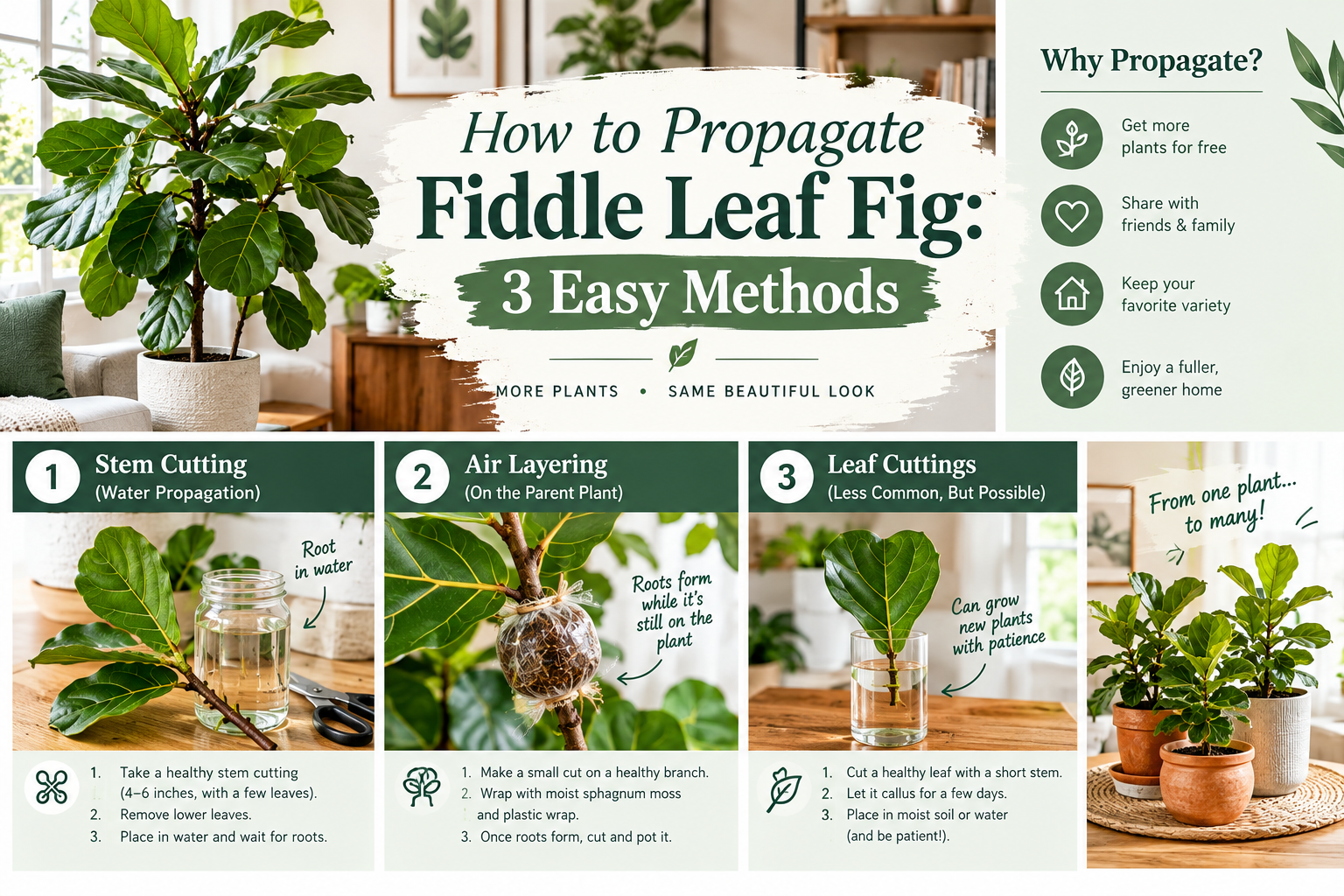
Repotting and propagation are different plant-care processes.
Repotting involves moving an established plant into a different container.
Propagation involves producing a new plant from a stem cutting or another suitable plant part.
You may prune a fiddle leaf fig during its growing season and use suitable healthy stem sections for propagation.
However, heavy pruning and major root disturbance at the same time can place additional stress on the parent plant.
For beginners, it's often easier to space these activities apart.
Frequently Asked Questions About Repotting a Fig Tree
How Do You Repot a Fiddle Leaf Fig Tree?
Choose a slightly larger pot with drainage holes, prepare fresh potting mix, remove the plant carefully, inspect the roots, and position it at its original depth. Fill around the root ball, water thoroughly, and let the container drain.
When Should I Repot My Fiddle Leaf Fig?
Repot when roots are severely crowded, growing through drainage holes, or when the growing mix has deteriorated. Spring is usually the most convenient time.
How Much Bigger Should the New Pot Be?
A container roughly 1–2 inches wider is a practical starting point for many indoor fiddle leaf figs. Very large plants may require individualized sizing and stability assessment.
What Is the Best Soil for Repotting a Fiddle Leaf Fig?
Use a well-draining indoor potting mix. A blend of quality houseplant mix, perlite, and fine bark can provide a suitable balance of moisture retention and aeration.
Can I Repot a Fiddle Leaf Fig in Winter?
Yes, when necessary. However, spring is usually preferable for routine repotting because active growth supports establishment.
Should I Water Immediately After Repotting?
Usually, yes. Water thoroughly to settle the mix, allow it to drain, and then monitor moisture carefully before watering again.
Why Is My Fiddle Leaf Fig Drooping After Repotting?
Possible reasons include root disturbance, excess moisture, insufficient water, or environmental changes. Check the soil and roots rather than assuming all drooping is temporary stress.
Will a Fiddle Leaf Fig Lose Leaves After Repotting?
Some leaf loss can occur, but extensive or continuing leaf drop should be investigated. Check drainage, watering, light, and root health.
Can I Repot a Fiddle Leaf Fig Without Drainage Holes?
Direct planting into a pot without drainage is not recommended. Instead, use a nursery pot with drainage holes inside the decorative container.
Should I Put Rocks in the Bottom of the New Pot?
No. Gravel beneath potting mix does not improve drainage and may create a saturated zone above the gravel.
Can I Use the Same Pot Again?
Yes. If the plant does not need a larger container, you may refresh the potting mix and reuse a clean, appropriate pot. Root pruning, if required, should be approached cautiously.
How Long Does It Take a Fiddle Leaf Fig to Recover From Repotting?
Adjustment time varies. Some plants continue growing with little interruption, while others may need several weeks to reestablish. Continuing decline should prompt inspection rather than simply waiting.
Is Repotting the Same as Propagating a Fig Tree?
No. Repotting relocates an existing plant and its roots. Propagation creates a new plant from suitable plant material, usually a stem cutting for fiddle leaf figs.
Does This Guide Apply to Edible Fig Trees?
No. This article concerns the indoor ornamental fiddle leaf fig, Ficus lyrata. Edible fig trees, Ficus carica, have different growing and transplanting requirements.
Conclusion
Learning how to repot a fiddle leaf fig helps you keep an indoor tree healthy as its roots and foliage grow.
The most important steps are choosing an appropriately sized container, using well-draining potting mix, preserving healthy roots, and maintaining the correct planting depth.
Avoid oversized pots, gravel drainage layers, excessive root pruning, and rigid watering schedules.
After repotting, provide bright indirect light, stable temperatures, and careful moisture management while the plant establishes.
With the right approach, you can give your fiddle leaf fig room to grow without creating unnecessary transplant stress.
Authoritative Sources
Last reviewed: October 17, 2026. Repotting recommendations depend on the root system, growing conditions, container size, and plant health.