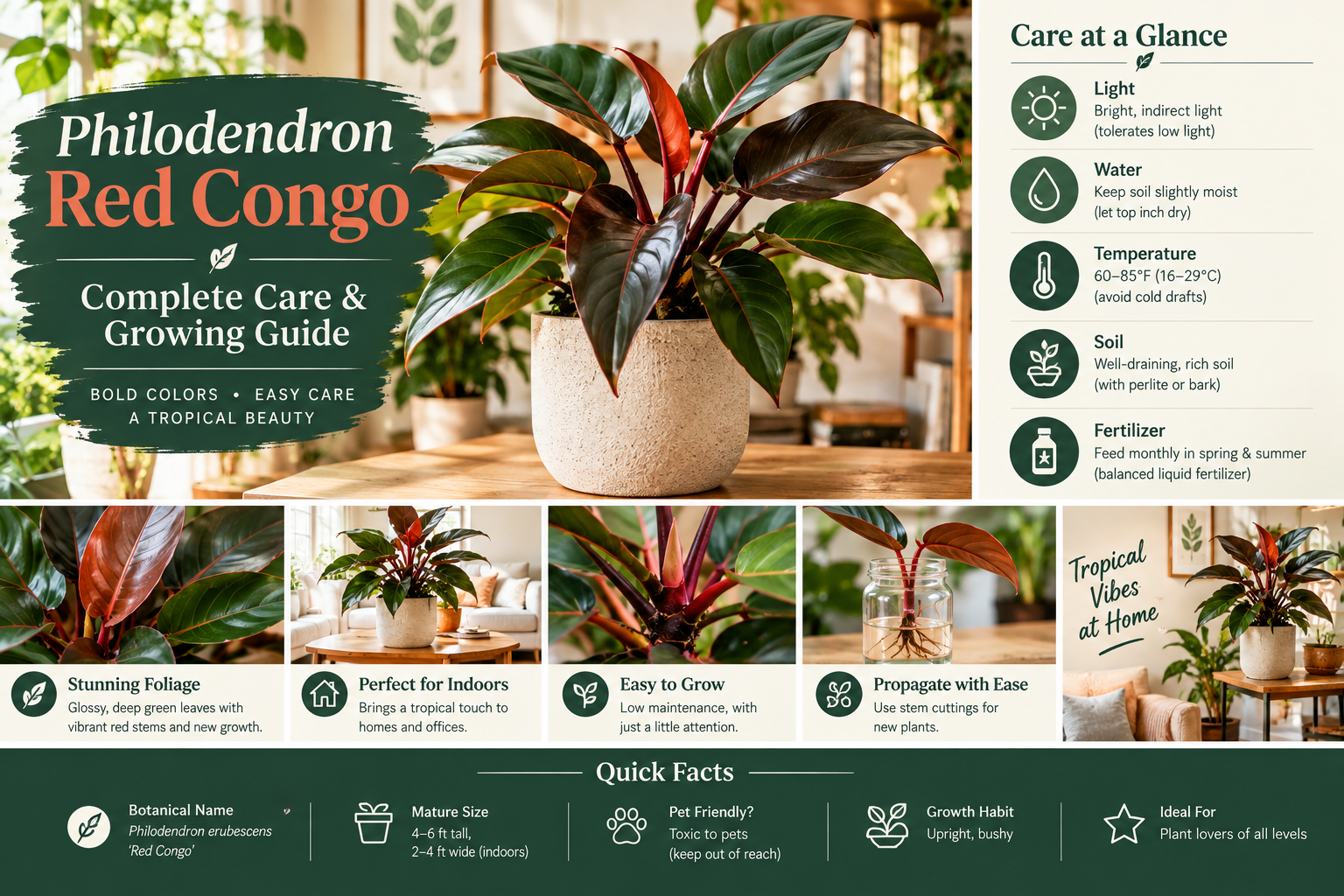
The Philodendron Red Congo is a striking tropical houseplant known for its glossy, dark green leaves, reddish-purple stems, and dramatic burgundy new growth. Also sold as Philodendron Rojo Congo or Congo Rojo, this plant brings bold color to indoor spaces without requiring the climbing support used by many other philodendrons.
Unlike trailing varieties, Red Congo grows in an upright, self-heading form. Its large leaves create a full, sculptural appearance, making it an attractive choice for living rooms, bedrooms, offices, and bright indoor corners.
Although it's relatively easy to maintain under suitable conditions, problems such as yellow leaves, brown spots, poor growth, and overwatering can affect its appearance.
Quick answer: Grow Philodendron Red Congo in bright, indirect light, using a loose potting mix that retains some moisture while draining freely. Water when the upper portion of the mix has dried, keep it away from cold drafts and harsh direct sunlight, and feed lightly during active growth. Avoid leaving its roots in standing water.
This guide explains everything you need to know about Philodendron Red Congo care, including watering, light, soil, humidity, mature size, repotting, propagation, and troubleshooting common problems.
What Is a Philodendron Red Congo?
Philodendron Red Congo is commonly used as a trade name for the hybrid cultivar Philodendron ‘Rojo Congo’, a member of the Araceae family.
The cultivar was developed through a breeding program intended to produce vigorous philodendrons with attractive coloration and self-supporting growth.
Its original US plant patent identifies ‘Imperial Red’ as the female parent and an unidentified Philodendron selection as the male parent.
The plant is especially recognizable for its reddish petioles, large glossy leaves, and upright form.
Philodendron Red Congo Quick Care Guide
| Feature | Care requirement |
|---|---|
| Botanical identity | Philodendron hybrid ‘Rojo Congo’ |
| Common names | Red Congo, Rojo Congo, Congo Rojo |
| Plant family | Araceae |
| Growth habit | Upright, self-heading, non-vining |
| Light | Bright, indirect light |
| Water | Water after the upper potting mix begins to dry |
| Soil | Moisture-retentive but well-aerated potting mix |
| Temperature | Ideally around 65–85°F (18–29°C) indoors |
| Humidity | Moderate indoor humidity; higher humidity can support growth |
| Fertilizer | Diluted balanced houseplant fertilizer during active growth |
| Propagation | Tissue culture commercially; division when offsets exist |
| Toxicity | Toxic if chewed or ingested by pets and people |
Why Does Philodendron Red Congo Have Red Leaves?
The rich coloration of Philodendron Red Congo comes partly from plant pigments called anthocyanins.
New leaves may emerge reddish, coppery, or burgundy before gradually maturing toward deep green.
The plant's petioles often remain dark red or purple-brown, creating contrast against the foliage.
Its appearance depends on genetics, leaf age, light exposure, and growing conditions.
Do Red Congo Leaves Turn Green?
Yes. It is normal for new leaves to become greener as they mature.
An older leaf turning deep green does not automatically mean the plant is unhealthy.
However, prolonged insufficient light may reduce the intensity of the plant's attractive new growth and slow overall development.
If leaves are otherwise firm and healthy, greener mature foliage is usually part of the cultivar's normal appearance.
How Much Light Does Philodendron Red Congo Need?
Bright, indirect light is ideal for maintaining healthy growth and attractive foliage.
The plant can tolerate moderately lower light, but growth may slow and its new leaves may become smaller.
Strong direct sunlight, particularly through hot windows, can scorch the foliage.
Best Indoor Placement
An east-facing window with gentle morning light may be suitable.
Near a south- or west-facing window, place the plant back from intense sunlight or use a sheer curtain.
For north-facing rooms, assess the actual light level. A bright northern exposure may be adequate, while a dark corner may require supplementary grow lighting.
Signs of Too Much Light
Scorched leaves may show pale, tan, or brown patches on surfaces exposed to direct sun.
Damaged tissue generally does not recover its original appearance.
Move the plant into filtered light and monitor new growth.
Signs of Too Little Light
Insufficient light may cause slower growth, smaller leaves, and reduced color intensity.
Move the plant gradually toward a brighter location without exposing it abruptly to intense direct sun.
How Often Should You Water Philodendron Red Congo?
Watering frequency depends on the plant's size, root system, potting mix, season, temperature, and indoor light.
A rigid weekly schedule is less reliable than checking the soil.
How to Check Whether It Needs Water
Insert your finger into the upper 1–2 inches of the potting mix.
If the upper layer feels dry while the deeper mix retains a little moisture, watering may be appropriate.
For a large pot, check deeper moisture as well; a dry surface can hide a saturated root zone.
You can also lift the pot to compare its weight when wet and dry.
How to Water Correctly
Water the potting mix evenly until excess water drains through the bottom.
Allow the pot to finish draining.
Empty any water collecting in a decorative outer pot or saucer.
Avoid keeping the roots constantly saturated.
Does Red Congo Need Less Water in Winter?
Often, yes.
Growth typically slows in cooler, darker months, particularly in the UK, Canada, and northern US states.
Check soil moisture more carefully in winter rather than watering on the same schedule used during summer.
Best Soil for Philodendron Red Congo
Red Congo grows well in a potting medium that combines moisture retention with good aeration.
Its roots need both water and oxygen.
Dense, waterlogged potting mix can contribute to poor root health.
Recommended Potting Mix
A practical starting mixture is:
Two parts quality indoor potting mix
One part perlite
One part fine orchid or pine bark
This is a suggested home-growing blend rather than a required scientific formula.
Adjust the mix according to your environment. A very dry room may need slightly more moisture retention, while a cooler home may benefit from additional aeration.
The University of Florida's commercial philodendron guidance identifies peat, pine bark, perlite, and vermiculite as suitable potting-medium ingredients and emphasizes both water-holding capacity and aeration.
Can You Use Regular Potting Soil?
Yes, provided the product drains adequately.
Adding perlite or bark may improve the structure of a dense mix.
Avoid using ordinary outdoor garden soil in indoor containers, as it may compact and introduce pests.
Philodendron Red Congo Temperature and Humidity
Red Congo is a tropical plant that prefers stable indoor conditions.
It generally performs well in temperatures comfortable for people, roughly 65–85°F (18–29°C).
Avoid prolonged exposure to cold windows, freezing drafts, or excessive heat.
The University of Florida describes warmer production conditions for commercial philodendrons, but commercial greenhouse targets should not be treated as mandatory conditions in a home.
Does Red Congo Need High Humidity?
Moderate household humidity is often sufficient, particularly when watering and light are appropriate.
Higher humidity may support leaf expansion, but it should not come at the expense of airflow.
If your home is very dry during winter, a room humidifier may be useful.
Avoid placing the plant directly above heating vents.
Should You Mist the Leaves?
Misting provides only a temporary increase in surface moisture and is not a dependable long-term humidity solution.
If you use a humidifier, keep it clean and avoid condensation that encourages mold.
How Big Does Philodendron Red Congo Grow?
Philodendron Red Congo is a large, self-heading cultivar.
Unlike a climbing heartleaf philodendron, it develops an upright, outward-spreading form.
The original cultivar patent documented a specimen approximately 76.5 cm (30 inches) tall and 112.6 cm (44 inches) wide under its described growing conditions.
Those measurements are a useful reference, not a guaranteed maximum size.
Indoor size varies with the age of the plant, container, lighting, and other growing conditions.
Does Red Congo Need a Moss Pole?
Usually not.
Its growth habit is self-supporting rather than naturally climbing.
A mature plant may occasionally need temporary physical support if it has been damaged or grows unevenly, but a moss pole is not normally required for healthy Red Congo growth.
Is Philodendron Red Congo Fast Growing?
It can grow vigorously under suitable warmth, light, and care.
Growth will generally slow when light is weak or temperatures are cool.
Do not expect a fixed number of new leaves each month because individual plant conditions differ considerably.
How to Fertilize Philodendron Red Congo
Fertilizer helps replace nutrients used during growth.
However, applying too much can damage roots and cause leaf-tip problems.
Best Fertilizer Type
A balanced houseplant fertilizer is usually suitable.
University of Florida commercial production guidance mentions nutrient ratios such as 3:1:2 or 3:1:3 for foliage production.
These are commercial nutrient-ratio recommendations, not a requirement to buy one exact household fertilizer product.
When to Fertilize
Feed lightly when the plant is actively producing leaves.
Follow the product label and consider starting at a reduced strength for an indoor plant.
Reduce feeding when growth slows.
Avoid fertilizing a severely stressed, newly repotted, or root-damaged plant until conditions improve.
When and How to Repot Philodendron Red Congo
Repot when the plant has outgrown its container or the potting mix has deteriorated.
Common signs include roots circling densely inside the pot, unusually rapid drying, or reduced growth despite otherwise suitable care.
How to Repot
Choose a container with drainage holes, typically 1–2 inches wider than the current pot when an increase is needed.
Prepare fresh, aerated potting mix.
Remove the plant carefully and inspect the roots.
Trim clearly dead or mushy roots using clean tools.
Position the plant at approximately the same depth as before.
Add potting mix around the roots without compacting it excessively.
Water appropriately and allow the pot to drain.
Avoid moving a small plant into a dramatically oversized container because excess unused potting mix may remain wet for too long.
Best Time to Repot
Spring and early summer are often convenient because increasing light and warmth support recovery.
However, a severely root-bound plant or one suffering from unsuitable potting conditions may need attention at another time.
How to Propagate Philodendron Red Congo
Propagation is possible, but Red Congo does not behave like the common climbing heartleaf philodendron.
Commercial growers commonly use tissue culture to produce uniform ‘Rojo Congo’ plants.
Can You Propagate Red Congo From Stem Cuttings?
The short internodes and dense growth habit can make obtaining viable stem sections difficult.
Simply removing a leaf and placing its petiole in water is not a dependable method of growing a new Red Congo.
A viable propagation section must contain tissue capable of producing a new shoot.
Do not cut deeply into the central growing point merely to obtain a cutting.
Propagating by Division
If your established plant produces separate basal shoots with their own roots, division may be possible.
Carefully remove the plant from its pot.
Identify a naturally separable section with sufficient roots and growing tissue.
Use a clean cutting tool if necessary and pot the division in suitable mix.
Not every Red Congo forms separable offsets, so this method is not universally available.
Tissue Culture
Tissue culture is a specialist propagation technique performed under controlled, sterile conditions.
It was the documented propagation method for the original ‘Rojo Congo’ cultivar and helps commercial nurseries produce consistent plants.
For most home growers, purchasing a healthy young plant is easier than attempting laboratory propagation.
Common Philodendron Red Congo Problems and Solutions
Even relatively resilient houseplants can develop problems.
Start by identifying the actual symptom and checking the growing conditions before applying treatments.
| Symptom | Possible Cause | What to Check |
|---|---|---|
| Yellow leaves | Excess water, old foliage, low light or root stress | Soil moisture, drainage and roots |
| Brown crispy edges | Dry conditions, inconsistent watering or salt buildup | Moisture pattern and fertilizer use |
| Large pale-brown patches | Excessive direct sunlight | Window exposure |
| Drooping leaves | Thirst, saturated roots, or temperature stress | Soil and root condition |
| Soft stems or black roots | Possible root rot | Drainage and damaged root tissue |
| Small new leaves | Limited light, nutrients or root space | Growing conditions |
| Sticky leaves | Possible sap-feeding pests | Leaf undersides and petioles |
| No new leaves | Low light, cool temperature or stress | Light and seasonal conditions |
Why Are My Red Congo Leaves Turning Yellow?
Yellowing can have more than one cause.
An occasional older leaf turning yellow is not always alarming.
Several yellowing leaves combined with persistently wet potting mix may indicate excessive moisture or root problems.
Check drainage and inspect the roots if necessary.
Avoid adding more water simply because foliage looks unhappy.
Why Does My Red Congo Have Brown Spots?
Brown spots may result from sun scorch, watering stress, physical damage, or disease.
Large dry patches on sun-exposed leaves suggest light damage.
Soft, spreading lesions can indicate a different problem and may require isolation and more careful assessment.
Remove badly damaged foliage only when appropriate; avoid unnecessary heavy pruning.
Why Is My Red Congo Drooping?
Drooping can occur when a plant is too dry, but saturated roots can produce similar symptoms.
Check the potting mix before watering.
If the soil is dry and the plant is otherwise healthy, water thoroughly.
If the mix is wet and the plant continues to wilt, investigate root health and drainage.
Red Congo Philodendron Pests
Indoor philodendrons can be affected by spider mites, mealybugs, scale insects, and thrips.
Inspect new plants before placing them near existing houseplants.
Check leaf undersides, petioles, and emerging foliage.
If pests appear, isolate the affected plant and identify the pest before choosing a treatment.
Wiping foliage or using a properly labeled insecticidal soap may help with certain infestations.
Always follow product instructions and test treatments carefully because leaves can be sensitive.
Red Congo vs. Imperial Red vs. Black Cardinal
These three philodendrons are frequently confused because of their dark foliage and compact appearance.
| Feature | Red Congo / Rojo Congo | Imperial Red | Black Cardinal |
|---|---|---|---|
| Growth habit | Self-heading | Self-heading | Self-heading |
| New foliage | Often reddish or burgundy | Commonly coppery to reddish | Commonly dark red to bronze |
| Mature foliage | Dark green with dark petioles | Generally green to dark green | Often very dark green to near-black |
| Main appeal | Large glossy leaves and red petioles | Compact, colorful foliage | Particularly dark foliage |
| Support required | Generally no | Generally no | Generally no |
Appearance varies with cultivar authenticity, plant maturity, and light conditions.
Some commercial labels use names inconsistently, so the original cultivar description is more reliable than leaf color alone.
Is Philodendron Red Congo Toxic to Cats and Dogs?
Yes. Philodendrons contain insoluble calcium oxalate crystals and should be treated as toxic if chewed or ingested by cats, dogs, or people.
Possible effects include oral irritation, drooling, vomiting, and difficulty swallowing.
Keep the plant out of reach of pets and children.
The sap can also irritate sensitive skin, so gloves are useful when pruning or repotting.
If a pet chews the plant, contact a veterinarian or animal poison-control service promptly.
Do not attempt home remedies without professional advice.
Can Philodendron Red Congo Grow Outdoors?
Red Congo can be grown outdoors in suitable warm conditions, but it is not frost-hardy.
In much of the United States, United Kingdom, and Canada, it is best maintained as an indoor plant or moved outdoors only during appropriately warm weather.
If placing it outside temporarily, introduce outdoor light gradually.
Shelter it from strong midday sunlight and cold nights.
Check for pests before bringing the plant indoors again.
Outdoor suitability depends on actual local conditions rather than country alone.
Philodendron Red Congo Care Tips for Every Season
Spring
Inspect the root system, resume light feeding when growth increases, and consider repotting if necessary.
Summer
Monitor soil moisture more often in warm, bright conditions.
Protect foliage from excessive direct sun and hot window glass.
Autumn
As daylight decreases, reassess watering frequency.
Move the plant if seasonal sunlight begins striking leaves more directly.
Winter
Avoid cold drafts and waterlogged soil.
Reduce fertilization when growth slows.
Maintain adequate indoor light, especially in northern regions with short winter days.
Frequently Asked Questions
How Do You Care for a Philodendron Red Congo?
Provide bright indirect light, a well-draining but moisture-retentive mix, and stable indoor warmth. Water after the upper soil begins drying and feed lightly during active growth.
Is Philodendron Red Congo Easy to Care For?
It is generally manageable for beginners when given suitable light, drainage, and watering. Overwatering and strong direct sun are common preventable problems.
How Often Should I Water Philodendron Red Congo?
Check the upper potting mix and water when it has dried sufficiently. Frequency depends on pot size, light, temperature, humidity, and season rather than a fixed number of days.
Does Red Congo Need Direct Sunlight?
No. Bright indirect light is preferable. Strong direct sunlight can scorch the leaves.
How Big Can a Red Congo Philodendron Get?
It can develop a substantial upright, spreading form. The original cultivar patent documented a specimen around 30 inches tall and 44 inches wide under specified growing conditions, but individual plants vary.
Is Red Congo a Climbing Philodendron?
No. It is a self-heading hybrid that normally supports its own growth without a moss pole.
Why Is My Red Congo Turning Green?
New reddish leaves naturally mature toward deeper green. Light conditions also influence foliage appearance.
What Soil Is Best for Red Congo?
A loose, aerated houseplant mix containing ingredients such as bark and perlite is suitable. It should retain some moisture without remaining saturated.
Can You Propagate Red Congo in Water?
Not as easily as climbing philodendrons. A detached leaf alone is not a reliable propagule. Viable stem tissue is necessary, and tissue culture is widely used commercially.
Is Red Congo Toxic to Pets?
Yes. Philodendrons contain insoluble calcium oxalate crystals and can cause painful oral irritation if pets chew them.
Why Is My Red Congo Not Growing?
Slow growth may relate to insufficient light, cooler temperatures, root restriction, seasonal changes, or other stress. Review overall care before adding fertilizer.
How Do You Make Red Congo Bushier?
Its natural growth habit is already compact and self-heading. Focus on suitable light and healthy growth rather than heavily cutting the central growing point.
Conclusion
Philodendron Red Congo is an attractive tropical houseplant that combines glossy foliage, dramatic reddish petioles, and a self-supporting growth habit.
Its care is straightforward when you understand the basics: bright indirect light, consistent warmth, a properly aerated potting mix, and careful watering.
Avoid strong direct sunlight and constantly wet roots. Repot only when needed, fertilize moderately, and monitor leaves for early signs of stress.
With suitable conditions, this distinctive philodendron can become a beautiful statement plant in a home or office.
Authoritative References
Last reviewed: October 17, 2026. Individual plants respond differently depending on their environment, growing medium, and maturity.