A trellis for pot is a simple way to support climbing plants while making your indoor or outdoor greenery look more organized and attractive. Whether you're growing a Hoya, pothos, climbing philodendron, jasmine, or another vining plant, the right trellis gives its stems a structure to follow.
You don't need expensive gardening accessories or professional woodworking skills to make one. Bamboo stakes, wooden dowels, natural branches, and coated wire can all be used to create functional plant supports.
However, choosing a trellis isn't just about appearance. It should suit the plant's natural climbing habit, fit securely inside the container, and remain stable as the foliage grows.
Quick answer: To make a trellis for a pot, choose three sturdy bamboo stakes or dry wooden branches, insert them carefully around the inside edge of the planter, and tie their tops together with garden twine. Train the plant's vines around the structure using soft ties where necessary. For aerial-root climbers such as pothos and climbing philodendrons, a moss pole or textured support may be more appropriate if you want their roots to attach as they climb.
This guide explains seven DIY trellis designs, how to choose the correct size, which plants benefit from support, and how to install and maintain a potted plant trellis.
What Is a Trellis for a Pot?
A pot trellis is a vertical support structure placed inside or securely attached to a plant container.
Its purpose is to guide climbing or trailing stems upward while helping the plant maintain a manageable shape.
Unlike a large garden trellis fixed to a fence or wall, a potted plant trellis is usually smaller and designed to work with an individual container.
Common designs include bamboo tripods, metal hoops, wooden ladders, fan-shaped frames, and moss poles.
Why Use a Trellis for Potted Plants?
A suitable trellis can help organize long vines, keep stems away from walkways, support decorative plant arrangements, and make vertical growth easier to manage.
For certain climbing plants, an appropriate support also allows their natural attachment structures to function.
However, not every plant needs a trellis. Some trailing species grow perfectly well in hanging baskets or on shelves.
The best choice depends on whether you want the plant to climb, trail, or maintain a particular shape.
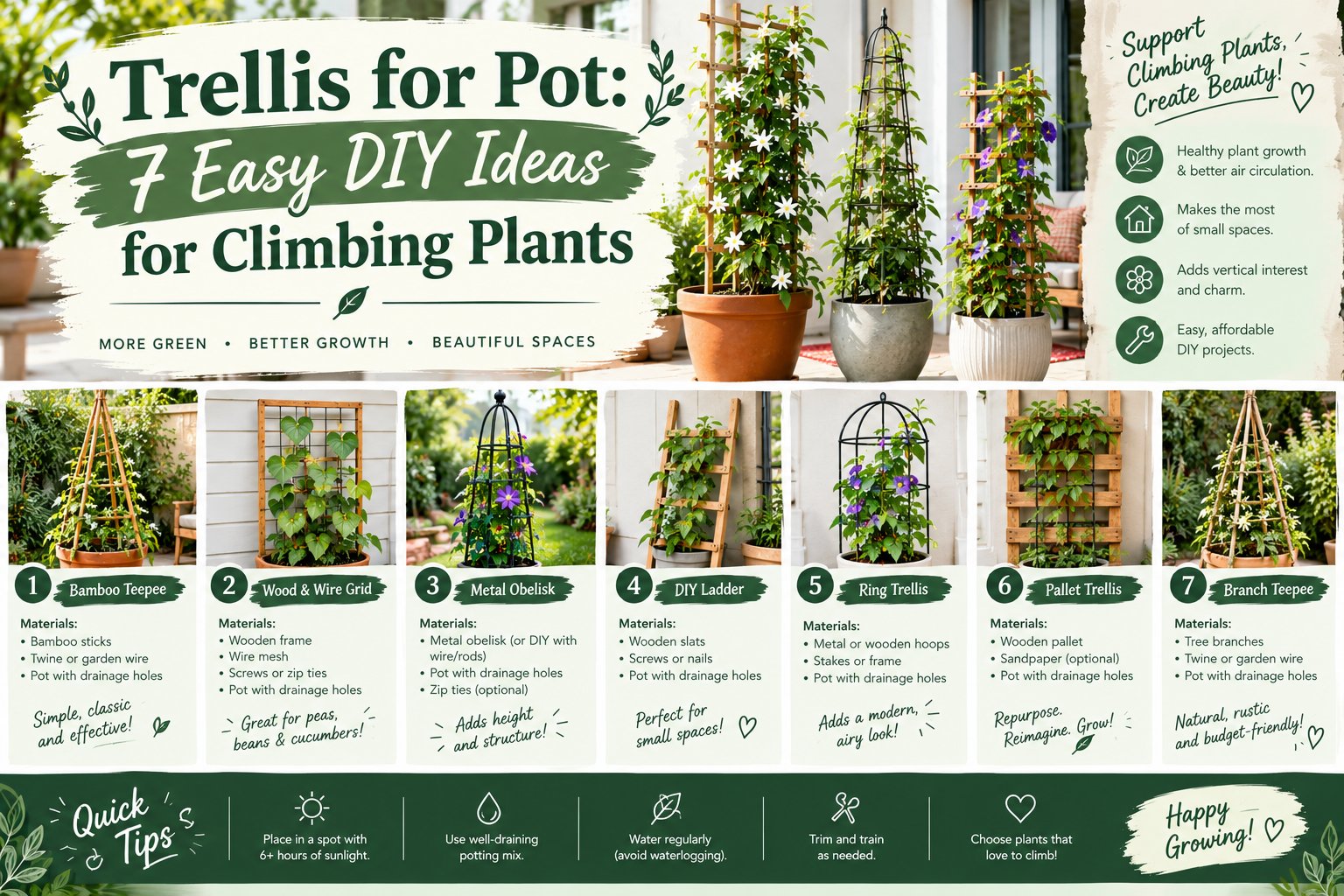
7 Easy DIY Trellis Ideas for Potted Plants
1. Bamboo Tripod Trellis
A bamboo tripod is one of the simplest supports for climbing plants.
It uses three bamboo stakes arranged around the inside edge of a pot.
The stakes meet near the top, forming a stable triangular structure when installed correctly.
Materials: Three bamboo stakes, soft garden twine, pruning shears, and a suitable planter.
Choose stakes that are tall enough for the plant's expected growth but not so tall that the container becomes unstable.
Insert the stakes carefully and tie them securely near their upper ends.
Train vines around the support without pulling them tightly.
Best for: Hoyas, small climbing vines, and lightweight container plants.
2. Natural Branch Trellis
A natural branch trellis is ideal if you prefer a rustic or organic appearance.
Choose sturdy, clean, dry branches with relatively smooth surfaces.
Avoid rotten, brittle, contaminated, or pest-infested wood.
Arrange two or three branches into a support structure.
Secure the joints with suitable twine or garden wire.
For a more decorative design, use branches with subtle curves.
Best for: Hoya, ornamental indoor vines, and rustic-style houseplant displays.
3. Wire Hoop Trellis
A wire hoop creates a compact support for plants with flexible climbing stems.
You can use a commercially made coated-wire plant hoop or make one from sufficiently sturdy, smooth wire.
Shape the wire into an arch or loop.
Insert its two ends securely into the container, avoiding major roots.
Make sure any cut wire ends are folded, capped, or otherwise made safe.
A hoop trellis is particularly useful when you want vines to circle around one structure instead of growing upward indefinitely.
Best for: Hoya and other lightweight twining houseplants.
4. Wooden Ladder Trellis
A miniature ladder trellis can be made using wooden dowels and horizontal crosspieces.
Its open design creates multiple places to guide stems.
Select untreated or plant-safe materials appropriate for moist environments.
Cut two longer side supports and several short horizontal pieces.
Secure the crosspieces using an appropriate construction method.
Allow adhesives or coatings to cure fully before placing the support near a plant.
Best for: Small ornamental climbers, lightweight vines, and indoor plant displays.
5. Fan-Shaped Trellis
A fan trellis spreads stems across a wider area instead of concentrating growth around one narrow pole.
It works well when a plant needs more horizontal training space.
Use several thin, sturdy bamboo stakes or appropriate wooden strips.
Arrange them so they spread outward from the lower section.
Secure the structure with horizontal ties or crosspieces.
The finished support should remain balanced and firmly anchored.
Best for: Selected flowering container climbers and plants trained across a wider surface.
6. Moss Pole for Climbing Houseplants
A moss pole is different from an ordinary decorative trellis.
It provides a textured, potentially moisture-retentive surface that certain climbing plants can grip with aerial roots.
The Royal Horticultural Society recommends moss poles for climbing philodendrons and suitable related plants.
A DIY moss pole may use a rigid core and an appropriate sustainably sourced moisture-retentive covering.
Install it securely and train the plant so its root-producing nodes face the support.
Best for: Climbing philodendrons, pothos, and suitable Monstera species.
A moss pole isn't necessarily the best choice for Hoyas, which can often be trained around simple loops or tripods.
7. Mini Obelisk Trellis
A mini obelisk is a decorative, tower-shaped plant support.
It usually consists of three or four vertical stakes connected by horizontal supports.
The structure narrows toward the top.
Choose dimensions that match the container and plant.
Secure all joints before installing.
For large outdoor plants, use stronger materials and consider anchoring the structure beyond the pot itself.
Best for: Decorative container vines and selected outdoor climbing plants.
Which Trellis Is Best for Different Plants?
Not all climbing plants attach to supports in the same way.
Some wrap their stems around narrow structures.
Others use aerial roots to grip textured surfaces.
Some plants need to be tied loosely because they don't naturally attach to a simple trellis.
| Plant | Preferred support | Important consideration |
|---|---|---|
| Hoya | Wire hoop, tripod, or small trellis | Flexible stems may be guided around supports |
| Pothos | Moss pole or textured support | Aerial roots can attach under suitable conditions |
| Climbing philodendron | Moss pole or suitable vertical support | Support can encourage natural climbing growth |
| Monstera deliciosa | Sturdy moss pole or climbing board | Mature foliage can become heavy |
| Indoor jasmine | Hoop or small trellis | Requires suitable light and training |
| Sweet peas in containers | Netting or fine trellis | Tendrils need suitable gripping points |
| Compact climbing beans | Sturdy outdoor support | Requires adequate pot volume and anchoring |
| Flowering annual climbers | Fan or obelisk trellis | Choose according to mature plant size |
The Royal Horticultural Society confirms that Hoyas can be trained around wire loops or tripods, while climbing philodendrons commonly benefit from moss poles.
How to Make a Bamboo Trellis for a Pot: Step-by-Step
This simple DIY method is ideal for beginners.
Materials You'll Need
Gather three untreated bamboo stakes or other suitable supports, garden twine, scissors, and a pot containing a lightweight climbing plant.
For a small indoor plant, the stakes might be around 12–24 inches long, depending on the pot and the desired appearance.
These are example sizes, not universal requirements.
Step 1: Measure the Pot and Plant
Measure the pot's diameter and estimate how much vertical space the plant needs.
Choose a support that won't make the entire container top-heavy.
If the plant has long, vigorous vines, consider whether a wider or heavier container is needed.
Step 2: Prepare the Stakes
Inspect each stake for splinters, sharp edges, or damage.
Trim them to a suitable length if necessary.
Make sure the materials are clean and structurally sound.
Step 3: Plan the Placement
Position the three stakes around the inside of the pot, forming a triangle.
Avoid placing them directly through the center of an established root ball.
If the roots are dense, it may be safer to install the support during repotting.
Step 4: Insert the Stakes
Press each stake carefully into the potting mix.
Do not force a thick stake through obvious resistance.
If needed, remove the plant during repotting and position the support before adding the final potting mix.
Step 5: Tie the Tops Together
Bring the upper ends together.
Wrap suitable garden twine around the joining point and tie it firmly.
Check that the structure doesn't wobble excessively.
Step 6: Guide the Vines
Carefully lift the plant's flexible vines toward the trellis.
Wind suitable stems loosely around the stakes.
Use soft plant ties where necessary.
Do not force woody or brittle stems into sharp bends.
Step 7: Check the Final Balance
Lift or move the container carefully to determine whether it remains stable.
Water the plant according to its normal needs.
Check whether the pot becomes less stable when the soil dries or the foliage grows.
Adjust the support if necessary.
How Tall Should a Trellis for a Pot Be?
The correct trellis height depends on the plant, container and available space.
A small Hoya in a compact pot may need only a short hoop or tripod.
A vigorous climbing philodendron may benefit from a taller support that can be extended as the plant grows.
A large outdoor climber may require anchoring beyond the container itself.
Illustrative Size Guide
| Container diameter | Possible starting support | Typical use |
|---|---|---|
| 4–6 inches | 8–16 inches tall | Small lightweight vines |
| 6–8 inches | 12–24 inches tall | Hoyas and compact climbers |
| 8–12 inches | 18–36 inches tall | Established houseplant vines |
| 12+ inches | Plant-specific structure | Larger or heavier climbers |
These are approximate design examples, not engineering or stability standards.
Trellis height should never be chosen from pot diameter alone.
Consider pot weight, plant mass, root development, the center of gravity, and exposure to wind or accidental contact.
How to Keep a Pot Trellis Stable
Stability is particularly important for tall climbing plants.
A trellis that looks attractive when newly installed may become unstable as its foliage grows.
Choose an Appropriate Container
Use a sufficiently broad and stable planter.
A heavy ceramic pot may resist tipping better than a lightweight container of similar dimensions, but adequate drainage remains important.
Install the Support Securely
Position stakes deep enough for their intended load without damaging the roots.
For larger outdoor structures, use independent anchoring where necessary.
Avoid Excessive Top Weight
Don't attach heavy decorations or guide all the vines to one side.
Distribute plant growth where possible.
Consider Outdoor Wind Exposure
Wind can place considerable force on tall, leafy plants.
An outdoor trellis may require stronger materials or anchoring than a comparable indoor support.
Can You Add a Trellis Without Repotting?
Yes, but proceed carefully.
Small supports can sometimes be inserted near the inside edge of an existing pot.
Avoid forcing stakes through the root mass.
If the container is crowded with roots, consider waiting until repotting or using an externally supported structure.
A plant that is already stressed by root damage may respond poorly to additional disturbance.
For larger supports, repotting may provide a better opportunity to position the trellis securely.
Trellis vs. Moss Pole: What's the Difference?
A traditional trellis primarily provides a physical frame for climbing or training stems.
A moss pole can provide both structural support and a textured surface for aerial roots.
| Feature | Pot trellis | Moss pole |
|---|---|---|
| Main purpose | Support and train stems | Support and encourage aerial-root attachment |
| Common materials | Bamboo, wood, wire, metal | Rigid core with moss or suitable covering |
| Best for | Hoyas, twining vines, decorative training | Pothos, climbing philodendrons, selected Monsteras |
| Maintenance | Check ties and stability | Check moisture, condition and stability |
| Appearance | Hoop, ladder, fan, tripod | Usually a vertical column |
| Space needed | Varies by design | Often more vertical |
If your plant naturally climbs with aerial roots, a moss pole may be beneficial.
If it wraps its stems around narrow supports, a simple trellis may be more practical.
How to Train Climbing Plants on a Trellis
Start training when the stems are still flexible.
Gently move a vine toward the support without pulling at its base.
Use soft plant ties to hold it temporarily.
Leave space between the tie and the stem to prevent constriction.
Check the ties as the plant grows.
Remove or loosen them before they cut into expanding stems.
Some plants naturally wrap around supports. Others require periodic guidance.
For a climbing plant that produces aerial roots, position the root-bearing side of the stem toward a suitable attachment surface.
Best Materials for Indoor Plant Trellises
| Material | Main advantage | Possible drawback |
|---|---|---|
| Bamboo | Lightweight, natural appearance | Can degrade over time |
| Dry branches | Low cost, organic style | Quality and pest concerns |
| Wooden dowels | Easy to customize | May absorb moisture |
| Coated metal wire | Flexible design and durability | Must avoid sharp ends |
| Commercial metal frame | Strong and reusable | Heavier appearance or higher cost |
| Moss-covered pole | Supports suitable aerial-root climbers | Requires additional maintenance |
| Plastic-coated frame | Lightweight and easy to clean | Appearance may not suit every interior |
Choose clean, stable, non-toxic materials appropriate for contact with moist potting mix.
Avoid treated wood or salvaged materials of uncertain chemical composition.
How Much Does a DIY Pot Trellis Cost?
A DIY trellis can be inexpensive when made from existing supplies.
| DIY design | Illustrative materials budget |
|---|---|
| Small natural branch tripod | $0–$10 |
| Bamboo tripod | $3–$15 |
| Simple wire hoop | $3–$15 |
| Wooden ladder | $5–$20 |
| Mini obelisk | $10–$30 |
| DIY moss pole | $10–$30 |
These are general US-dollar planning ranges rather than verified current store prices.
Costs depend on the materials, tools, dimensions, and location.
Common Pot Trellis Problems and Solutions
The Trellis Keeps Leaning
Check whether the support is securely installed and whether the container is stable.
Reduce excessive height or add appropriate anchoring.
The Vines Won't Stay Attached
Identify how the plant naturally climbs.
A Hoya may benefit from a wire hoop, while an aerial-root climber may need a textured pole.
Use soft plant ties rather than tight string around delicate stems.
The Pot Keeps Falling Over
The support may be too tall or the plant too heavy for the container.
Choose a wider, heavier container or an independently anchored support.
The Stems Are Breaking
Avoid forcing mature or woody stems into sharp bends.
Train new flexible growth gradually.
The Trellis Is Rotting
Natural wood can deteriorate in damp growing media.
Replace damaged supports with clean, suitable materials.
The Plant Is Not Growing Upward
A trellis does not replace adequate light, water, nutrition, and suitable temperature.
Review the plant's overall care and natural growth habit.
Indoor vs. Outdoor Pot Trellises
Indoor supports are usually protected from wind and harsh weather.
Outdoor supports must withstand rainfall, sunlight, wind, and the greater weight of some flowering or edible climbing plants.
For outdoor containers, select weather-resistant materials and provide appropriate anchoring.
Never assume an indoor decorative tripod can support a mature outdoor vine.
The University of Georgia Extension emphasizes adequate drainage, container size, and proper growing media when selecting containers for plants.
Frequently Asked Questions About Trellises for Pots
How Do You Make a Trellis for a Pot?
Insert three suitable bamboo stakes or branches around the inner edge of a planter, bring their tops together, and secure them with garden twine. Guide the climbing stems around the structure using soft ties when necessary.
Can You Put a Trellis in Any Pot?
Not always. The pot must be sufficiently stable and large enough for the support without excessive root damage or tipping risk.
What Is the Best Trellis for Indoor Plants?
The best choice depends on the plant. Hoyas often work well on hoops or tripods, while climbing philodendrons and pothos may benefit from textured moss poles.
How Tall Should a Trellis Be for a Potted Plant?
Choose a height that accommodates expected growth without making the container unstable. A small indoor plant may use a support around 12–24 inches tall, but larger plants require individual assessment.
Can You Make a Trellis From Tree Branches?
Yes. Choose clean, dry, sturdy branches that are free of pests and decay. Secure them properly and inspect them over time.
Is Bamboo Good for a Pot Trellis?
Bamboo is lightweight, widely available, and suitable for many small climbing plants. Replace it if it becomes weak or deteriorates.
Do Pothos Plants Need a Trellis?
Pothos can grow as trailing plants without one. A suitable climbing support provides another growth option and may help the plant develop a more mature climbing habit.
Do Hoyas Prefer to Climb or Hang?
Many Hoyas can either climb or trail. The Royal Horticultural Society recommends wire loops and tripod supports for suitable Hoya species.
Can You Add a Trellis Without Repotting?
Yes, if the support can be installed without significantly damaging the roots. For larger structures or heavily rooted containers, repotting may be preferable.
What Is Better: A Moss Pole or a Trellis?
A moss pole is often useful for aerial-root climbers, while a traditional trellis suits twining or manually trained plants. Choose according to the species.
How Do You Secure Vines to a Trellis?
Use soft plant ties or suitable clips. Leave enough space for stem expansion and inspect the attachments regularly.
Can You Use a Pot Trellis Outdoors?
Yes, but outdoor structures must withstand wind and weather. Larger climbing plants may need a stronger, independently anchored support.
Conclusion
A trellis for pot can make climbing plants easier to manage while creating an attractive indoor or outdoor display.
Simple designs made from bamboo, natural branches, wood, or wire can support lightweight vines without requiring expensive materials.
The most important step is choosing a structure suited to the plant's natural growth habit.
Hoyas may thrive on hoops or tripods, while climbing philodendrons and pothos can benefit from textured supports that encourage aerial-root attachment.
Before installing a trellis, consider its height, the pot's stability, root placement, and future plant growth.
With a suitable structure and careful training, you can transform an ordinary potted vine into an attractive vertical plant display.
References and Further Reading
Last reviewed: October 17, 2026. Support dimensions and material costs are illustrative. Choose structures based on actual plant weight, container stability and growing conditions.