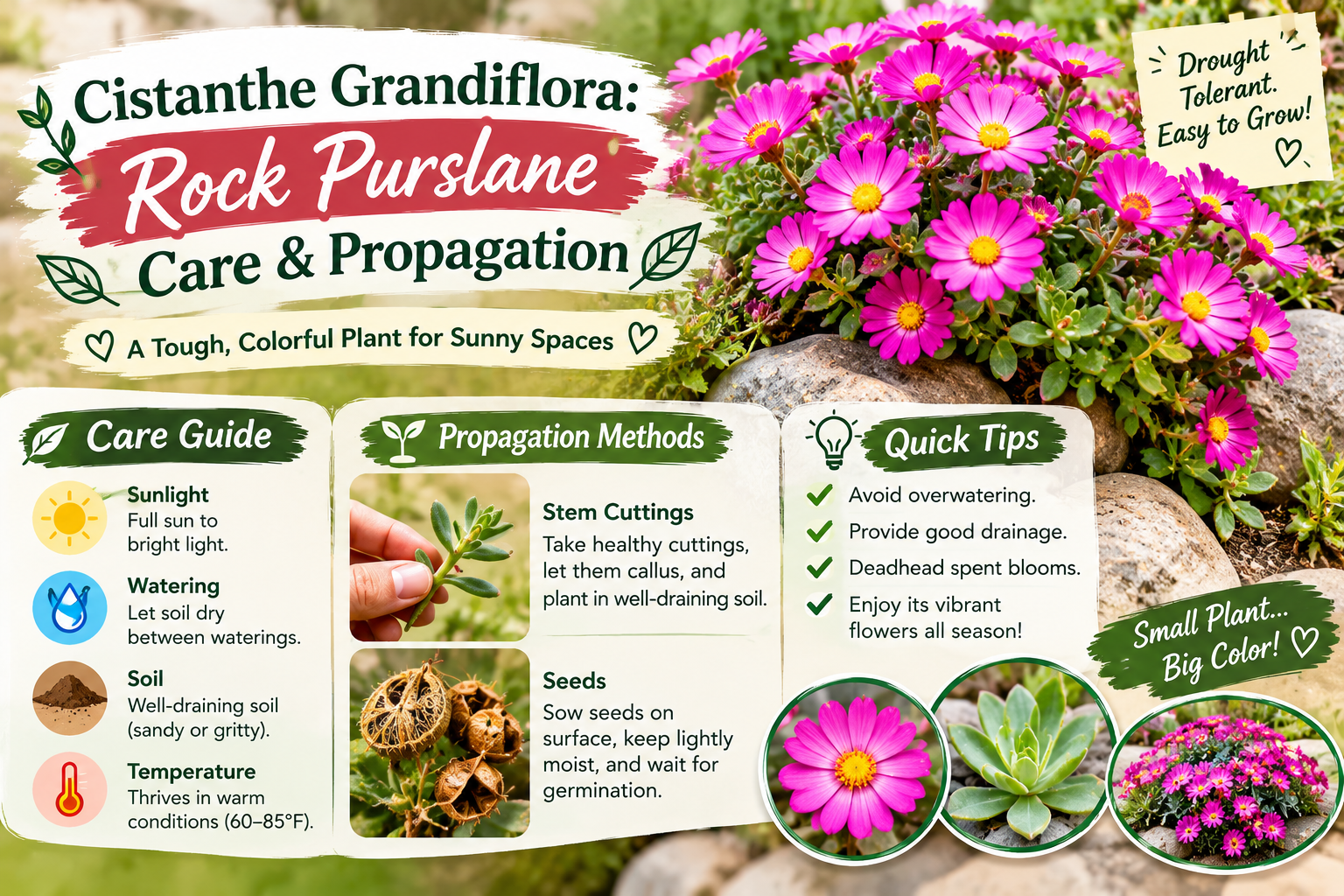
Cistanthe grandiflora, commonly known as rock purslane, is a beautiful flowering succulent recognized for its blue-green leaves and vibrant pink-purple flowers. Native to Chile, this drought-tolerant perennial is especially attractive in sunny gardens, gravel landscapes, rock gardens, and well-drained containers.
Unlike many succulents grown mainly for their foliage, rock purslane produces delicate, cup-shaped flowers on slender stems rising above its fleshy leaves. Its long flowering season makes it a distinctive addition to Mediterranean-inspired and water-wise gardens.
Although it is relatively easy to grow under suitable conditions, successful care depends on good soil drainage, appropriate sunlight, and avoiding excessive watering.
Quick answer: Grow Cistanthe grandiflora in full sun or a bright position with afternoon shade in very hot climates. Use well-drained soil, water young plants while they establish, and reduce irrigation once roots are established. Propagate healthy stems using a porous rooting mix, allow cut surfaces to dry appropriately, and protect young plants from excessive moisture and freezing weather.
This guide covers rock purslane identification, light, watering, soil, flowering, mature size, pruning, stem propagation, and common growing problems.
What Is Cistanthe Grandiflora?
Cistanthe grandiflora is a succulent perennial or subshrub in the Montiaceae family.
It is native to northern and central Chile, where it grows in relatively dry environments.
The plant develops clusters of fleshy, gray-green to blue-green foliage and sends up slender flowering stems bearing vivid magenta or purple-pink flowers.
These flowers provide striking contrast against the more subdued foliage.
Cistanthe Grandiflora Quick Care Guide
| Feature | Growing information |
|---|---|
| Botanical name | Cistanthe grandiflora |
| Synonym | Calandrinia grandiflora |
| Common name | Rock purslane |
| Family | Montiaceae |
| Native range | Northern and central Chile |
| Plant type | Succulent perennial or subshrub |
| Light | Full sun; some afternoon protection in intense heat |
| Water | Low once established, depending on conditions |
| Soil | Well-drained sandy, gritty or amended soil |
| Flowers | Pink-purple to magenta |
| Blooming | Often extended in suitable warm climates |
| Propagation | Stem cuttings |
| Winter care | Protect from severe or prolonged freezing |
| Best uses | Rock gardens, containers, slopes and water-wise landscapes |
Cistanthe Grandiflora vs. Calandrinia Spectabilis
One confusing aspect of rock purslane is its botanical naming.
Gardeners may encounter labels such as Cistanthe grandiflora, Calandrinia grandiflora, Calandrinia spectabilis, and Cistanthe laxiflora.
Although these names are sometimes used interchangeably in horticultural commerce, they do not all represent the same accepted species.
According to Kew's Plants of the World Online:
Cistanthe grandiflora is an accepted species.
Calandrinia grandiflora is a synonym of Cistanthe grandiflora.
Calandrinia spectabilis is a synonym of Cistanthe laxiflora.
Cistanthe laxiflora is recognized separately from Cistanthe grandiflora.
Both closely related plants can be sold as rock purslane.
If you are purchasing a plant for its exact mature size, cold tolerance or growth habit, confirm its botanical identification with a knowledgeable nursery.
The general care principles discussed here apply to C. grandiflora, while similar nursery-sold plants may have slightly different needs.
How Much Sun Does Cistanthe Grandiflora Need?
Rock purslane performs well in sunny locations.
In mild coastal climates, a full-sun position often supports healthy growth and flowering.
In extremely hot inland regions, some protection from intense afternoon sun can help reduce foliage stress.
Best Garden Location
Choose a bright, open planting bed where the soil drains freely.
Rock gardens, raised beds and well-drained slopes can provide suitable conditions.
Avoid deeply shaded locations where growth may become weak and flowering may decrease.
Can Rock Purslane Grow in Partial Shade?
Yes, light afternoon shade can be beneficial in particularly hot environments.
However, excessive shade may reduce flowering and produce stretched stems.
A location with morning sun and some late-day protection can be worth testing in very hot gardens.
Signs of Excessive Sun Exposure
Foliage may develop reddish or brownish stress coloration.
Severe exposure can cause dry or scorched areas.
Before moving a plant, also check soil moisture and overall growing conditions, because color changes are not always caused by sunlight alone.
How Often Should You Water Rock Purslane?
Rock purslane is valued for its drought tolerance, but that does not mean new plants should be left completely dry.
Watering requirements change as the root system develops.
Watering Newly Planted Rock Purslane
After planting, water thoroughly enough to settle the soil around the roots.
Monitor soil moisture during establishment.
Water when the root zone has dried sufficiently, avoiding prolonged saturation.
Newly planted specimens may need additional water during hot or windy weather.
Watering Established Plants
Once established, rock purslane can often thrive with relatively little supplemental irrigation in suitable climates.
However, prolonged extreme heat, container growing, and very sandy soils may increase water requirements.
Check the plant and soil rather than following a rigid weekly schedule.
Signs of Overwatering
Excessively wet soil can lead to soft stems, yellowing foliage and root deterioration.
If the plant declines while the ground remains wet, investigate drainage before adding more water.
Signs of Underwatering
Extended water stress may cause leaves to lose firmness, dry tips or reduced growth.
Succulent plants store water in their tissues, but they still require some moisture to survive and establish.
Best Soil for Cistanthe Grandiflora
Well-draining soil is one of the most important growing requirements.
Rock purslane generally performs best when its roots are not exposed to constant wetness.
Recommended Soil Characteristics
Choose a mix that allows excess water to move away from the root zone.
Sandy or gritty soil can be appropriate where it also provides adequate rooting support.
In containers, use a suitable succulent or cactus potting mix.
Perlite or pumice can improve aeration in some potting media.
Avoid treating one fixed soil recipe as essential for all growing environments.
Can You Grow Rock Purslane in Clay Soil?
Heavy clay can present difficulties when drainage is poor.
Rather than simply mixing a little sand into a clay planting hole, consider a properly designed raised bed, mound or another planting method that addresses the overall drainage conditions.
A planting pocket surrounded by poorly draining clay may still collect water.
How Big Does Cistanthe Grandiflora Grow?
Rock purslane develops a mounding or spreading growth habit.
Its succulent foliage tends to remain relatively low, while flowering stems rise above the leaves.
Exact dimensions vary with plant identity, growing conditions, age and available space.
The related plant commonly sold as Calandrinia spectabilis is often described as producing foliage clumps roughly 12–18 inches tall and around 3 feet wide, with taller flower stems.
However, these measurements should not automatically be assigned to botanically verified Cistanthe grandiflora.
If mature width is important for a narrow border or container, confirm the particular nursery stock's expected dimensions.
Is Rock Purslane a Ground Cover?
It can function as a low, spreading ornamental in suitable climates.
Its foliage may cover exposed soil between taller plants.
Leave adequate spacing for airflow and mature growth.
Monitor its spread near paths and other smaller plants.
When Does Rock Purslane Flower?
Rock purslane is appreciated for its vivid magenta flowers and potentially long blooming season.
In favorable climates, flowering may extend from spring through autumn.
In some mild, frost-free settings, flowering can continue for much of the year.
However, bloom timing depends on the species, local climate, plant maturity, sunlight, and growing conditions.
Why Do Rock Purslane Flowers Close?
Individual flowers may open in brighter daylight and close during lower light or unfavorable conditions.
A closed flower does not necessarily indicate poor health.
Observe the plant throughout the day before assuming it has stopped blooming.
Does Rock Purslane Attract Pollinators?
The colorful flowers can attract visiting insects, including bees.
Their pollinator value depends on the region and species present.
If planting specifically for local biodiversity, combine rock purslane with suitable native flowering plants that provide resources through different seasons.
How to Propagate Cistanthe Grandiflora From Cuttings
Stem cuttings are a practical method for producing additional rock purslane plants.
The technique uses healthy stem sections to form new roots.
Step 1: Choose a Healthy Parent Plant
Select a vigorous plant without obvious rot, severe pest damage or extensive disease.
Avoid taking cuttings from stems that are soft, blackened or heavily damaged.
Step 2: Take a Stem Cutting
Use clean pruning shears.
Choose a healthy stem containing several nodes.
Make a clean cut while leaving enough growth on the parent plant.
A moderate-sized cutting is easier to handle than a very large, heavily branched section.
Step 3: Remove Lower Leaves
Remove any leaves that would be buried in the rooting medium.
This reduces the amount of foliage in contact with moisture and soil.
Retain enough healthy upper foliage to support the cutting.
Step 4: Allow the Cut End to Dry
For succulent stems, a short drying period may help reduce the chance of decay.
Place the cutting in a shaded, airy location until the cut surface is no longer wet.
The appropriate interval varies with stem thickness, temperature and humidity.
Avoid leaving delicate cuttings to shrivel excessively.
Step 5: Prepare the Propagation Medium
Use a small container with drainage holes.
A suitable starting mixture is a propagation medium amended with perlite or pumice.
For example, a roughly equal-parts mixture of suitable potting medium and perlite can provide both moisture retention and aeration.
This is a practical option, not a mandatory formula.
Step 6: Insert the Cutting
Make a hole in the medium using a pencil or dibber.
Place the cutting deep enough to remain stable and position viable lower nodes within the rooting area.
Firm the mix gently around the stem.
Avoid forcing the stem through compacted material.
Step 7: Provide Bright, Filtered Light
Place the cutting somewhere bright but protected from intense direct sunlight.
New cuttings lack established roots and can dehydrate rapidly.
Keep the rooting medium lightly moist when necessary without saturating it.
Step 8: Monitor Root Development
Rooting may begin within a few weeks under suitable conditions.
The competitor reports seeing roots in approximately two to four weeks, although this should be treated as one grower's experience rather than a guaranteed deadline.
Avoid pulling cuttings repeatedly to inspect them.
New growth and increasing stability may indicate successful rooting.
Step 9: Transplant the Rooted Cutting
Once a cutting has developed a functional root system, transfer it to a suitable pot or garden location.
Avoid exposing it abruptly to full afternoon sunlight or prolonged drought.
Gradually adjust watering and light as the plant becomes established.
Can You Grow Rock Purslane From Seeds?
Propagation from seed may be possible where viable seed is available.
However, seed quality, germination conditions and plant identity need to be considered.
Many gardeners find vegetative propagation easier when they already have a healthy parent plant.
If using seed, follow instructions from a reputable supplier and confirm that the material is correctly identified.
Growing Rock Purslane in Pots and Containers
Rock purslane can be attractive in containers because of its succulent foliage and colorful flowers.
Choose a Suitable Pot
Use a container with drainage holes.
A wide container may suit its spreading habit better than a very narrow one.
Avoid excessive pot size relative to the root system.
Select the Right Soil
Choose a free-draining cactus or succulent mix, or another suitable porous potting medium.
Do not use a dense mixture that stays wet for extended periods.
Find a Bright Position
Place the container where it receives substantial natural light.
In very hot regions, protect it from extreme reflected heat when necessary.
Water Container Plants Carefully
Container-grown rock purslane may dry out faster than plants established in the ground.
Check soil moisture regularly, particularly during summer.
Avoid leaving the pot standing in water.
Can Cistanthe Grandiflora Grow Indoors?
Rock purslane is primarily valued as a sunny outdoor ornamental.
Indoor cultivation is more challenging when daylight is insufficient.
A bright sunroom or suitable growing-light setup may support growth, but flowering performance can be less dependable than outdoors.
For indoor growing, provide strong light, a porous potting mix and excellent drainage.
Keep the plant away from cold drafts and avoid frequent watering.
For most gardeners, outdoor containers in suitable weather are the easier option.
Rock Purslane Cold Hardiness and Winter Care
Cold tolerance varies with botanical identity, establishment, soil moisture and the duration of freezing temperatures.
Some horticultural descriptions of rock purslane recommend cultivation in approximately USDA Zone 8 or warmer, but published thresholds vary and may refer to different closely related plants.
Do not rely on one minimum temperature as a guarantee.
Winter Care in Mild Climates
In regions with occasional light frost, established plants may survive outdoors when soil drainage is good.
Monitor local conditions and protect young or exposed plants if unusually cold weather is forecast.
Winter Care in Colder Regions
Gardeners in colder parts of the US, UK or Canada may prefer growing rock purslane as a seasonal container plant.
Move pots to an appropriate protected location before damaging freezes.
Ensure any indoor overwintering location provides sufficient light and does not keep the soil excessively wet.
When and How to Prune Rock Purslane
Pruning can help refresh plants that develop long, bare or untidy stems.
It may also keep growth away from paths and neighboring plants.
Best Time to Prune
Late winter or early spring may be appropriate in climates where the plant survives outdoors.
Wait until the risk of severe frost has passed if substantial new growth would be vulnerable.
How to Prune
Use clean, sharp tools.
Remove dead or damaged stems.
Shorten overly long growth while preserving enough healthy tissue for recovery.
Avoid removing all the foliage from a stressed plant at once.
Should You Deadhead Rock Purslane?
Repeatedly removing individual flower heads is often unnecessary.
Some flower stalks may continue producing new flowers over time.
Avoid cutting an entire active flowering stem merely because one flower has closed or faded.
Remove clearly spent stems when the flowering sequence has finished.
Common Rock Purslane Problems and Solutions
| Problem | Possible cause | Recommended action |
|---|---|---|
| Yellow leaves | Excess moisture, normal aging or root stress | Check drainage and root health |
| Soft stems | Possible rot | Reduce excess moisture and inspect damaged tissue |
| Little flowering | Inadequate light, immature plant or seasonal conditions | Review light and plant maturity |
| Leggy growth | Too much shade or aging stems | Improve light and prune appropriately |
| Brown leaf patches | Strong sun, temperature stress or damage | Check site conditions |
| Poor rooting | Unhealthy cutting or unsuitable moisture | Use clean, healthy stems and porous mix |
| Winter dieback | Frost or cold-wet conditions | Protect vulnerable plants |
| Wilting | Drought or root problems | Check soil before watering |
Why Is My Rock Purslane Not Flowering?
Insufficient sunlight is one possible cause.
A recently propagated plant may also need time to establish.
Review the season, light exposure, root health and general growing conditions.
Why Are the Leaves Turning Yellow?
Yellow foliage can indicate excessive moisture, aging leaves or general stress.
If several stems soften while the soil remains wet, inspect for root or stem rot.
Why Is My Plant Getting Leggy?
Older growth may naturally become more open.
Insufficient light can also contribute to elongated stems.
Appropriate pruning and improved light can help maintain a fuller appearance.
Landscaping Ideas With Cistanthe Grandiflora
Rock purslane can complement several garden styles.
Rock Gardens
Use it alongside suitable drought-tolerant plants and well-drained stone features.
Mediterranean Landscaping
Its foliage and vivid flowers can complement gravel pathways, terracotta pots and silver-leaved shrubs.
Water-Wise Borders
Combine it with plants that have compatible watering requirements.
Sunny Container Displays
Grow it in a wide, well-drained container where the flowering stems have room to develop.
Pollinator-Friendly Gardens
Use it as one flowering element alongside locally appropriate plants that support native insects.
Before planting nonnative ornamentals, check local invasive-plant and environmental guidance.
Cistanthe Grandiflora vs. Common Purslane
Rock purslane should not be confused with common purslane, Portulaca oleracea.
Both have succulent characteristics, but they are different plants.
| Feature | Cistanthe grandiflora | Common purslane |
|---|---|---|
| Botanical family | Montiaceae | Portulacaceae |
| Main ornamental feature | Large pink-purple flowers | Small yellow flowers |
| Typical use | Ornamental succulent | Often regarded as a weed or edible plant |
| Growth form | Mounding or spreading | Low, branching, spreading |
| Garden role | Flowering ornamental | Vegetable or unwanted volunteer |
Do not assume that any plant called purslane is edible.
Confirm the botanical identity before considering any culinary use.
Frequently Asked Questions About Cistanthe Grandiflora
What Is Cistanthe Grandiflora?
Cistanthe grandiflora is a succulent perennial or subshrub native to Chile. It is commonly known as rock purslane and is grown for its blue-green foliage and bright magenta flowers.
Is Cistanthe Grandiflora the Same as Calandrinia Grandiflora?
Yes. Kew Plants of the World Online recognizes Calandrinia grandiflora as a synonym of Cistanthe grandiflora.
Is Calandrinia Spectabilis the Same Plant?
Not under Kew's current taxonomy. Calandrinia spectabilis is treated as a synonym of Cistanthe laxiflora, a separate accepted species. Nursery names are sometimes used inconsistently.
How Do You Care for Rock Purslane?
Plant it in a bright location with well-drained soil. Water during establishment, reduce irrigation as appropriate once established, and protect it from prolonged cold or waterlogged conditions.
Does Rock Purslane Need Full Sun?
It generally performs well in full sun, although some afternoon shade may help in areas with intense summer heat.
Is Rock Purslane Drought Tolerant?
Yes, established rock purslane can tolerate relatively dry conditions. Newly planted specimens still need appropriate moisture while roots develop.
How Do You Propagate Cistanthe Grandiflora?
Take healthy stem cuttings, allow the cut surfaces to dry appropriately, and plant them in a porous rooting medium. Provide bright filtered light and moderate moisture while roots develop.
How Long Does Rock Purslane Take to Root?
Cuttings may begin forming roots within a few weeks under favorable conditions. Rooting time varies with temperature, cutting health and propagation medium.
Can Rock Purslane Grow in Pots?
Yes. Use a well-draining container and a suitable succulent potting mix. Place it in strong light and monitor watering carefully.
Can Rock Purslane Survive Frost?
Some cultivated rock purslane plants tolerate light to moderate frost, but survival depends on plant identity, growing conditions and freeze duration. Protect vulnerable plants during severe cold.
Why Isn't My Rock Purslane Blooming?
Possible causes include inadequate light, seasonal conditions, poor plant health or insufficient maturity. Check the plant's growing environment before making changes.
Should I Deadhead Rock Purslane Flowers?
It is usually unnecessary to remove every faded flower. Flower stems may continue producing new blooms. Remove stems after they are clearly finished.
Can You Grow Cistanthe Grandiflora Indoors?
It may be possible with strong light and careful watering, but it generally performs more reliably as an outdoor plant in suitable climates.
Conclusion
Cistanthe grandiflora, or rock purslane, is a distinctive flowering succulent that combines attractive blue-green foliage with bright pink-purple flowers.
It is especially useful in sunny, well-drained gardens, rock gardens, water-wise landscapes and containers.
Successful care begins with sufficient light, proper drainage and sensible watering. Propagation from healthy stem cuttings can provide additional plants without requiring complicated equipment.
Before buying or propagating rock purslane, confirm its botanical identity, since related species are sometimes sold under overlapping names.
With suitable growing conditions and occasional maintenance, rock purslane can provide striking color and texture in a wide range of ornamental gardens.
Authoritative References
UC Master Gardeners — Mixed Mediterranean and California Native Garden
Greenhouse Garden Design — Care and Propagation of Rock Purslane
Last reviewed: October 17, 2026. Rock purslane names are used inconsistently in horticultural commerce. Check the plant's identity, growing conditions and local climate before applying species-specific care recommendations.