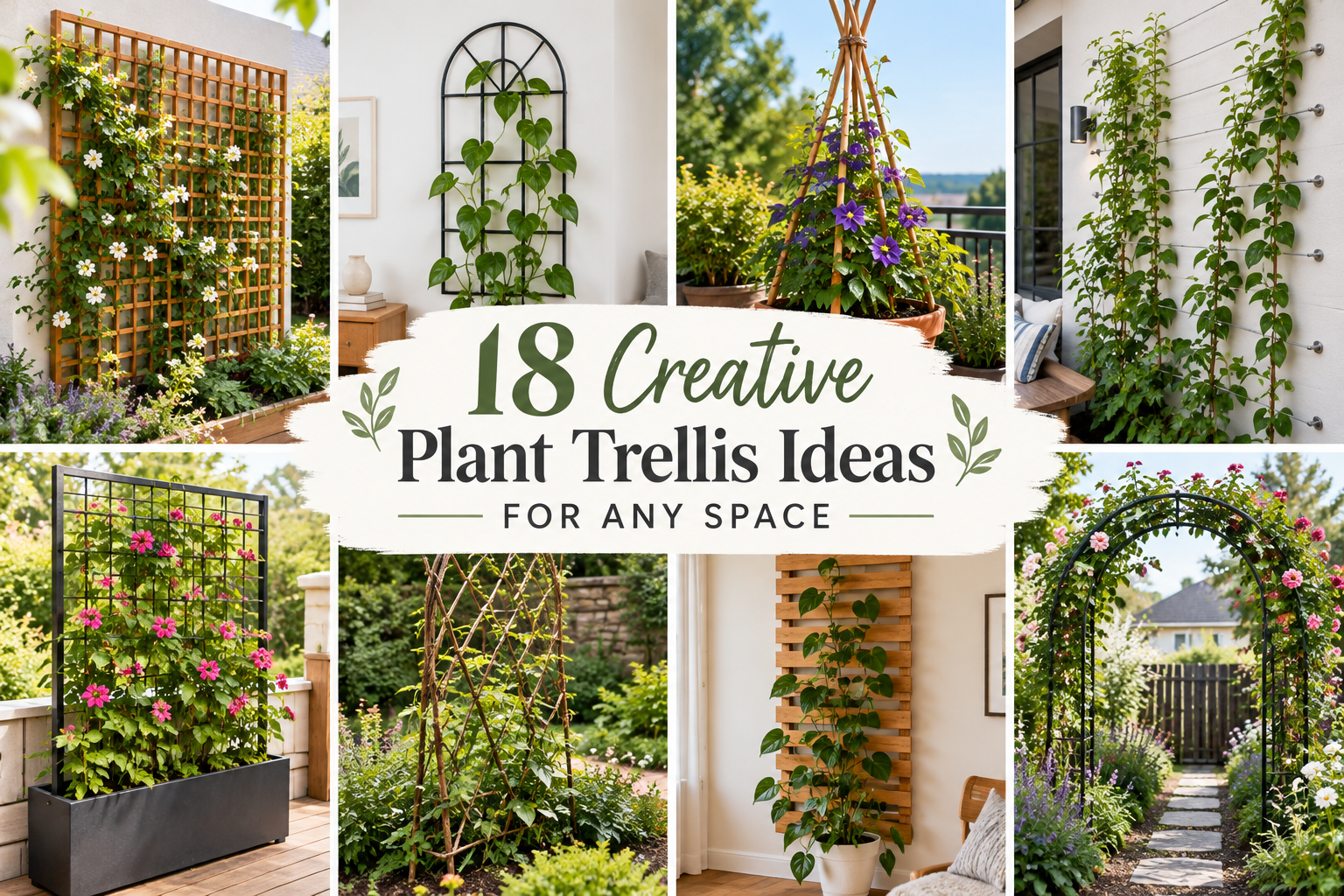
Looking for plant trellis ideas that make your climbing plants healthier and your home or garden more attractive? A well-chosen trellis can turn an ordinary houseplant into a vertical display, bring flowers to a bare fence, or help vegetables grow neatly in a small backyard.
You don't need expensive landscaping materials to get started. Bamboo canes, natural branches, wooden frames, wire hoops and recycled materials can all become attractive plant supports.
The trick is choosing a design that suits your plant's growth habit and the space available.
A Hoya trained around a small circular hoop needs a different type of support from a clematis growing against a garden fence or a cucumber vine producing heavy fruit.
Quick answer: For indoor plants, try a wire hoop, wooden ladder, geometric frame or natural branch tripod. For outdoor climbers, consider a bamboo teepee, fan trellis, wall lattice, garden arch or raised-bed A-frame. Match the structure to the plant's climbing method, expected weight and mature size, and secure it before training the stems.
Below are 18 creative trellis designs, followed by practical advice for choosing materials, matching plants to supports and avoiding common mistakes.
Why Use a Trellis for Plants?
A plant trellis is a framework that supports or guides climbing, vining or sprawling growth.
Some plants naturally wrap their stems around narrow supports. Others use tendrils or aerial roots to attach themselves, while certain plants must be secured with ties.
The Royal Horticultural Society explains that climbing plants use several mechanisms, including twining stems, tendrils, stem roots and adhesive pads.
An appropriate trellis can help you make better use of vertical space, keep vines organized, simplify pruning and create attractive garden features.
In vegetable gardens, support structures can also keep certain fruits off the ground and make harvesting easier.
However, trellises are not necessary for every plant. Some varieties naturally grow as compact bushes, while certain houseplants are equally attractive when allowed to trail.
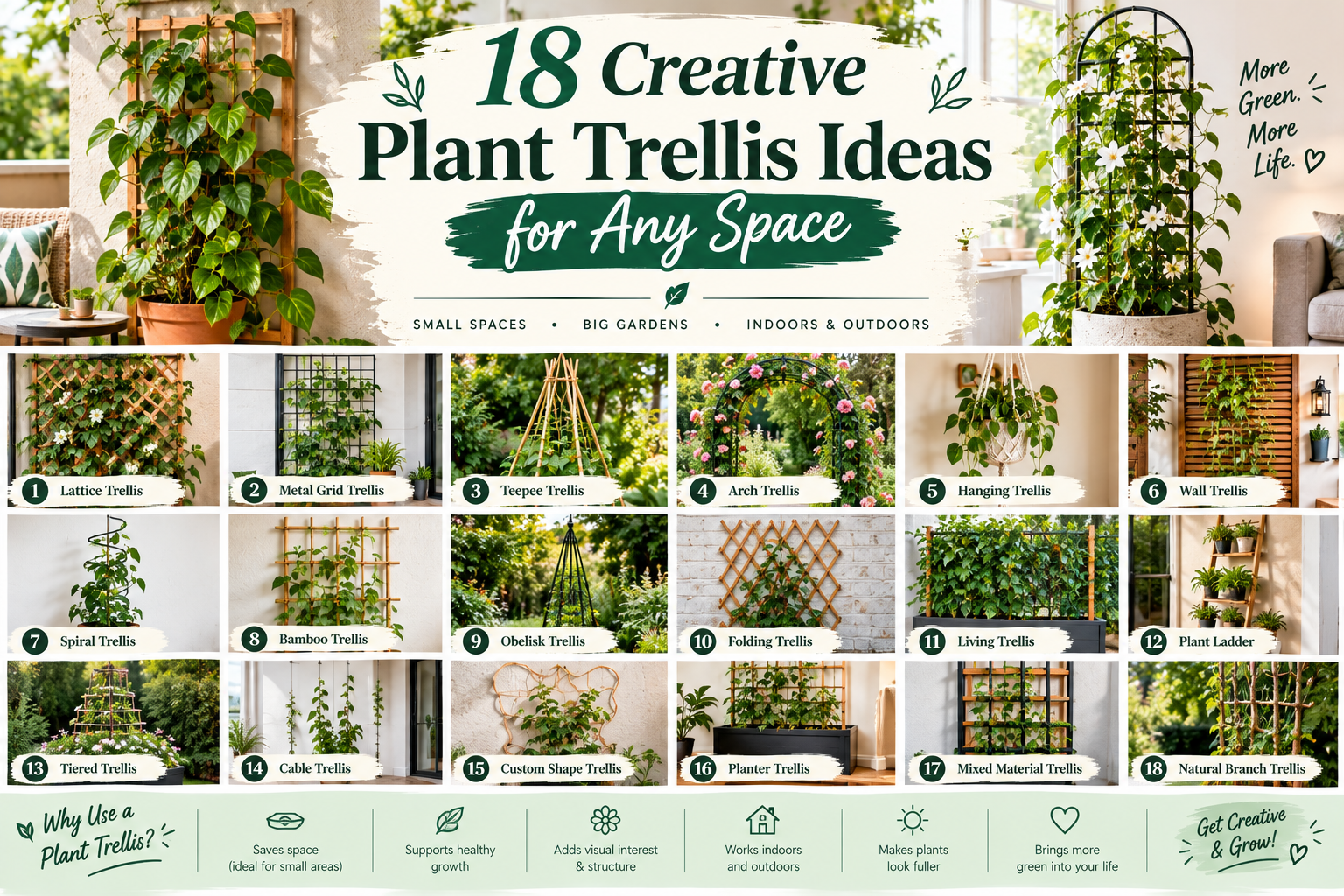
18 Creative Plant Trellis Ideas
1. Bamboo Teepee Trellis
A bamboo teepee creates a simple vertical framework using three to six canes arranged around a central point.
Bring the tops together and secure them with suitable garden twine.
Its narrow base and wider lower growing area make it attractive for smaller vegetable gardens and container arrangements.
Use it for lightweight climbing beans, sweet peas and other compatible vines.
Make sure the canes are deeply anchored and strong enough for the mature plant.
Best for: Small vegetable gardens, large planters and budget DIY projects.
2. Circular Wire Hoop Trellis
A circular wire hoop is a stylish choice for indoor climbing plants.
It is especially effective for Hoyas because their long, flexible stems can be gently trained around the frame.
Choose smooth, coated wire with no exposed sharp edges.
A circular support also helps keep the plant compact enough for a shelf or windowsill.
The Royal Horticultural Society identifies wire loops as a suitable support option for many Hoyas.
Best for: Hoya, indoor ivy and flexible ornamental vines.
3. Rustic Natural Branch Trellis
Natural branches can create an inexpensive plant support with an organic appearance.
Collect suitable dry branches from your own garden or another location where collection is permitted.
Remove damaged pieces and inspect for pests or decay.
Arrange three branches into a tripod or several branches into a simple open framework.
Tie them securely with garden twine.
Use this design for lightweight plants rather than heavy, mature outdoor vines.
Best for: Rustic interiors, indoor climbing plants and small decorative containers.
4. Mini Wooden Ladder Trellis
A miniature ladder adds a structured, decorative element to a potted plant.
You can make one from wooden dowels connected by horizontal crosspieces.
Its evenly spaced rungs help guide climbing stems upward.
A ladder trellis can look particularly attractive in Scandinavian, farmhouse or minimalist interiors.
Choose materials that can withstand repeated exposure to moisture.
Best for: Small potted vines, indoor jasmine and decorative houseplants.
5. Fan-Shaped Plant Trellis
A fan trellis spreads wider toward the top, giving climbing plants space to develop across a broader area.
It is especially useful for flowering plants grown near a wall or fence.
The widening structure provides several possible directions for training stems.
Choose a sufficiently strong frame for the plant's eventual size.
Best for: Clematis, selected flowering vines and patio planters.
6. Minimalist Metal Grid Trellis
A simple black or dark metal grid can create an attractive contemporary plant display.
Position the grid behind a planter or mount it appropriately to a suitable wall.
Guide vines across the framework using loose plant ties where necessary.
The open grid allows the leaves to become the main visual feature.
Protect walls from trapped moisture and ensure the support is securely attached.
Best for: Indoor climbing vines and modern plant displays.
7. Moss Pole for Tropical Climbing Plants
A moss pole provides a textured surface that some tropical houseplants can grip with their aerial roots.
Unlike a basic wire hoop, a suitable moss pole may also retain moisture around the attachment surface.
Climbing philodendrons, pothos and some Monsteras can benefit from this type of support.
Install the pole securely, ideally while repotting if root disturbance would otherwise be significant.
Not every philodendron requires a moss pole. Self-heading types, such as Red Congo, generally grow without one.
Best for: Pothos, climbing philodendrons and suitable Monstera species.
8. Wooden Wall Lattice
A lattice panel is one of the most versatile garden trellis designs.
It creates a grid that climbing stems can follow.
Wooden lattice can also add visual interest to fences, patios and sheltered outdoor walls.
When mounting it against a wall, leave adequate space behind the panel for airflow and plant development.
The RHS recommends positioning wall supports roughly 2 inches (5 cm) away from the surface.
Best for: Clematis, honeysuckle and ornamental climbing plants.
9. Garden Arch Trellis
A garden arch transforms a pathway or entrance into a vertical garden feature.
Climbing plants can be trained along both sides of the arch and guided over the top.
Choose a structure rated for outdoor use and strong enough for the eventual mature weight.
A lightweight decorative arch may be unsuitable for large woody climbers.
Best for: Flowering climbers, garden entrances and ornamental landscaping.
10. A-Frame Vegetable Trellis
An A-frame trellis is especially useful for growing climbing vegetables in limited garden space.
It consists of two sloping support panels joined at the top.
Vegetable vines can grow upward along the mesh.
For certain crops, harvesting from the sides or underneath can be convenient.
The University of Minnesota Extension recommends sturdy trellis support for suitable cucumbers, beans and peas.
Choose stronger frames for heavier crops, and support developing fruit where required.
Best for: Cucumbers, climbing beans and appropriate small-fruited vines.
11. String Trellis for Climbing Beans
A string trellis can be made using upright supports and tightly secured garden twine.
Stretch suitable strings vertically from a stable upper support toward the planting area.
Twining bean stems can grow around the strings.
Some materials can be removed and composted after the season, depending on their composition.
The frame must remain securely anchored as plants gain height and foliage weight.
Best for: Pole beans and lightweight annual climbers.
12. Decorative Mini Obelisk
A mini obelisk is a narrow tower-shaped plant support.
It typically uses three or four vertical supports connected by horizontal sections.
It looks attractive in large patio pots or as a feature in a garden border.
You can create a rustic version from bamboo or choose a more traditional metal design.
Keep the structure proportional to the container.
Best for: Flowering container plants and small garden climbers.
13. Copper-Colored Wire Trellis
A copper-colored wire trellis can act as both a decorative accessory and a practical support.
Geometric shapes such as diamonds, arches and circles work particularly well in modern indoor spaces.
Use smooth, suitably coated or finished materials without sharp points.
If using actual copper, account for its softness, cost and gradual appearance changes.
Best for: Decorative potted plants and lightweight indoor vines.
14. Recycled Wooden Frame Trellis
An unused wooden frame can sometimes be adapted into an attractive trellis.
Add suitably spaced wooden strips or weather-resistant cords to create climbing points.
Inspect the material for splinters, old paint, structural weakness and unknown chemical treatments.
Avoid using salvaged wood that may contain lead-based paint or harmful preservatives.
Best for: Budget garden projects and lightweight climbing flowers.
15. Raised-Bed Trellis Panel
A raised-bed trellis provides vertical growing space along the edge of a vegetable bed.
A sturdy panel can help crops climb without spreading across the soil.
Plan the position so taller plants do not unnecessarily shade lower-growing vegetables.
Fasten the structure to an adequate support system rather than relying on loose soil alone.
Best for: Beans, peas, cucumbers and small-space edible gardening.
16. Hanging Trellis Against a Balcony Wall
Balconies can benefit from vertical greenery where floor space is limited.
A compact wall-mounted grid or hanging frame allows suitable vines to grow upward.
Choose materials that resist weather exposure and comply with building rules.
Do not hang heavy, soil-filled structures from balcony rails or façades without confirming their structural suitability.
Protect neighboring properties and walkways from falling objects.
Best for: Small balconies and urban container gardens.
17. Privacy Screen Trellis
A larger trellis panel can create a partially screened outdoor sitting area.
Instead of building a solid wall, climbing plants gradually add foliage coverage.
Select plants based on mature size, climate and growing conditions.
Fast-growing climbers may require more frequent pruning.
A freestanding screen needs strong anchoring, particularly in exposed areas.
Best for: Patios, outdoor seating areas and garden boundaries.
18. DIY Geometric Houseplant Trellis
A geometric support can turn a compact vine into a decorative display.
Create a simple diamond, triangle or arch shape using plant-safe, smooth wire or suitable wooden strips.
Install the support in a stable container and train flexible stems along the outline.
Keep the frame open enough that leaves can develop without becoming crowded.
Best for: Small Hoyas, indoor ivy and decorative climbing houseplants.
Plant Trellis Ideas: Quick Comparison
| Trellis design | Best location | Recommended plants | DIY difficulty |
|---|---|---|---|
| Bamboo teepee | Garden or large pot | Peas, beans, sweet peas | Easy |
| Wire hoop | Indoors | Hoya, indoor ivy | Easy |
| Natural branch tripod | Indoors | Lightweight vines | Easy |
| Wooden ladder | Indoors | Small climbing plants | Moderate |
| Fan trellis | Garden or patio | Clematis, ornamental vines | Moderate |
| Metal grid | Indoors or outdoors | Selected climbing vines | Easy to moderate |
| Moss pole | Indoors | Pothos, climbing philodendron | Moderate |
| Wooden lattice | Fence or wall | Honeysuckle, clematis | Moderate |
| Garden arch | Outdoors | Flowering climbers | Advanced installation |
| A-frame | Vegetable garden | Cucumbers, beans | Moderate |
| String trellis | Vegetable garden | Pole beans | Easy |
| Mini obelisk | Patio or border | Container climbers | Moderate |
| Copper-colored hoop | Indoors | Lightweight ornamental vines | Easy |
| Recycled frame | Garden | Small climbers | Moderate |
| Raised-bed panel | Vegetable garden | Peas, beans, cucumbers | Moderate |
| Balcony grid | Balcony | Lightweight suitable vines | Moderate |
| Privacy screen | Garden | Suitable perennial climbers | Advanced installation |
| Geometric mini trellis | Indoors | Hoya, ivy | Easy |
Difficulty ratings are editorial estimates and assume basic DIY tools and experience.
How to Choose the Best Plant Trellis
The best-looking trellis is not necessarily the most suitable one.
Start with the plant's growth habit.
Twining Plants
Twining plants wrap their stems around suitable supports.
They may grow well on bamboo canes, narrow poles, strings and other structures.
Examples include many climbing beans and selected flowering vines.
Tendril Climbers
Tendril climbers use narrow structures to hold themselves in position.
These plants often benefit from netting, wire grids or thin horizontal supports.
Peas and several climbing vegetables fall into this group.
Aerial-Root Climbers
Certain houseplants develop aerial roots that can attach to textured surfaces.
Climbing philodendrons and pothos may benefit from suitable moss poles or similar supports.
Plants That Need Tying
Some ornamental plants do not attach themselves effectively to trellis structures.
Their stems must be trained and secured using soft ties.
The RHS recommends checking ties regularly and loosening them before they constrict growing stems.
How to Make a Simple DIY Plant Trellis
If you want a quick beginner project, a three-stake tripod is a practical starting point.
Materials
You'll need three suitable bamboo canes or clean dry branches, garden twine, scissors and a stable planter containing a lightweight climbing plant.
Step 1: Measure the Container
Choose stakes that suit the plant's height and the container's stability.
Step 2: Position the Stakes
Arrange the three canes around the inside edge of the container.
If the plant is heavily rooted, avoid forcing stakes through the roots.
Step 3: Secure the Structure
Bring the upper ends together and tie them firmly.
Step 4: Guide the Plant
Gently train flexible vines around the support.
Use soft ties when necessary, leaving room for stems to thicken.
Step 5: Check Stability
Make sure the structure is secure and the pot does not tip.
For a more detailed tutorial, see our guide to making a trellis for potted plants.
Best Materials for DIY Plant Trellises
Different materials work better in different environments.
| Material | Advantages | Considerations |
|---|---|---|
| Bamboo | Affordable and lightweight | Can deteriorate over time |
| Natural branches | Rustic and reusable | Inspect for pests and decay |
| Wooden dowels | Easy to cut and customize | Need protection from excessive moisture |
| Coated wire | Flexible and decorative | Sharp ends must be covered |
| Metal frames | Durable and structurally strong when properly designed | Weight and corrosion resistance vary |
| Garden twine | Useful for training annual vines | Requires secure anchors and replacement |
| Mesh panels | Practical for climbing vegetables | Choose strength appropriate to crops |
For outdoor structures, pay special attention to anchoring, wind resistance and the weight of mature foliage.
How to Make a Trellis Look Attractive
A trellis should complement the plant rather than dominate it.
For a minimalist interior, consider simple black metal, pale wood or geometric shapes.
For farmhouse or rustic spaces, natural branches and bamboo can blend with terracotta containers and wooden furniture.
For traditional gardens, lattice panels and decorative obelisks offer a more architectural appearance.
Choose colors and materials that complement nearby pots, planters, fences and outdoor furniture.
Avoid overcrowding the arrangement with ornaments that make it difficult for the plant to grow.
Small-Space Plant Trellis Ideas
Small rooms and balconies benefit from compact vertical designs.
A small Hoya can be wrapped around a circular hoop rather than left to trail across a shelf.
A climbing houseplant may be trained up a narrow ladder.
On a balcony, a properly installed vertical grid may support lightweight climbers while preserving floor space.
For narrow raised beds, trellises can help climbing vegetables grow upward instead of spreading across pathways.
Common Plant Trellis Mistakes
Choosing a Support That's Too Weak
A lightweight structure may hold a young plant but fail when it matures.
Consider future stem and foliage weight.
Installing a Trellis Too Late
Adding a large support after roots become crowded can cause avoidable disturbance.
Install supports early whenever practical.
Forcing Stems Around Tight Corners
Mature stems may crack when bent sharply.
Train new flexible growth gradually.
Tying Vines Too Tightly
Tight string can damage expanding stems.
Use appropriate soft ties and inspect them regularly.
Ignoring Drainage
A decorative support does not compensate for an unsuitable container.
Potted plants still need correct drainage and growing conditions.
Using Weak Materials Outdoors
Wind and rain can damage structures that work well indoors.
Choose appropriate materials and anchoring.
Assuming Every Climber Needs the Same Support
A Hoya on a circular hoop, a pothos on a moss pole and cucumber vines on a garden A-frame have different support needs.
Frequently Asked Questions About Plant Trellis Ideas
What Can I Use as a Plant Trellis?
Bamboo canes, clean natural branches, wooden dowels, coated wire, lattice panels and purpose-built metal supports can all work, depending on the plant and location.
How Do You Make a Simple Plant Trellis?
Arrange three bamboo stakes into a tripod, secure the tops with garden twine and guide suitable climbing stems around the structure.
What Are the Best Indoor Plant Trellis Ideas?
Circular wire hoops, small wooden ladders, geometric frames and moss poles are useful choices, depending on the plant's growth habit.
Can You Make a Trellis From Tree Branches?
Yes. Use sturdy, clean, dry branches that are free from obvious pests, rot and unsuitable chemical residues.
What Is the Cheapest Way to Make a Plant Trellis?
Using suitable existing bamboo canes, branches or garden twine can reduce costs. The structure must still be stable and appropriate for the plant's weight.
What Is the Best Trellis for Potted Plants?
For lightweight vines, a bamboo tripod or wire hoop may work well. Larger or heavier plants need stronger, more stable structures.
Do Pothos Plants Need a Trellis?
No. Pothos can trail from a hanging basket or shelf, but a suitable climbing support can encourage upright growth.
What Trellis Is Best for Hoya?
The Royal Horticultural Society recommends supports such as wire loops and cane tripods for many Hoyas.
What Is the Best Trellis for Cucumbers?
A sturdy garden trellis or A-frame with suitable mesh can support vining cucumber varieties. Select strength and dimensions according to the crop.
Can I Use a Trellis on a Balcony?
Yes, provided the structure is secure, suitable for the environment and permitted by the building's rules. Avoid excessive loads or unsafe rail attachments.
Should I Install a Trellis Before Planting?
Ideally, yes. Installing supports early can help avoid disturbing established roots and makes initial plant training easier.
What Is Better for Indoor Plants: A Trellis or a Moss Pole?
Choose a trellis for plants that twine or can be guided around a frame. A moss pole is often suitable for climbing plants that use aerial roots.
Conclusion
The best plant trellis ideas combine attractive design with practical support for the plants you want to grow.
For indoor houseplants, consider wire hoops, wooden ladders, moss poles and small geometric frames.
For outdoor spaces, bamboo teepees, wall lattices, obelisks, garden arches and A-frame trellises can help create vertical greenery while using space efficiently.
Before choosing a structure, identify how your plant climbs, estimate its mature size and select materials suitable for the location.
With the right support, climbing plants can become beautiful focal points in your home, patio or garden.
Authoritative References
Royal Horticultural Society — How to Grow Climbers and Wall Shrubs
University of Minnesota Extension — Trellises and Cages to Support Garden Vegetables
Last reviewed: October 17, 2026. Trellis strength, dimensions and suitability depend on the plant, its mature weight, the environment and the installation method.